
Long-form guides with structure, evidence, and review workflow
Gixo helps content, research, and product teams build long-form guides, resource hubs, and cited explainers from a strong outline first. Search visibility can benefit, but the product is built around reviewable depth and editorial control. Built for teams that need format-first drafting, visible source context, structured editing, review workflow, export, and publishing in one place.
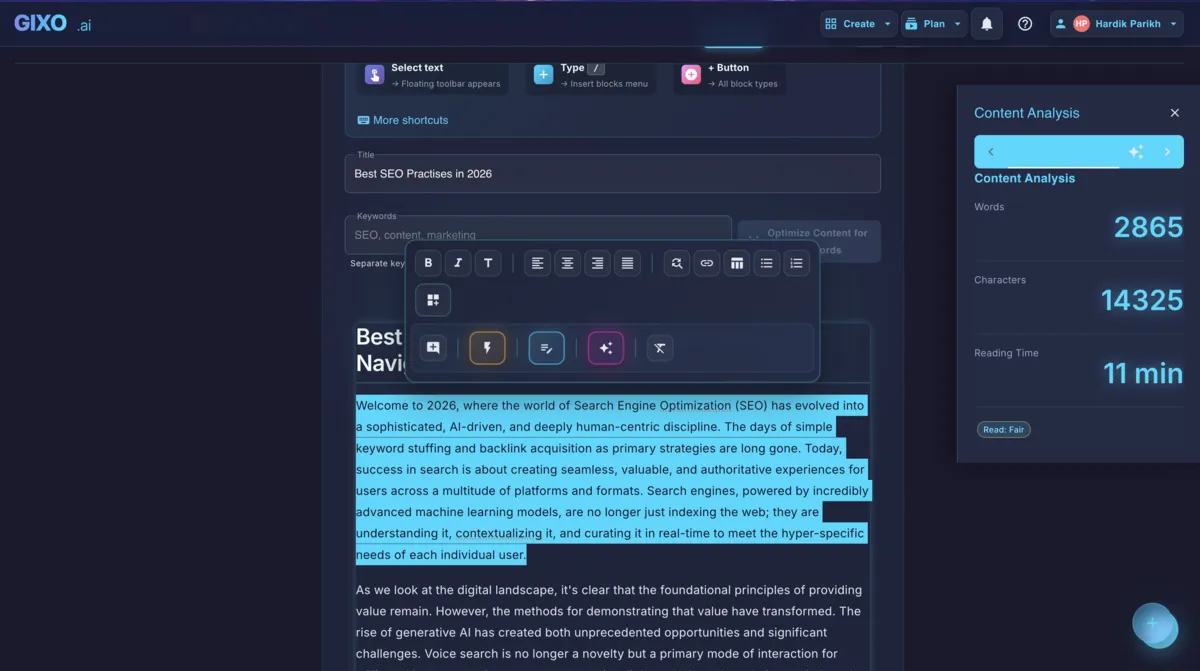
An AI long-form content generator turns a detailed brief, outline, and source set into an extended structured draft. Gixo Quill accepts a target up to 10,000 words, grounds generation in retrieved and supplied sources, attaches citations, and supports section-level editing and deterministic review checks. Editors still verify depth, coherence, repetition, and claim support.

How does Gixo handle a long-form target?
Quill accepts a target up to 10,000 words, uses a reviewable outline and format guide to shape generation, and lets editors expand or rewrite selected sections afterward. A target is drafting guidance, not a guarantee that the first response reaches the exact length or required depth.
| Workflow factor | Gixo Quill | Generic prompt | Manual workflow |
|---|---|---|---|
| Target length | User-set, up to 10,000 words | Tool- and model-dependent | Set in the brief |
| Outline review | Reviewable structure before full generation | Prompt-dependent | Editor creates it |
| Section editing | Expand or rewrite selected content | Tool-dependent | Editor rewrites |
| Grounding and citations | retrieved source set and citations attached | Tool- and mode-dependent | Researcher manages them |
| Post-generation checks | Brief, structure, readability, links, answer readiness, and own-library overlap | Usually external or prompt-dependent | Manual or separate tools |
| Factual verification | Human reviewer | Human reviewer | Human reviewer |
How the long-form AI writer holds structure past 3,000 words
Six workflow capabilities for long drafts. Format guidance and checks make structure easier to inspect, but model output can still repeat, drift, or miss required depth.
AI proposes an outline from the format and brief. Review, reorder, add, or remove sections before generation; the model does not guarantee complete topic coverage.
Quill retrieves relevant web sources and Quill keeps the source set and citations attached to the draft. Editors verify whether important claims are accurate, adequately supported, and represented in context.
Edit, expand, or regenerate any section independently. Add more depth to critical sections, simplify others, or insert new sections without regenerating the entire article.
Create a pillar draft from an explicit coverage brief, then plan supporting pieces through the idea or bulk workflow. Use the own-library overlap and link checks to review the relationship between pages.
A navigable table of contents can mirror the article headings and help readers move through a long page. Inspect anchors after editing and in the chosen export or destination preview.
Quill checks structure, word-count bands, brief coverage, answer readiness, links, and overlap with your own library so reviewers can find thin or missing sections. It does not benchmark live competitor pages.
How does outline-first generation keep long articles coherent?
Readers reward depth when teams can keep the argument coherent, evidence-backed, and easy to navigate.
Length Is a Coverage Choice, Not a Ranking Guarantee
A long page is useful when the subject and reader questions genuinely require depth. Word count alone does not create relevance, authority, links, or rankings, and padding a short answer into a pillar page can make it worse. Set the target from the assignment, not a universal SEO threshold.
Pillar and cluster structures can make related pages easier to navigate when each URL serves a distinct intent. Review internal links and own-library overlap so the pages support one another instead of competing for the same job.
How Gixo's Outline-First Architecture Prevents Quality Degradation
Writing 5,000 or 10,000 words that hold together is fundamentally different from writing 1,000. The longer an article gets, the harder it becomes to maintain a consistent voice, avoid repetition, keep every section substantive, and ensure the overall structure guides the reader logically from introduction to conclusion. Most AI tools generate long text by stringing together loosely related paragraphs, resulting in content that feels padded rather than purposeful.
Gixo addresses this with outline-first generation, section-level editing, a structured brief, and deterministic review. The workbench checks whether required topics and questions are covered, whether the opening is direct, whether sections and lists are scannable, and whether the draft overlaps your existing library. It does not scrape live competitor pages, so competitor-depth research remains an external input when the assignment requires it.
Four steps to a review-ready long-form piece
From brief to comprehensive guide in four steps.
Enter the subject area, source material, and audience context. Gixo creates a comprehensive outline covering the subtopics your team needs to address.
Choose a target appropriate to the format, up to the 10,000-word request limit. Treat it as a planning constraint and review whether each section earns its space.
AI generates the full article with citations and structure. Use inline tools to expand thin sections, add examples, or deepen technical explanations.
Publish the guide when it is approved, then create supporting follow-up assets or related articles from the same core source material.
Who benefits most
Four audiences that may need reviewable depth, without assuming length itself creates organic growth.
What is included in Quill's long-form workflow?
| Capability | Quill behavior | Boundary |
|---|---|---|
| Target word count | User-set up to 10,000 | Target is not guaranteed exact output or depth |
| Section-level editing | Expand, rewrite, or restructure selected content | Review the surrounding argument after changes |
| Table of contents | Heading-based navigation for long content | Inspect anchors and destination rendering |
| Brief coverage | Required topics and questions checked | No live competitor-depth comparison |
| Research citations | retrieved sources and citations attached | No independent factual verification |
| Own-library overlap | Draft compared with your content library | No competitor-domain gap analysis |
Tips for better results
Four principles that separate pillar pages from padded pages.
Frequently Asked Questions
Inside Quill
Start with the amount of structure you already have

Updated