
Best Article Templates for AI + Structured SEO Content
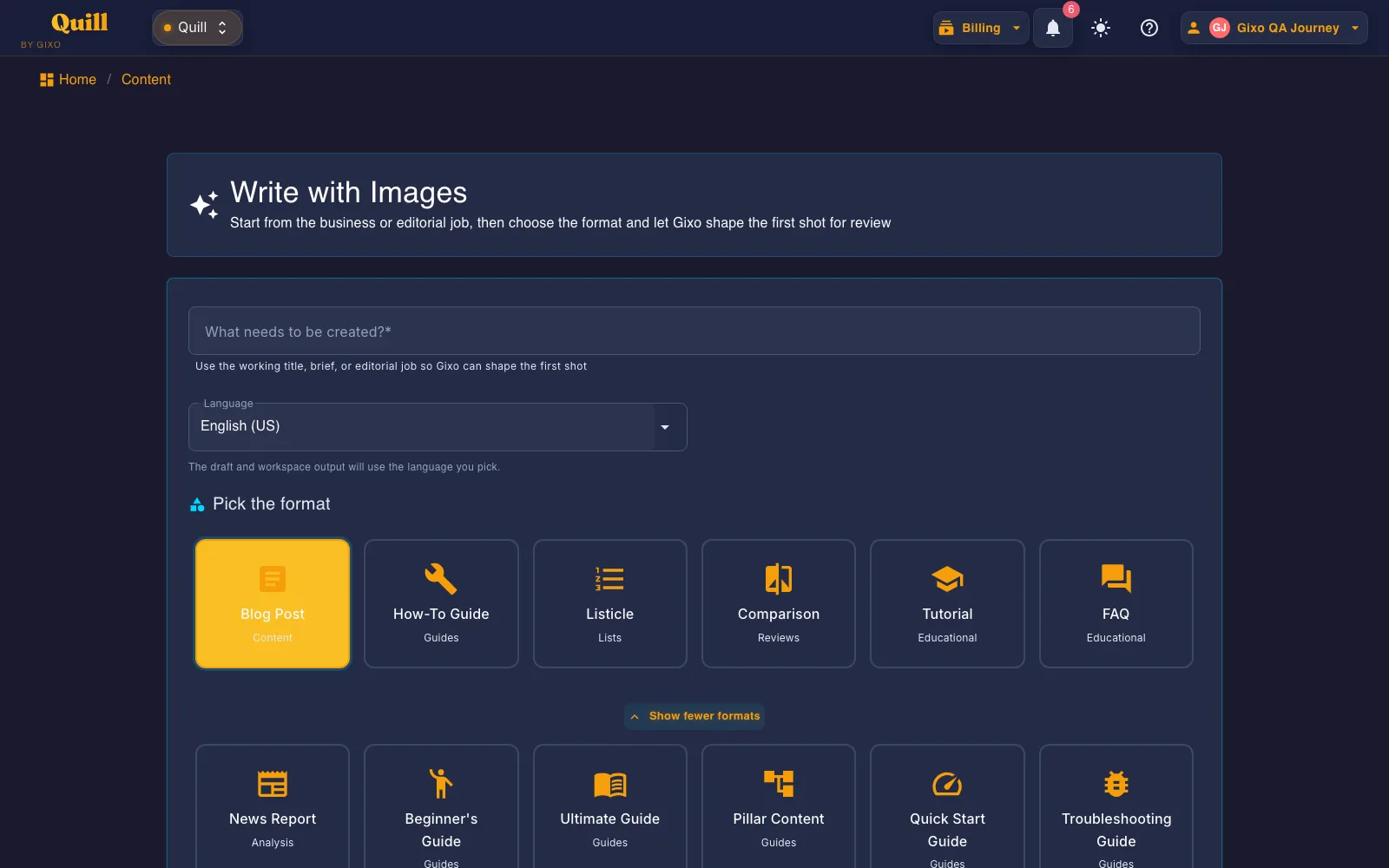
A useful article template is not a fill-in-the-blanks form — it is a format guide: heading hierarchy, expected sections, depth, and formatting that give generation a repeatable shape. Gixo applies that guidance during generation and checks the resulting draft before review.

An AI article template for SEO is a format-specific generation guide: it describes the expected heading hierarchy, sections, depth, and formatting while the words are generated for the topic. In Gixo, the selected content type carries those instructions into generation, and the workbench later checks structure, brief coverage, readability, links, and answer readiness. Model output still needs review, Quill does not run a plagiarism database check, and generic Article, FAQ, or HowTo schema is added in the receiving CMS.
What is an AI article template for SEO?
The reason templates matter for AI content is simple: without clear format instructions, a model can return a plausible draft in the wrong shape. A template tells it what belongs in the piece — an answer-first introduction, relevant H2s, a comparison table, steps, or an FAQ where the chosen format calls for them.
A good template standardizes expectations, not text. Each article is newly generated from its topic, brief, and sources. Editors still check for missing sections, repeated phrasing, originality, and fit rather than assuming the template guarantees them.
What should a strong AI article template guide? Six parts of an SEO template
| Element | What it guides | Why it matters |
|---|---|---|
| Answer-first intro | States the answer in the first few sentences, no long wind-up | What search and AI engines lift as the snippet |
| Logical heading hierarchy | H2s/H3s mapped to expected subtopics, in expected order | The outline a crawler uses to understand the page |
| Required sections | Comparison table for commercial intent, step list for how-to, FAQ for long-tail | Completeness for the query type |
| Schema-aware visible structure | Clean HTML plus a real FAQ block | Provides visible content that CMS-authored JSON-LD can accurately mirror |
| Consistent depth | A target length and required elements per article | Every piece in a cluster is thorough, not a mix of substantial and thin |
| Brand voice | Tone and voice guidance layered on top of the format | Output sounds like you, not generic/neutral |
How do Gixo's article templates structure AI content?
In Gixo, the selected content type brings a format-specific style guide into generation. That guide describes the heading hierarchy, expected elements, target depth, and formatting, while the editorial brief adds required topics and questions. The workbench then reports deterministic issues in the generated result.
You pick the type, set writing controls, add the topic, brief, and reference material, then review whether the output followed the requested shape. Guidance plus checks is stronger than a bare prompt, but it is not a guarantee that every model response is complete.
Frequently Asked Questions
Inside Quill
Choose a content structure before generation
Updated