
Content Health Check
Paste an article or draft and get a deterministic report: an overall health score, SEO and readability snapshots, a publish-readiness checklist, and a link audit. No signup — subject to request limits and rate limiting — the same rule set Gixo Quill runs inside the paid workspace. Same input, same score, every time.
Inside Quill
Inspect the report before changing the draft
What this SEO check measures
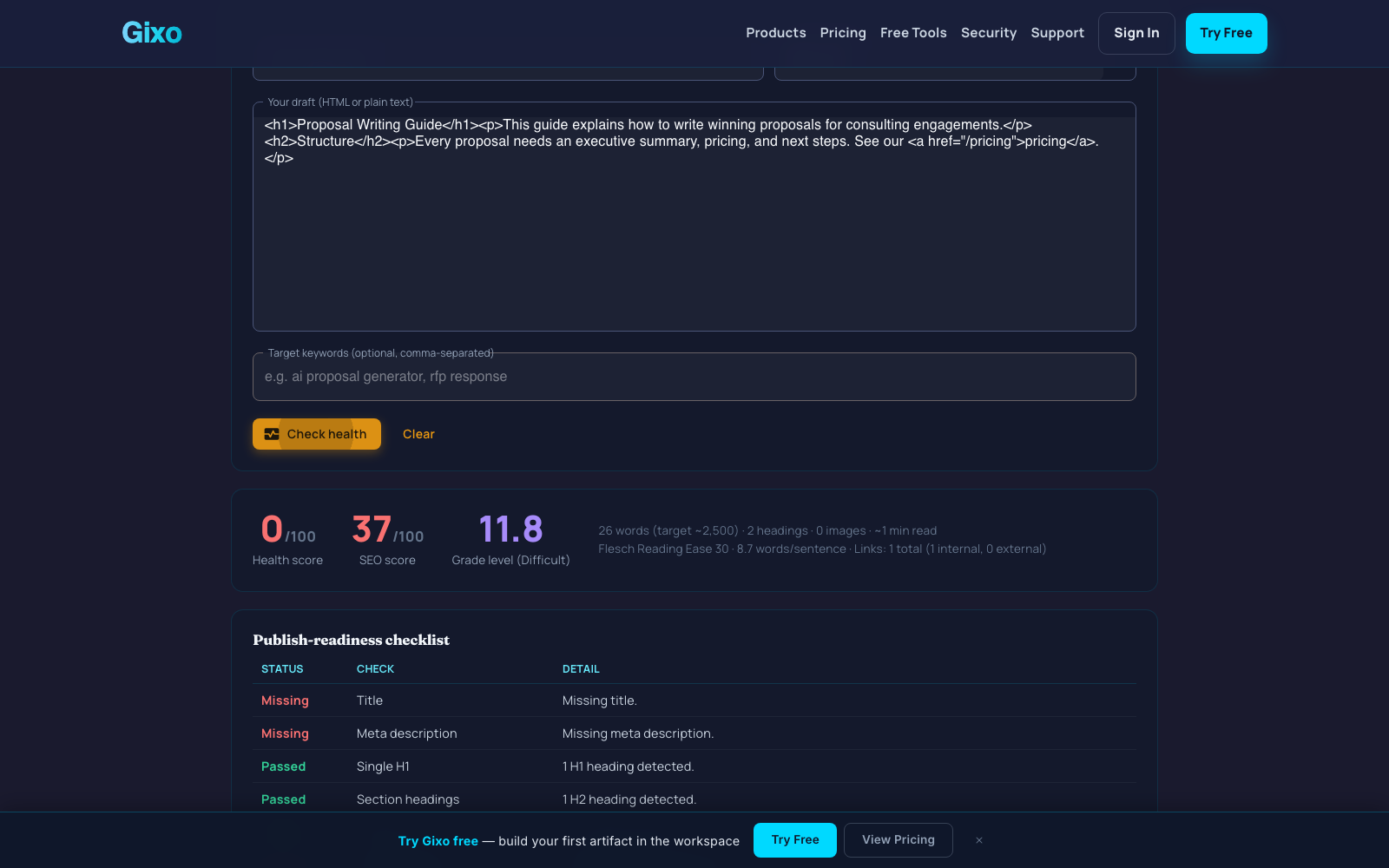
The check reads the draft you paste — it does not crawl a URL, so nothing here depends on your site being live, indexed, or reachable. Five things are scored, and the overall content score is their weighted average: the on-page SEO signals in the text at 30%, readability at 20%, structural completeness against the chosen content type at 25%, the publish-readiness checklist at 15%, and the link audit at 10%. Every error found then subtracts 6 points and every warning 2, and the result is clamped to 0–100.
How to read the content score
The denominator is the sum of the weights that actually applied, not a fixed 1.0. A component that does not apply to your draft is dropped from both halves of the fraction rather than scored zero or scored full marks, so a piece judged on four of the five checks is still on the same 0–100 scale and can still reach 100. That is why a short brief and a 4,000-word guide can be compared to each other at all. Readability is dropped this way when most of a draft is in a script the readability formulas cannot read, such as Hindi or Arabic: the report says it was not measured instead of inventing a grade, and still gives the average sentence length. A score above 80 means the draft meets more of the configured mechanical checks; it does not verify facts or approve publication. Use the findings table to see which bands carry the loss, then review the piece yourself. Below 40, look at the error count before the bands: at 6 points each, a handful of errors moves the score more than any single weighting does.
What the publish-readiness checklist tests
Six items on a search-targeted draft: a title of 30–70 characters, exactly one H1, at least one H2, alt text on every image, applicable stored or code-built structured data, or a JSON-LD block in the pasted body, and a call to action. Supplying target keywords adds a seventh — the primary keyword appearing inside the first 350 characters. The meta description is deliberately not one of them: the workbench reports it as advice rather than scoring it. Quill now lets you edit and save publication metadata separately from the article body. Structural completeness is a separate band, scored against the content type you choose, because a comparison and a how-to guide are not missing the same things; its word-count target is a band of 0.65 to 1.75 times that type's target length rather than a single number.
What this SEO check does not do
It is worth being exact, because most tools called an SEO checker take a URL and do something different. This one does not crawl your site, fetch your robots.txt or sitemap, measure Core Web Vitals or page speed, look at backlinks or domain authority, read your Search Console data, check your current SERP position, or compare you against the pages that outrank you. It reads one piece of text and reports what is measurable inside it. Nothing you paste creates a document in a Quill workspace, no account is created, and no AI model is called — which is also why the same draft returns the same score every time, and why re-running it after an edit is a fair before-and-after rather than a fresh opinion.