
Prompt box vs content workspace
Compare a general conversational interface with Quill's content-workspace approach.
Compare Quill
Compare AI writing tools by the work around the draft: sources, structure, editing, review, SEO research, automation, and delivery. Use the decision criteria below, then open a detailed guide and verify current third-party product details before deciding.
Product capabilities and third-party offerings can change; confirm current details on the relevant product and pricing pages.
Inside Quill
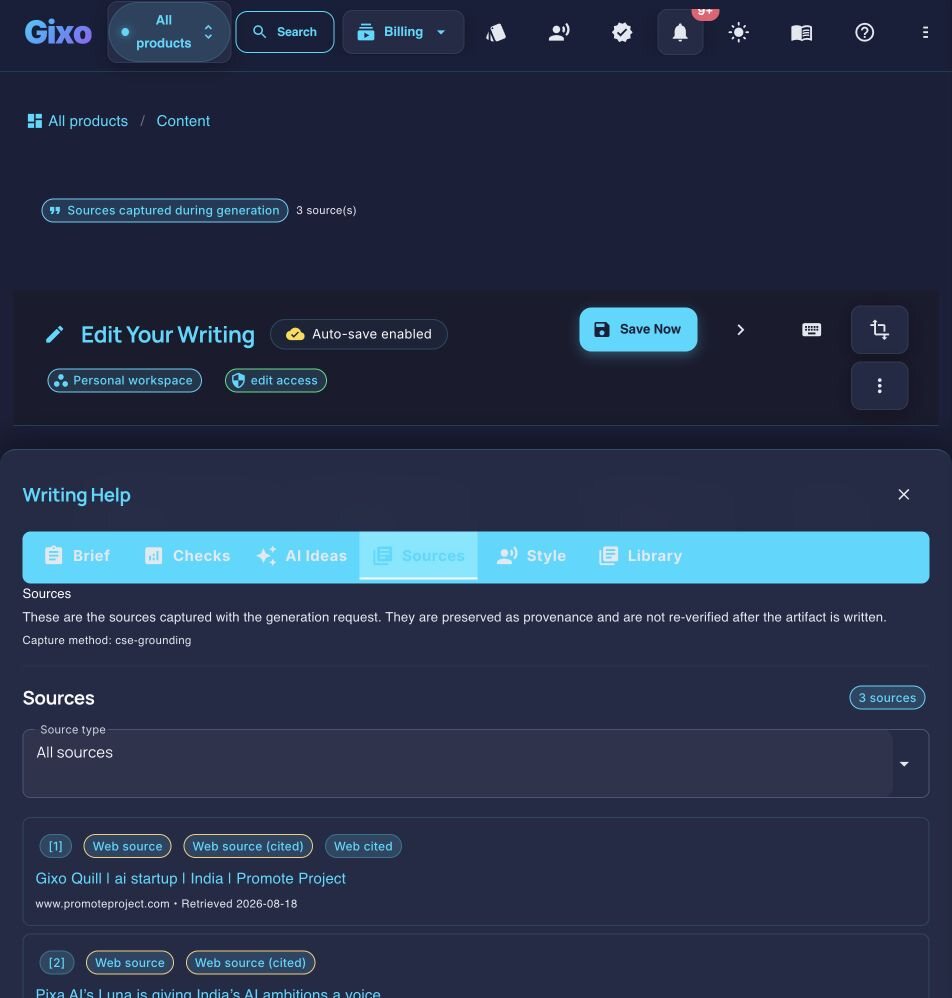
Decision criteria
The best comparison starts with the job and the evidence you need to inspect, not a universal score. This table separates writing-workflow needs from jobs that belong to dedicated SEO or campaign tools.
| Factor | Choose Quill when | Choose another category when |
|---|---|---|
| Sources and grounding | A draft should use provided or retrieved sources and keep citations and references inspectable for review. | You only need a quick, low-risk, one-off response from a general prompt box. |
| Editing and review | The same document needs inline revision, comments, review state, version history, and approval context. | Your existing editor and review process already cover the work after generation. |
| SEO research | You need content-side structure and deterministic writing checks around the draft. | You need live SERP scoring, rank tracking, backlink data, site crawling, or keyword-volume research from a dedicated SEO platform. |
| Reuse and delivery | Approved source content should remain attached while the team transforms, localizes, exports, or publishes it. | You mainly need a large template library for many short campaign variants. |
| Human accountability | Grounding should reduce fabrication risk while a reviewer remains responsible for verifying claims before publication. | Your use case does not require an inspectable evidence trail or editorial approval. |
Direct comparisons
Most AI writing tools differ less in what they draft than in what happens afterwards — review, evidence, and publishing. Open a dedicated comparison page when you already have another tool or workflow in mind.
Compare a general conversational interface with Quill's content-workspace approach.
Review the two products through content creation, workflow, and team-fit criteria.
Compare SEO-oriented workflows and the role each product can play in content production.
Alternative guides
These pages are organized around teams actively evaluating a named writing or content platform.
Evaluate Quill when Jasper is already on the shortlist.
Review Quill against a Copy.ai-led content workflow.
Compare the workflow considerations around Writer and Quill.
Evaluate Quill alongside Writesonic for content work.
Review Quill when comparing AI writing platform options.
Compare Quill with a blog-writing workflow centered in HubSpot.
Compare operating models
Use these guides to compare prompt-led and workspace-led approaches, software and freelance writing, or different pricing models.
Compare one-off prompt interactions with a workflow built around drafting, review, and delivery.
Review the responsibilities, trade-offs, and fit of software-assisted and freelance writing models.
Understand common pricing structures before comparing Quill plans with other platforms.
Questions before you choose
Compare them by the job around the draft: source inputs, grounding, editing, collaboration, SEO research, automation, delivery, price, and the human review the output still needs. A single overall score hides which workflow each tool is designed to support.
There is no universal best tool. Quill fits teams that want source-grounded drafting, inspectable citations, editing, review, transformation, and delivery around one document. A general assistant can fit one-off drafting, while a dedicated SEO platform fits live SERP, rank, backlink, and site-audit work.
No. Quill supports the content side of SEO with structured drafting and deterministic writing checks. It does not replace live SERP analysis, rank tracking, backlink data, keyword-volume research, or site crawling.
No. Quill can ground claims in provided or retrieved sources and keep citations and references available for inspection. Grounding reduces risk and makes review traceable; a qualified human still verifies claims before publishing.
Choose Quill when the draft must stay connected to sources, structured editing, team review, transformation, and delivery. A prompt box can be enough for a quick, low-risk, one-off response that does not need that workflow.
Self-service from first draft to delivery
Start a 14-day, no-card trial to use Quill's generation and review workflow. Prefer to inspect first? The Content Health Check stays free and anonymous.