
AI vs Freelance Writer: Cost, Workflow and Fit
Freelance work is usually quoted per assignment, while Gixo Quill is priced per seat from $10 to $129 per month. Actual software throughput still depends on plan limits, article length, source retrieval, and review capacity; a seat is not an unlimited-content promise. The useful question is not which is universally better, but which workflow gives you the right mix of original expertise, grounded drafting, editorial time, and cost for the work in front of you.
Scope note: this page compares a Quill-assisted writing workflow with commissioning a freelance writer. It does not rank freelance marketplaces or claim that one marketplace is the best supplier; use a separate, sourced vendor comparison for that question.
The comparison that actually matters
Both options have strengths. The better choice depends on whether you need scale, expertise, speed, or a mix of all three.
Quill can shorten first-draft assembly and batch multiple assignments. The real time to publish still includes source review, subject-matter judgment, editing, and destination QA.
Quill uses per-seat plans rather than a freelance quote for every assignment. Compare total cost using plan limits plus the human research, editing, and approval time each article still requires.
Shared briefs, format guidance, writing controls, and terminology settings make expectations repeatable. Model output still varies and needs the same editorial standard on every piece.
Bulk generation can queue more drafts without hiring a writer for each assignment. Review capacity, plan limits, source quality, and destination QA still bound responsible throughput.
Freelancers bring deep domain expertise and original insights. AI excels at research synthesis but benefits from human expert review for specialized topics.
A hybrid workflow can use Quill for grounded drafting and deterministic checks while writers and editors contribute interviews, original experience, judgment, verification, and final approval.
Look past the article price of outsourcing blog writing
The sticker price of a freelance article or an AI subscription tells only part of the story. To make an informed decision between hiring freelance writers and using AI content tools, you need to account for every cost that goes into producing a finished, published piece of content.
Freelance writer costs
Freelance pricing varies by scope, expertise, research, interviews, revision terms, and commercial arrangement, so use the writer's current quote rather than a generic market estimate. Add the internal cost of preparing the brief, answering questions, reviewing the work, and coordinating delivery. A specialist may cost more than a generalist while also contributing expertise or original reporting that software cannot supply.
Quill costs
Quill's published monthly plans are $10 for Lite, $59 for Starter, $79 for Professional, $99 for Business, and $129 for the marketplace Enterprise tier. Prices are per month; seat counts, plan terms, and usage limits differ. Compare the applicable plan with the human time still needed for source review, verification, editing, approval, and publishing.
Costs both comparisons can miss
Both approaches require a usable brief, access to trustworthy source material, editorial attention, and destination QA. Quill grounds drafts in the retrieved source set and attaches citations, but it does not independently verify every claim. Budget a qualified reviewer for factual verification, original expertise, brand judgment, and approval. For freelancers, confirm whether research, interviews, revisions, metadata, and CMS delivery are included in the quote.
When AI makes more sense
AI-assisted drafting is a useful candidate when a team has recurring, well-briefed assignments and enough editorial capacity to review the resulting drafts. Quill can retrieve sources, assemble grounded drafts, attach citations, apply shared writing controls, and queue bulk work. It does not make the research authoritative, guarantee a turnaround, or remove the need for verification.
Content refreshes and structured formats such as product descriptions, FAQs, comparisons, how-to guides, and listicles can benefit from a repeatable starting point. Whether the workflow is cheaper or faster depends on plan limits, source complexity, output length, and the amount of expert review each page requires.
When you still need a human
Being honest about the limitations of AI tools is important for making a sound content strategy decision. Thought leadership and opinion pieces require a distinct voice, lived experience, and the willingness to take a position — qualities that AI cannot replicate convincingly. Highly technical or specialized content in fields like medicine, law, or advanced engineering benefits from writers who hold relevant credentials and can speak with genuine authority.
Personal narratives, founder stories, and case studies depend on firsthand experience and real human perspective. Content that requires interviews, primary research, or proprietary analysis needs people to gather and interpret that evidence. Brand storytelling that relies on humor or cultural nuance also merits close human authorship. Quill can help structure and draft from supplied material, but it should not be presented as the origin of experiences or evidence it did not collect.
The hybrid model: combining AI and human writers
A hybrid workflow assigns each part of the job to the right contributor. First, give Quill a clear brief and let it retrieve web sources or use the references you provide. Quill generates a structured draft grounded in that source set, with citations and deterministic content checks; those checks are not a live SERP suite or a factual-verification service.
Second, human editors inspect the cited sources, verify important claims, contribute original experience, and refine the argument and voice. Third, the approved article moves through the delivery workflow: direct publishing to WordPress or Ghost, a Medium draft handoff, a Substack export, or another supported export format.
Measure the hybrid model against your own baseline. Track total editor hours, approval rate, correction rate, publishing throughput, and performance after publication. Quill can reduce drafting work, but the product does not promise a universal efficiency multiple, cost saving, traffic result, or ranking outcome.
How It Works
Identify which content types benefit from AI speed and which need human expertise.
Generate a grounded draft with attached citations and deterministic content checks.
Have subject experts review, add unique insights, and ensure accuracy.
Increase drafting volume only as far as your review and approval capacity allows.
Side-by-side comparison
| Factor | AI (Gixo Quill) | Freelance Writer |
|---|---|---|
| Starting point | Grounded draft, then review | Brief, research, and writer draft |
| Commercial model | Per-seat plan; credits and limits apply | Usually per-assignment or retainer |
| Consistency | Shared controls; output reviewed | Depends on brief and writer |
| SEO workflow | Deterministic content checks | Depends on scope |
| Throughput | Bulk drafting; review capacity applies | Depends on availability and scope |
| Domain expertise | Research-based | Direct experience |
| Original insights | Evidence synthesis | Personal perspective |
| Brand voice | Trainable | Requires briefing |
Who benefits from switching to AI
Different teams and business models see different returns from AI content tools. Here are the profiles that gain the most from making the switch.
Early-stage teams can compare a per-seat Quill plan with per-assignment writing costs, then reserve human budget for interviews, expert input, editing, and distribution. A lower drafting cost does not guarantee traffic or remove the work required to earn it.
Teams with recurring assignments can use bulk generation and shared briefs to increase drafting throughput. Editors should set an explicit review ceiling, because producing drafts faster than the team can verify them creates a quality backlog rather than useful scale.
Teams that prioritize organic search need a repeatable review process. Gixo Quill keeps keyword targeting, heading hierarchy, readability, source grounding, citations, and deterministic SEO checks in one workspace. The delivery workflow can generate and edit metadata, while page-level schema is completed or validated in the receiving CMS except for Quill's deterministic Product/Offer schema path.
Agencies can use separate briefs, writing controls, and terminology for client work while keeping human reviewers responsible for evidence, voice, and approval. Compare any efficiency gain against the added work of protecting client boundaries and reviewing every destination.
Tips for making the transition
Run a controlled comparison using your own assignments, reviewers, and quality standard before changing the production workflow.
Frequently Asked Questions
Inside Quill
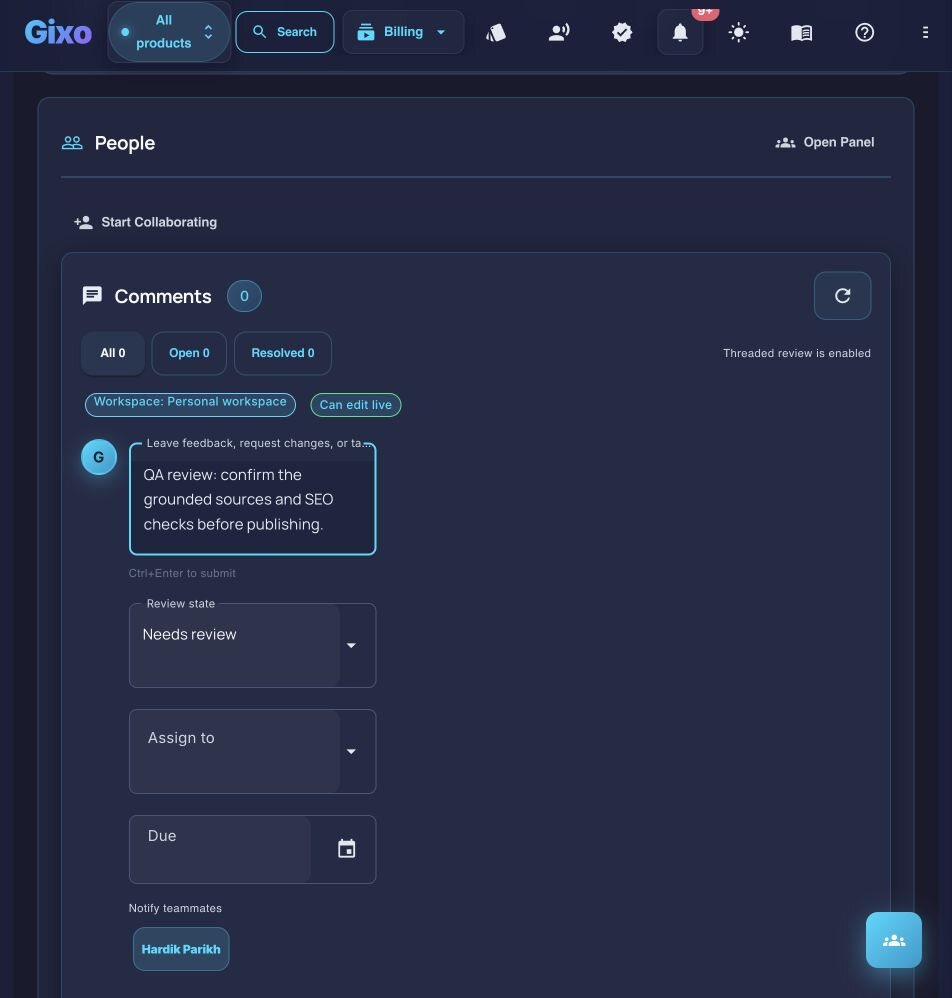
Prepare review ownership and feedback in context
Updated