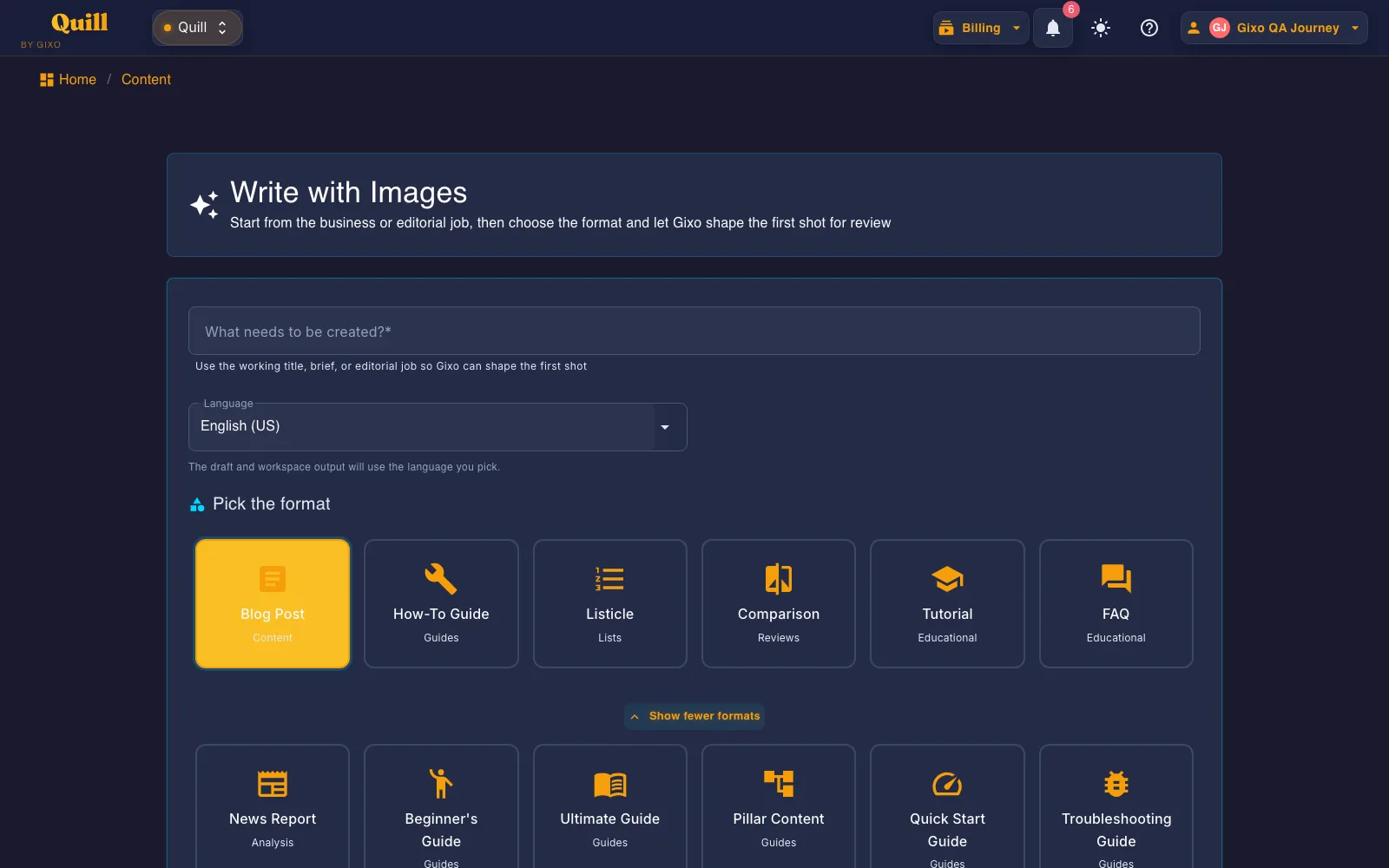
Showing 12 curated formats.
Expand a card to inspect its brief shape, then open Quill with the format and starting topic prefilled.
Blog post
Best for: A focused explanation, update, or point of view for a defined reader.
Reader promiseScannable supporting sectionsEvidence, takeaway, next step
Preview reusable brief
- Starting topic
- State the topic and the useful change the reader should leave with.
- Reader need
- A reader who needs a clear, credible explanation without a full reference guide.
- Review check
- Confirm the introduction makes the promise and every section earns its place.
What-is article
Best for: A direct definition followed by context, examples, and practical implications.
Answer-first definitionHow it works and why it mattersExamples, limits, related terms
Preview reusable brief
- Starting topic
- Name the concept, the audience, and the misconception the article should correct.
- Reader need
- A reader trying to understand a term quickly before exploring it in depth.
- Review check
- Check that the first paragraph can stand alone as a useful answer.
How-to guide
Best for: A task readers need to complete in a reliable sequence.
Prerequisites and outcomeOrdered steps with checksTroubleshooting and completion criteria
Preview reusable brief
- Starting topic
- Describe the task, starting condition, tools, and what successful completion looks like.
- Reader need
- A reader who needs to complete a concrete task with fewer avoidable errors.
- Review check
- Verify every step has one clear action and that prerequisites appear before step one.
Beginner's guide
Best for: A safe orientation for readers with little prior knowledge.
Plain-language orientationCore concepts in learning orderFirst action and common mistakes
Preview reusable brief
- Starting topic
- Name the topic, what the beginner already knows, and the first useful outcome.
- Reader need
- A newcomer who needs confidence, vocabulary, and a sensible place to begin.
- Review check
- Remove unexplained jargon and confirm the learning order does not assume hidden knowledge.
Troubleshooting guide
Best for: A diagnostic path from symptom to likely cause and verified resolution.
Symptoms and quick checksCause-by-cause fixesVerification and escalation
Preview reusable brief
- Starting topic
- List the observable symptom, environment, recent changes, and safe checks already attempted.
- Reader need
- A reader who needs to restore a working state without trying random fixes.
- Review check
- Confirm every fix includes a verification step and a clear escalation boundary.
Pillar content
Best for: A canonical topic page connecting definitions, subtopics, and supporting resources.
Answer-first orientationTopic map and deep sectionsSupporting links and next actions
Preview reusable brief
- Starting topic
- Define the topic boundary, primary audience, core subtopics, and the supporting pages it should connect.
- Reader need
- A reader who needs both orientation and a path into deeper material.
- Review check
- Check for a coherent topic boundary and remove sections that belong on unrelated pages.
Ultimate guide
Best for: A comprehensive reference for readers who need depth in one place.
Scope and key takeawaysComprehensive ordered chaptersExamples, FAQ, action plan
Preview reusable brief
- Starting topic
- State the subject, reader maturity, required depth, and evidence sources the guide should prioritize.
- Reader need
- A reader who expects a durable reference rather than a short introduction.
- Review check
- Verify that depth comes from useful coverage and evidence, not repeated wording.
FAQ
Best for: A set of real questions that benefit from concise, extractable answers.
Question-led headingsAnswer-first responsesCaveats and related guidance
Preview reusable brief
- Starting topic
- List the audience's actual questions, the approved answer source, and any answer that needs a caveat.
- Reader need
- A reader who wants a direct answer and a clear route to more detail.
- Review check
- Check that each answer opens directly, avoids duplication, and preserves necessary limits.
Checklist
Best for: A repeatable control for work that must not skip critical steps.
Purpose and ownerOrdered check itemsCompletion evidence and handoff
Preview reusable brief
- Starting topic
- Describe the workflow, who performs it, when it runs, and what proves each item is complete.
- Reader need
- An operator who needs consistency under time pressure.
- Review check
- Remove vague verbs and make every item observable or verifiable.
Comparison
Best for: A buyer or operator weighing criteria, trade-offs, and fit.
Evaluation criteriaBalanced option-by-option evidenceBest-fit guidance by scenario
Preview reusable brief
- Starting topic
- Name the options, decision owner, must-have criteria, constraints, and sources for claims.
- Reader need
- A reader deciding between real alternatives with different trade-offs.
- Review check
- Check that criteria are applied consistently and recommendations are conditional, not universal.
Buying guide
Best for: A category-level decision aid before a reader evaluates individual products.
Needs and constraintsEvaluation frameworkShortlist questions and red flags
Preview reusable brief
- Starting topic
- Describe the category, buyer context, budget or operating limits, and non-negotiable requirements.
- Reader need
- A buyer who needs to know what matters before comparing vendors or products.
- Review check
- Verify that the guide teaches evaluation rather than steering readers with unsupported rankings.
Product description
Best for: A product page connecting concrete details to buyer value.
Specific product promiseFeatures translated into outcomesConstraints, proof, next action
Preview reusable brief
- Starting topic
- Provide the product facts, target buyer, differentiators, use context, and claims that have approved proof.
- Reader need
- A buyer deciding whether the product fits a specific job or constraint.
- Review check
- Confirm every benefit traces to a product fact and remove unsupported superlatives.