
How to Evaluate AI-Generated Content Quality
Generating content is the easy part. Knowing whether it is good enough to publish is the job. Here is the eight-pillar scorecard and the publish-readiness gate professionals use, so you review a scored draft instead of a blank one.
Evaluating AI-generated content quality means scoring every draft against eight pillars — accuracy & factuality, clarity & readability, relevance & task fulfillment, originality & uniqueness, tone & brand voice, structure & formatting, SEO & answer optimization, and bias, safety & ethics — before it clears a publish-readiness gate. The core rule is trust, but verify: treat AI output as a highly articulate first draft, never a final source. A piece can score flawlessly on one pillar and fail catastrophically on another, so no single check is sufficient on its own. Gixo Quill turns four of those eight pillars into a deterministic 0–100 health score, weighted SEO 30%, structure completeness 25%, readability 20%, publish readiness 15%, and links 10%, minus 6 points for every error-level issue and 2 for every warning. The other four pillars — accuracy, originality, brand voice, and safety — are human judgment calls that no scorer replaces.
Generating content is no longer the bottleneck
An AI can produce a blog post or a product page in seconds. The competitive advantage is no longer creation — it is curation and quality assurance: systematically deciding whether a draft is accurate, useful, on-brand, and ready to ship. The central rule is simple: trust, but verify everything. Treat AI output as a highly articulate first draft, never a final source.
To do that consistently you need a defined set of criteria, not a vague sense of "good" or "bad." The eight pillars below are those criteria, and the cost of skipping them is real: wasted spend, poor search performance, lost credibility, and the occasional retraction.
What are the eight pillars of content quality?
Score every draft against these. A piece can be flawless in one and fail catastrophically in another.
Which pillars can be scored automatically into a content score, and which cannot?
Four of the eight pillars have measurable thresholds, so a machine can score them the same way every time. The other four are judgment calls. Here is exactly which is which, and the thresholds Gixo Quill's deterministic checker uses.
| Pillar | Machine-scored? | What the deterministic checker measures | Who owns the call |
|---|---|---|---|
| 1. Accuracy & factuality | No | Nothing. Gixo Quill does not fact-check claims or verify citations against sources — there is no automated accuracy score. | A human, against a primary source |
| 2. Clarity & readability | Yes — 20% of the health score | Flesch Reading Ease, Flesch–Kincaid grade level, and average words per sentence. Acronyms used 2 or more times without ever being expanded are raised as issues (up to 8 per draft). | You set the target grade level for the audience |
| 3. Relevance & task fulfillment | Partly — 25% as structure completeness | Word count inside 65–175% of that content type's target, plus the required and minimum-viable elements from its style guide. Quality-checklist items are surfaced as manual review, not auto-passed. | A human decides whether it answers the question asked |
| 4. Originality & uniqueness | No | Nothing. There is no plagiarism or similarity scan in the health check. | A dedicated plagiarism tool, plus a human for the fresh angle |
| 5. Tone & brand voice | No | Nothing in the health score. Brand voice is applied at generation time, not graded afterwards. | A human, against your style guide |
| 6. Structure & formatting | Yes — inside the 15% publish-readiness block | Exactly 1 H1, at least 1 H2, and 0 images missing alt text. The report also returns the heading outline, paragraph and image counts, and reading time at 225 words per minute. | You decide whether the shape suits the reader |
| 7. SEO & answer optimization | Yes — 30%, plus 10% for links | Title 30–70 characters, meta description 120–170 characters, at least 1 JSON-LD block, a detectable CTA, and the primary keyword inside the first 350 characters. The link audit starts at 100 and deducts 20 per broken anchor, 15 per link missing an href, and 10 for orphan risk. | You choose the keyword and the intent it serves |
| 8. Bias, safety & ethics | No | Nothing. There is no automated bias, safety, or claim-risk classifier. | A human, with stricter review for regulated content |
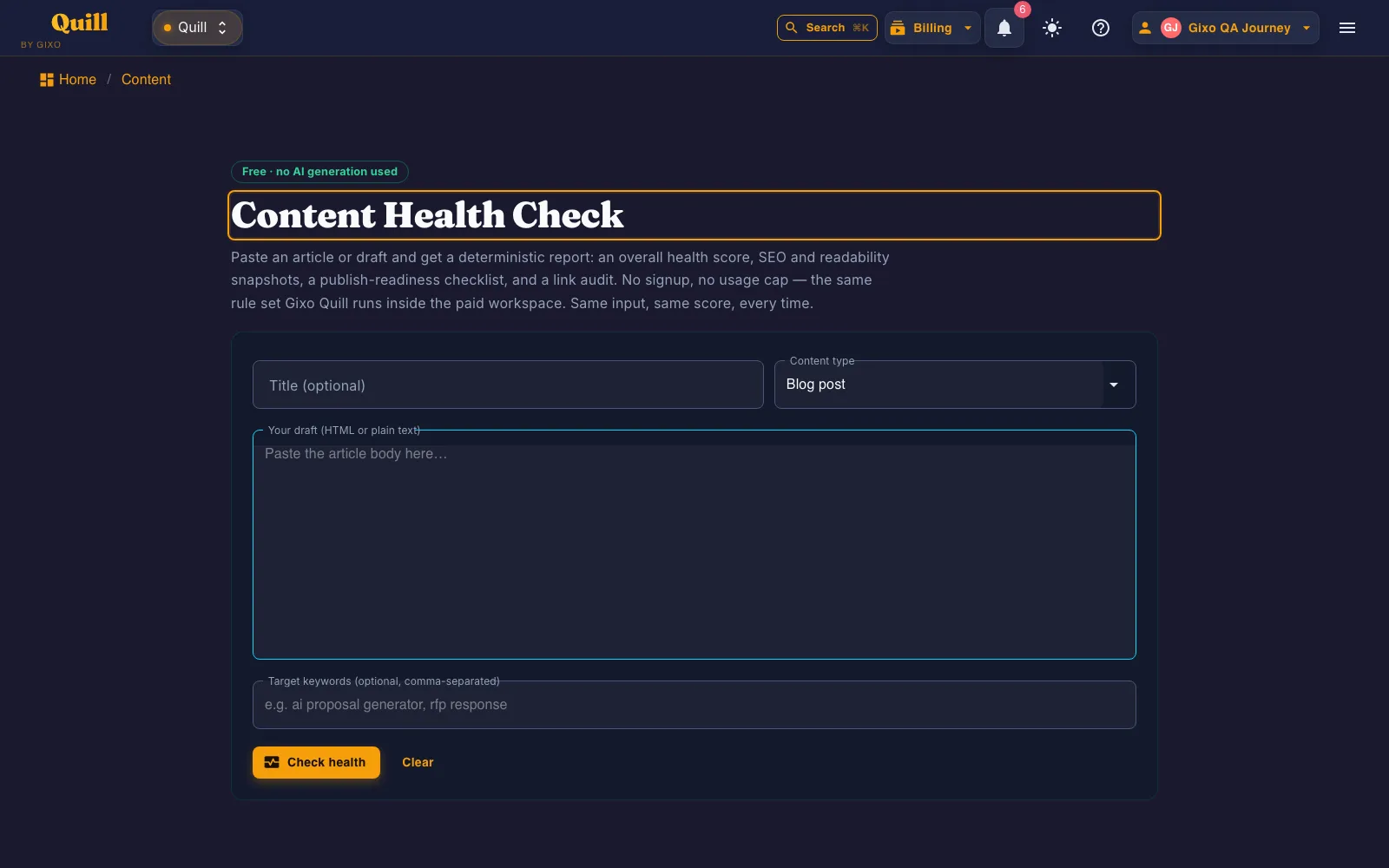
The free Article Health Check runs this rule set with no signup and no usage cap, across 5 content types — blog post, how-to guide, ultimate guide, comparison, and product review. It returns a health score and an SEO score out of 100 and a Flesch–Kincaid grade level; scores of 80 and above read as strong, 60–79 as workable, 40–59 as needing attention, and below 40 as not ready. It is the same ContentWorkbenchAnalysisService the paid Quill workspace uses, so the same draft always produces the same numbers.
How does Gixo run the content quality scorecard for you?
Most guides hand you the scorecard and tell you to check it manually with a stack of separate tools. Gixo's difference is that the checks are built into the product and run deterministically on every piece: the Quill content workflow scores SEO, readability, structure, links, and publish-readiness, then turns weak spots into edits before you publish.
That is the whole point of a scorecard — to turn "I think this is fine" into "here is what is ready and here is what is not." Because the checks are deterministic, the same draft always gets the same assessment, so review is a flagged checklist, not a guess. The human still owns the judgment calls: accuracy of claims, brand fit, and the final approval.
What is the publish-readiness gate for AI content?
Frequently Asked Questions
Inside Quill
Start with the amount of structure you already have
Updated