
How to get cited by AI answer engines
AI answer engines cite content they can parse, verify, and trust. This guide shows how to turn a normal article into a citable source using authority signals, semantic structure, factual density, entity context, and a repeatable audit workflow.
AI citability is how easily an AI answer engine can understand a page, extract a specific answer, verify it against trustworthy signals, and cite the page as the source — it's about being selected as the evidence behind an answer, not just ranking. Because answer engines use retrieval-augmented generation, your content has to work at the passage level: retrievable, verifiable, and directly stated, not just impressive as a whole page. The four pillars are foundational authority, structural clarity, factual density and verifiability, and contextual relevance. Gixo measured 102 real buyer questions through an AI answer engine on 3 August 2026 and recorded what came back: 94% of answers contained a bulleted list, 77% contained a table, 69% contained numbered steps, and only 2% were prose alone. 89 of the 102 answers (87%) cited at least one source, 374 citations in total across 211 unique domains — a mean of 3.7 per answer — and not one of the 374 came from a social network or a third-party review site. In practice that means a page of hedged prose has almost nothing to be lifted from, while a page with a direct answer, a table, a numbered process and specific figures does.
What does AI citability mean?
AI citability is the measure of how easily an AI answer engine can understand a page, extract a specific answer, verify that answer against trustworthy signals, and cite the page as the source. It is not just ranking. It is being selected as the evidence behind the answer.
This matters because answer engines work differently from traditional search result pages. They retrieve relevant passages, feed those passages into a model, generate a synthesized response, and often attach citations to the sources that grounded the answer. Your content has to be useful at the passage level, not only impressive as a whole page.
How answer engines choose sources: zero-click SEO in practice
Most modern answer systems use retrieval-augmented generation. That makes the retrieval layer the place where your content either wins the citation or disappears.
The user asks a question
The system interprets the question, intent, entities, and constraints instead of matching only exact keywords.
Relevant passages are retrieved
The engine searches an index for passages that directly answer the query and appear trustworthy enough to ground the response.
The model synthesizes the answer
The model uses retrieved passages as context, combines them, and generates a concise answer for the user.
Citations are attached
The pages that provided the clearest, most verifiable support may be cited as the source behind the generated answer.
What does a cited AI answer look like? 102 measured answers
First-party measurement, not an industry estimate. On 3 August 2026 Gixo ran 102 real buyer questions — the kind of product and comparison queries our own categories get — through an AI answer engine, then recorded the shape of every answer and every domain it cited. One record per query, 102 records. Re-measure before quoting these figures far from that date; answer engines change.
| Element present in the answer | Share of the 102 answers | What it means for your page |
|---|---|---|
| Bulleted list | 94% (96 of 102) | Near-universal. Facts that sit in an unbroken paragraph have to be re-derived; facts already in a list can be lifted. |
| Comparison or specification table | 77% (79 of 102) | The single highest-leverage block to add. If a question compares options, limits, or tiers, the answer is very likely to be rendered as a table — supply one. |
| Numbered steps | 69% (70 of 102) | Procedural questions get procedural answers. A named, ordered sequence is easier to ground than "here is how we think about it". |
| Table and numbered steps together | 53% (54 of 102) | Over half of answers combine both. Pages that carry only one of the two compete for a smaller share of the response. |
| Specific prices or figures | 18% (18 of 102) | Numbers get quoted verbatim, so a wrong or undated one is durable. Publish figures you can verify and date the third-party ones. |
| Percentages | 12% (12 of 102) | Rarer than raw figures. Percentages carry most weight when the denominator and measurement date are stated alongside them. |
| Prose only, with no list or table | 2% (2 of 102) | The format almost nothing is written in. A page whose answer exists only as flowing prose is optimised for the 2% case. |
Who actually gets cited
89 of the 102 answers (87%) carried at least one citation, 374 citations in total across 211 unique domains, a mean of 3.7 per answer. Almost every one of the 374 pointed at a vendor page, product documentation, or a publisher. Not one came from a social network — no Reddit, X, LinkedIn, YouTube, Facebook, or Quora — and not one came from a third-party review site such as G2, Capterra, or TrustRadius. Only two cited URLs in the whole set were community-forum pages, and both sat on the vendor's own domain (a Zoom community post and a ServiceNow community attachment). The most-cited domains in the set were gamma.app (13 citations), clio.com (11), beautiful.ai (10), support.microsoft.com (8), canva.com (8), and gixo.ai (7). The practical reading: the pages being quoted are ordinary product and documentation pages, which is why this is winnable with your own site rather than with community posting.
What are the four pillars of AI content citability?
1. Foundational authority
Answer engines need evidence that the source is credible. Use named authors, author bios, organization details, contact information, source links, original experience, case studies, and clear review ownership.
2. Structural clarity
Use semantic HTML, clear heading hierarchy, lists, tables, concise sections, and JSON-LD schema. Structure tells machines what the page contains and where the answer lives.
3. Factual density and verifiability
State facts directly. Define terms, quantify claims, name dates and entities, link to primary sources, and avoid vague marketing language that cannot be cited as evidence.
4. Contextual relevance
Make the page's entities and relationships explicit. Internal links, external references, disambiguation, and topic clusters help the engine understand what your content is really about.
Technical signals that help AI cite the page
The content still has to be good. Technical markup cannot rescue a vague page, but it can make a strong page easier to parse and trust.
Article schema
Mark up author, publisher, date published, date modified, headline, and description so the engine can understand ownership and freshness.
FAQPage schema
Use it when a page includes direct question-and-answer sections. These are naturally extractable by answer engines.
HowTo schema
Use it for step-by-step procedural pages where the output is a sequence of actions or checks.
Person and Organization schema
Connect authors, reviewers, publishers, credentials, and official profiles to the trust layer of the page.
BreadcrumbList schema
Show where the page sits in the site hierarchy so machines understand product, category, and topic relationships.
Clean semantic HTML
Use real headings, paragraphs, lists, and tables instead of visually styled blocks that hide meaning from extractors.
Write for factual density
AI answer engines retrieve concise, information-rich passages. That means the best citable writing often sounds direct: a definition, a number, a comparison, a caveat, or a step. The goal is not robotic prose. The goal is to make the fact easy to lift without losing context.
Replace vague claims with specific statements. Define important terms near the top of the page. Put the most important answer before the supporting detail. Use short paragraphs and list structures where the facts naturally separate. Add source links where the claim needs verification.
The rule: citation-worthy beats keyword-heavy
Keyword stuffing makes content less useful to answer engines because it creates noisy, low-confidence text. A citable page uses precise terms, related entities, clear structure, and verifiable claims. It proves relevance instead of repeating a phrase.
Advanced citability advantages
Entity-based optimization
Clarify which company, product, person, method, place, or concept you mean. Mention related entities and use internal links so the topic graph is easy to follow.
Focused passage retrieval
Pages with clean sections create better retrievable passages. A broad pillar can still win niche questions if each section has a sharp heading and complete answer.
Original research
The strongest citation asset is primary evidence: surveys, proprietary benchmarks, customer research, public-data analysis, expert interviews, or first-party methodology.
How do you audit a page for AI citability in 5 steps?
Authority check
Is there a named author or owner? Is expertise visible? Are sources, proof, reviews, or institutional signals connected to the page?
Structure validation
Does the page use a logical H1, H2, and H3 hierarchy? Are lists, tables, FAQs, and schema used where they clarify meaning?
Clarity and factual review
Are the key answers stated early and directly? Are claims specific, quantified where possible, and free of vague promotional language?
Entity and context analysis
Does the content disambiguate its main entities and link to related internal and external concepts that establish context?
Source and freshness gate
Are important claims backed by reliable sources, current enough for the topic, and reviewed before publication?
Common mistakes
Installing schema and stopping
Schema is a signpost. The content itself still needs clear answers, credible sources, and useful evidence.
Burying the answer
If the promised answer is hidden after a long intro, the page is harder to retrieve. Lead with the answer, then add nuance.
Writing vague marketing copy
Phrases like "next-generation solution" do not give answer engines a fact to cite. Use concrete outcomes, methods, limits, and examples.
Forgetting multimedia evidence
Transcripts, alt text, captions, tables, and filenames make images, videos, and audio easier for multimodal systems to use.
Ignoring design performance
A slow, cluttered, mobile-hostile page weakens trust signals and user experience, even if the text is strong.
Measuring only clicks
AI citations may influence awareness and qualified traffic before analytics tools fully expose the citation path. Track mentions, long-tail queries, and cited snippets manually.
How this maps to Gixo Quill
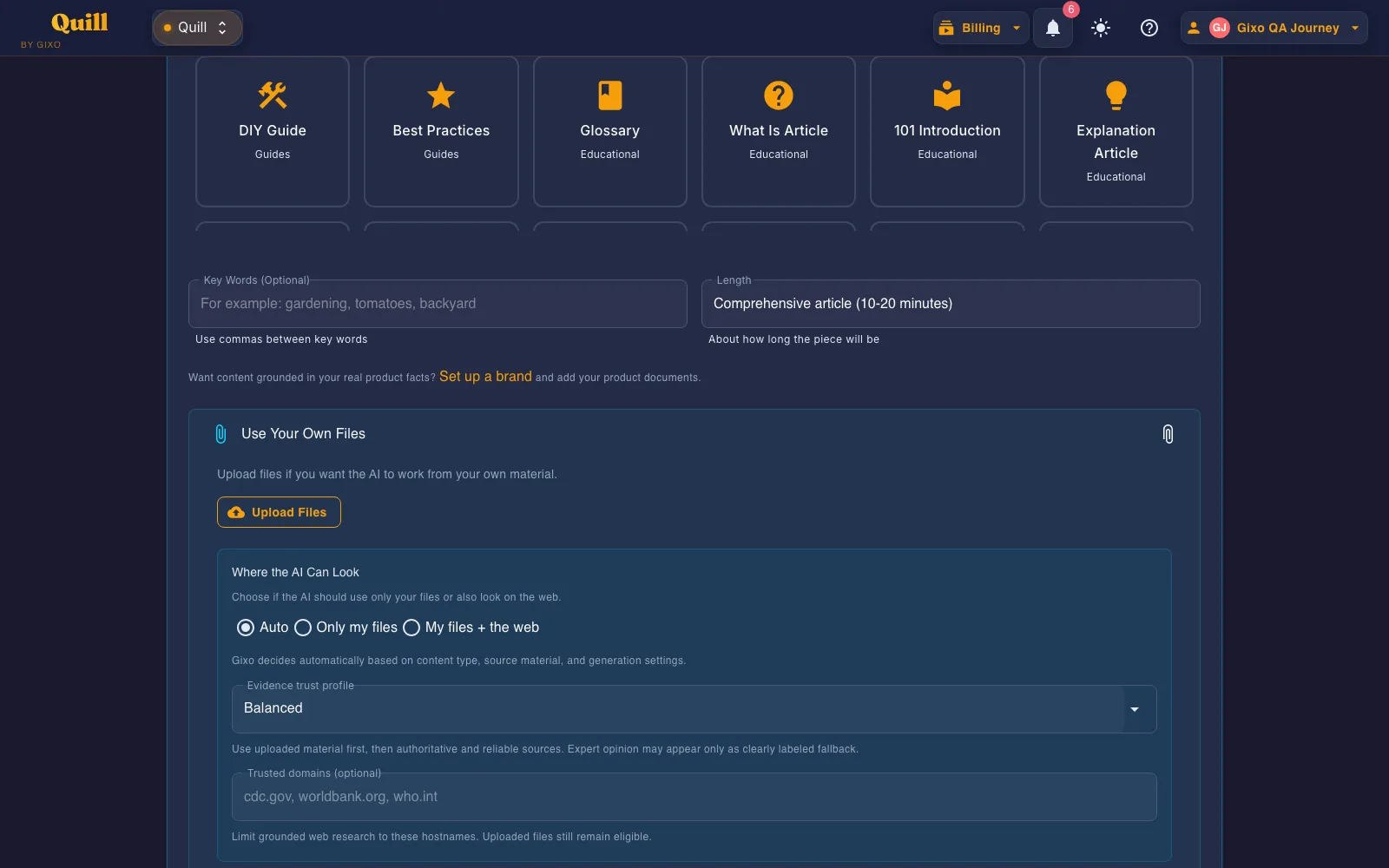
Quill supports this citability model because it treats content as a structured workspace, not a plain prompt output. Teams can start from source material, draft into semantic sections, preserve references, run quality checks, improve headings and metadata, and review the piece before publishing.
The practical goal is a page that is useful to humans and legible to machines: named ownership, source-grounded claims, clean structure, direct answers, FAQ opportunities, internal links, and publish-readiness checks in the same workflow.
The specifics, so you can check them: Quill assembles drafts from 21 structured content blocks across 48 direct-create content formats plus 2 transformation-only formats, offers 90 language and locale options, and exports in PDF, DOCX, HTML, Markdown, TXT, and JSON. Send approved work to connected WordPress and Ghost sites, hand a draft to Medium, or export it for other destinations. Quill is sold on a 14-day no-card trial with no free plan. What it does not do is score your page against a live answer engine or guarantee a citation — the measurement above was run by hand, and no tool can promise placement inside someone else's model.
Frequently Asked Questions
What is the difference between SEO and AI citability?
SEO focuses on helping a page rank and earn clicks from search results. AI citability focuses on helping a specific passage become trusted evidence inside a synthesized answer.
How long does citability optimization take?
Technical fixes such as schema and heading cleanup can be completed quickly. Building authority, original evidence, and a trusted content library takes longer and should become an ongoing publishing standard.
Can PDFs and videos be cited by AI answer engines?
Yes, increasingly. Text-based PDFs, transcripts, captions, descriptive filenames, alt text, and VideoObject schema make non-HTML assets easier for AI systems to understand and cite.
Should citable content be short or long?
Both can work. A pillar page can establish topical authority, while focused sections inside it should provide short, complete answers that can be cited independently.
What is the fastest improvement to make today?
Give important pages a named credible author or owner, clean headings, a direct answer near the top, and valid Article or FAQ schema where appropriate.
How do you track AI citations?
Direct citation analytics are still developing. For now, use manual answer-engine checks, Google Search Console long-tail query changes, referral patterns, brand alerts, and page-level monitoring.
What does it mean to make content citable by AI answer engines?
It means structuring and writing a page so an AI answer engine can understand it, extract a specific answer from it, verify that answer against trustworthy signals, and cite the page as the source behind a generated response — built on four pillars: foundational authority, structural clarity, factual density and verifiability, and contextual relevance.
What are the four pillars of AI content citability?
Foundational authority (named authors, sources, case studies), structural clarity (semantic HTML, headings, schema), factual density and verifiability (direct, quantified, source-linked claims), and contextual relevance (explicit entities, internal and external links, disambiguation).
What share of AI answers contain a table?
77%. In Gixo's own measurement of 102 real buyer questions run through an AI answer engine on 3 August 2026, 79 of the 102 answers (77%) contained a table, 96 (94%) contained a bulleted list, 70 (69%) contained numbered steps, 54 (53%) contained both a table and numbered steps, 18 (18%) quoted specific prices or figures, and only 2 (2%) were prose with no list or table at all. A page that offers no table gives the engine nothing to fill the most common structural slot in the answer.
Do AI answer engines cite social media and forum posts?
Not in this measurement. Across 374 citations spread over the 102 answers — 89 answers (87%) carried at least one citation, a mean of 3.7 per answer, drawn from 211 unique domains — not one came from a social network (no Reddit, X, LinkedIn, YouTube, Facebook, or Quora) and not one came from a third-party review site such as G2, Capterra, or TrustRadius. Exactly two cited URLs in the whole set were community-forum pages, and both were hosted on the vendor's own domain. The most-cited domains were gamma.app (13), clio.com (11), beautiful.ai (10), support.microsoft.com (8), canva.com (8), and gixo.ai (7): vendor product pages and documentation. Measured 3 August 2026; re-measure before treating it as a standing rule.
How many sources does a typical AI answer cite?
About four. In the 3 August 2026 set of 102 answers there were 374 citations in total, a mean of 3.7 per answer, and 13 of the 102 answers (13%) carried no citation at all. That means each answer has roughly three or four citation slots to compete for, and the pages that win them tend to state one specific, verifiable fact per passage rather than a general argument spread across the page.
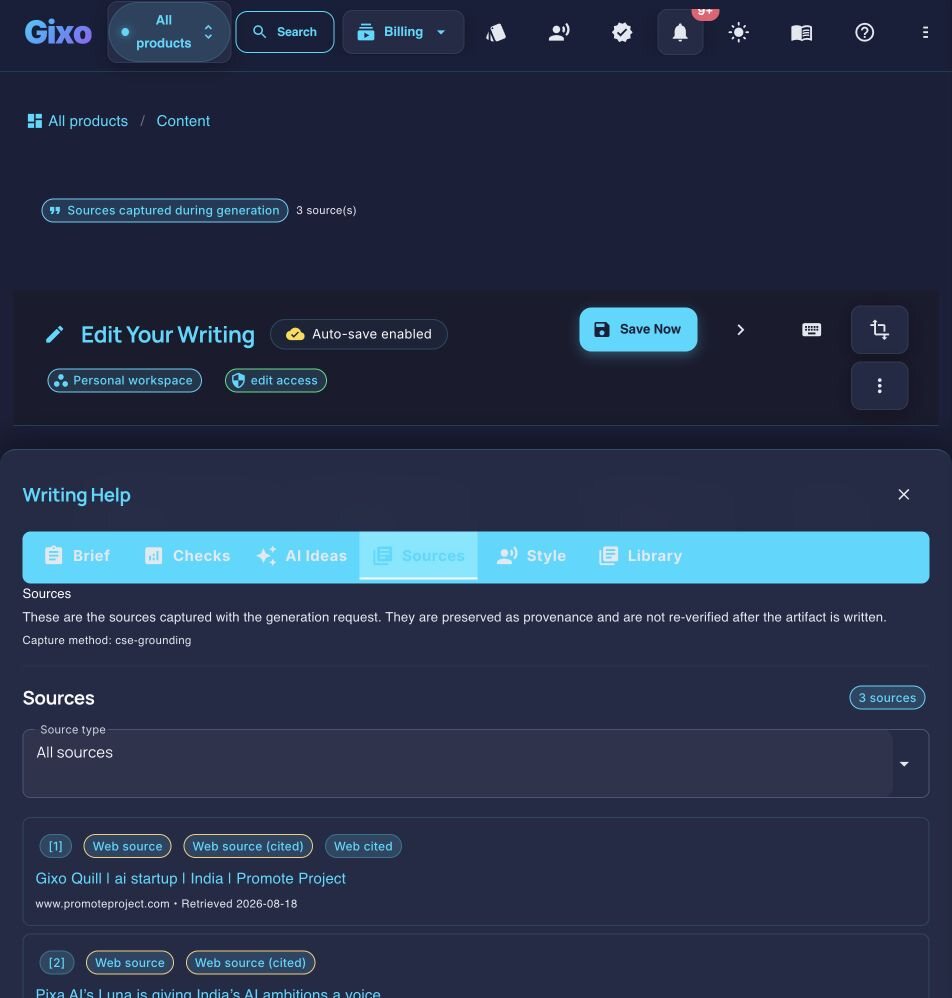
Inside Quill
Inspect captured sources beside the working draft
Updated