
AI content operations for teams
AI ContentOps is the operating system around AI-assisted content: source intake, drafting, review, governance, publishing, measurement, and improvement. Without it, teams get more drafts but not necessarily better content.
What your plan includes.Comments, mentions and team sharing is on Professional plans and above — from $79 per seat a month, minimum three seats. Writing, checks, exports, public share links and publishing are on every plan. The 14-day trial works like Starter, so it does not include them.
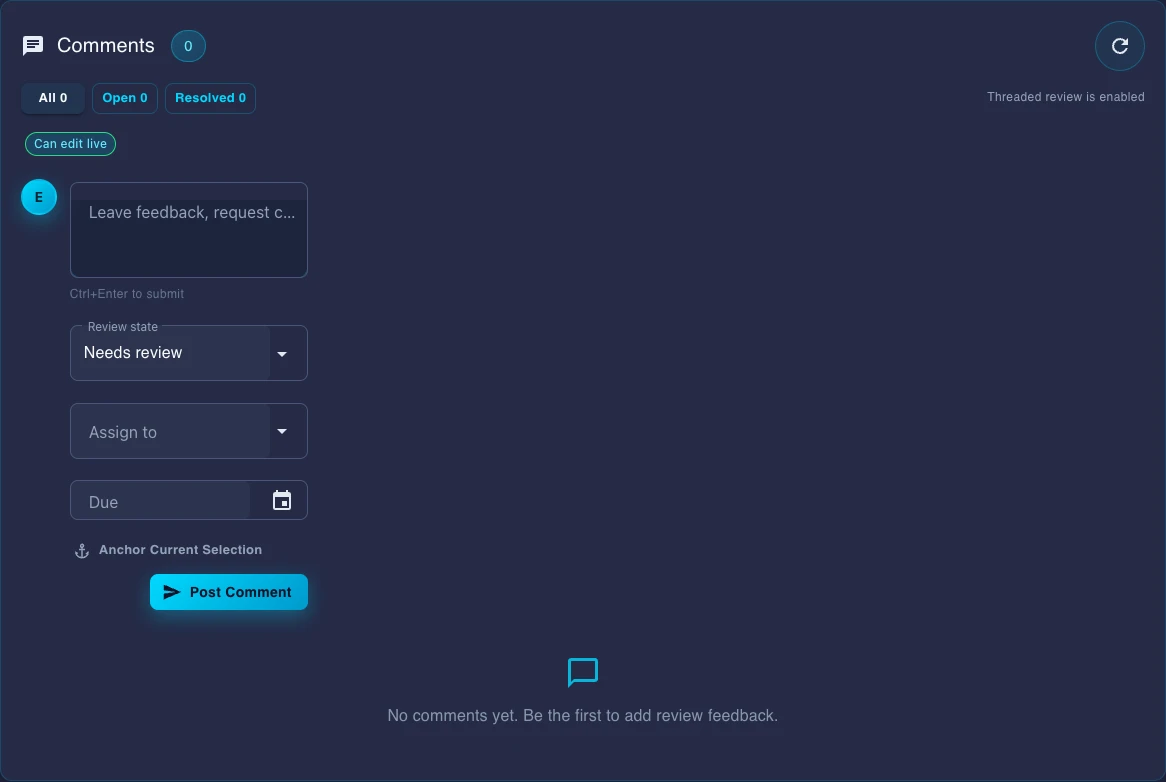
AI ContentOps is the workflow, roles, governance, tooling, and measurement system that lets teams use AI for content production reliably instead of treating every draft as a one-off prompt. It replaces ad hoc prompting with a repeatable pipeline of 6 stages — intake, grounding, generation, review, distribution, and measurement — owned by 6 roles: content owner, subject-matter reviewer, editor, governance owner, distribution owner, and system owner. Without it, teams get more drafts but not necessarily better content, because nobody knows which sources were used, which claims were verified, or why performance changed. In Gixo Quill the pipeline is concrete: up to 5 reference files per draft, 48 direct-create content formats, 21 structured content blocks, 90 language and locale options, 3 review states on every comment thread, direct publishing to connected WordPress and Ghost sites, and export in PDF, DOCX, HTML, Markdown, TXT, and JSON. Quill runs $10 to $129 per seat per month with a 14-day no-card trial.
What problem does AI ContentOps solve for content scaling?
Most teams adopt AI at the task level: one person drafts a post, another rewrites an email, someone else summarizes research. That produces local speed but creates operational sprawl. Nobody knows which sources were used, which claims were verified, which version was approved, or why performance changed.
AI ContentOps turns AI from a collection of prompts into a repeatable production system. It defines how content requests enter the pipeline, how evidence is attached, who reviews what, which checks happen before publishing, and how learning flows back into the next piece.
What is the AI ContentOps lifecycle?
Intake
Define the audience, job, channel, content type, owner, source pack, due date, and risk level before generation starts.
Grounding
Attach approved references, product facts, customer proof, research, examples, and exclusions so drafts begin from trusted context.
Generation
Create a structured first shot in the right format, with brand voice and evidence context included from the start.
Review
Run quality checks, verify claims, resolve comments, track approvals, and preserve the decision history.
Distribution
Export, publish, localize, or repurpose the approved asset without breaking structure or losing source context.
Measurement
Track quality, editing time, cycle time, organic performance, answer visibility, conversions, and recurring content defects.
What roles do teams need for AI ContentOps?
Content owner
Defines the audience, goal, content type, and acceptance criteria. Owns final performance, not just publication.
Subject-matter reviewer
Checks accuracy, nuance, examples, caveats, and source interpretation before the draft becomes public.
Editor
Improves clarity, structure, tone, narrative flow, and usefulness while preserving verified facts.
Governance owner
Maintains policy, risk tiers, approved sources, disclosure rules, and escalation paths.
Distribution owner
Publishes, repurposes, localizes, and measures the content across owned, search, social, and answer-engine channels.
System owner
Maintains templates, prompts, source collections, integrations, permissions, and quality automation.
Metrics that matter
Quality metrics
Accuracy defects, unsupported claims, readability, structure, brand voice fit, SEO basics, and publish-readiness score.
Operational metrics
Cycle time, editing time, review backlog, approval SLA, rework rate, and number of pieces shipped per owner.
Business metrics
Organic sessions, rankings, answer visibility, qualified conversions, assisted pipeline, and content reuse.
Which role owns each stage, and what supports it
The Gixo Quill column states shipped capability. Where Quill does not cover a stage, the row says so rather than implying coverage.
| Stage | Accountable role | Output of the stage | What Gixo Quill provides |
|---|---|---|---|
| 1. Intake | Content owner | Audience, job, channel, content type, owner, source pack, due date, risk level | A create flow that takes up to 5 reference files per draft (PDF, DOCX, DOC, TXT, MD, images, and audio or video) with OCR options for scanned PDFs, across 48 direct-create content formats |
| 2. Grounding | Subject-matter reviewer | Approved references, product facts, customer proof, exclusions | Select saved brand source documents when you create a draft so product, pricing, and feature material is available as grounding context. Citations and evidence details remain visible for human review. |
| 3. Generation | Content owner | A structured first shot in the right format and voice | Format-first drafting into 21 structured content blocks, with 90 language and locale options and 38 industry categories with format-aware guidance |
| 4. Review | Editor and governance owner | Verified claims, resolved comments, recorded approvals | Comment threads carrying 3 review states (needs review, changes requested, approved) plus assignee and due date, alongside deterministic structure and readability checks and inspectable citations |
| 5. Distribution | Distribution owner | The approved asset published, exported, localized, or repurposed | Direct publishing to connected WordPress and Ghost sites, Medium draft handoff and Substack export, and export in PDF, DOCX, HTML, Markdown, TXT, and JSON |
| 6. Measurement | Distribution owner and system owner | Quality defects, cycle time, organic performance, answer visibility, conversions | Quill records the production trail — activity, version, review, and publishing history on the document. It does not report traffic, rankings, or conversions; those stay in your analytics and search-console stack |
How Quill supports AI ContentOps
Quill connects the work that is usually scattered across chat, docs, spreadsheets, CMS tools, and review threads. Teams can generate source-aware first shots, keep brand voice and references attached, run deterministic content checks, collaborate in the editor, and move approved work toward export or publishing.
The point is not to generate more words. It is to shorten the path from source material to reviewed, structured, publishable content while keeping enough control for a real team to trust the output.
Frequently Asked Questions
What is AI ContentOps?
AI ContentOps is the workflow, roles, governance, tooling, and measurement system that lets teams use AI for content production reliably instead of treating every draft as a one-off prompt.
Who should own AI content operations?
Ownership usually sits with content, marketing, or product marketing, with input from SMEs, legal, brand, and RevOps. The owner should be accountable for quality and business outcomes, not just tool adoption.
What should teams automate first?
Automate repeatable checks before automating publication: structure, readability, metadata, links, source attachment, and missing review steps. Keep final approval human-led for public or high-risk content.
How do you prove ROI?
Measure cycle-time reduction, editing time saved, fewer quality defects, content reuse, organic growth, answer visibility, and conversions. Word count alone is not a useful ROI metric.
What are the stages of AI content operations?
AI ContentOps runs in six stages: intake (define audience, owner, source pack, and risk level), grounding (attach approved references and proof), generation (produce a structured first shot with brand voice and evidence), review (verify claims and track approvals), distribution (export, publish, or repurpose without losing source context), and measurement (track quality, cycle time, and answer visibility).
What roles are involved in AI content operations?
Six roles typically cover AI ContentOps: a content owner (accountable for outcomes, not just publication), a subject-matter reviewer (checks accuracy and source interpretation), an editor (clarity and structure), a governance owner (policy and approved sources), a distribution owner (publishing and measurement across channels), and a system owner (templates, prompts, and quality automation).
How many source files can one draft use in Gixo Quill?
Up to 5 reference files per draft. Accepted types are PDF, DOCX, DOC, TXT, MD, images, and audio or video files, and scanned PDFs can be run through enhanced OCR at intake. Saved brand source documents can be selected separately as grounding context, so product, pricing, and feature material does not have to be re-uploaded for every piece.
What review controls does the workspace give a team?
Every comment thread carries one of 3 review states — needs review, changes requested, or approved — plus an assignee and a due date, and threads resolve on the document rather than in a separate tracker. Alongside that, deterministic structure and readability checks and inspectable citations show reviewers what still needs verification. Final approval stays human-led.
Does Quill measure content performance?
No. Quill records the production trail — activity, version, review, and publishing history attached to each document — but it does not report traffic, rankings, or conversions. Those metrics stay in your analytics platform and search consoles; the ContentOps measurement stage joins the two by tracking published URLs back to the documents that produced them.
What does Gixo Quill cost for a content team?
Quill is $10 per seat per month on Lite (1 seat), $59 on Starter (1 seat), $79 on Professional (3 seats minimum), $99 on Business (5 seats minimum), and $129 on Enterprise (10 seats minimum, sold through Azure Marketplace or a private offer). It's a 14-day free trial (no card required), not an unlimited free tier — Gixo Quill has no standing $0 plan. After the trial, continued generation requires a paid plan.
Inside Quill
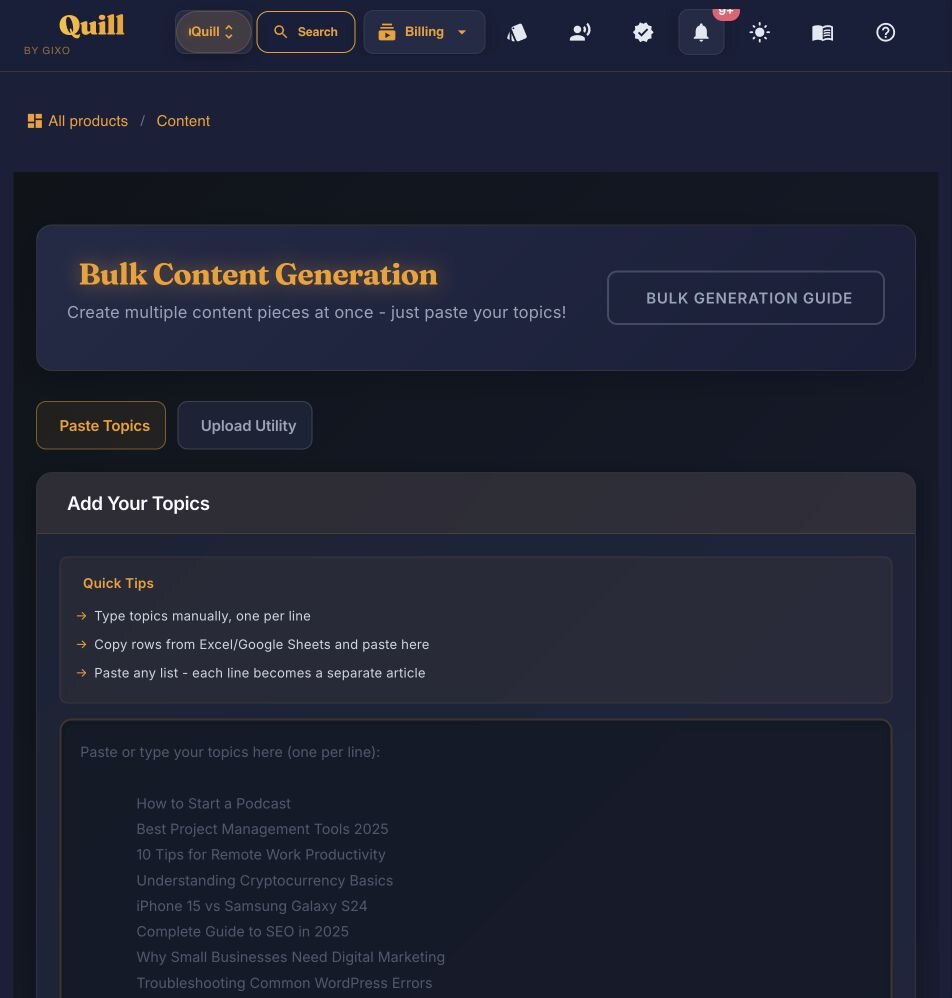
Turn a topic list into a previewable batch
Updated