
Human-in-the-loop AI SEO content
Human-in-the-loop AI SEO content is the operating model where AI accelerates research, drafting, analysis, and iteration, while humans own strategy, subject-matter accuracy, brand voice, ethical judgment, and final publication quality.
What your plan includes.Comments, mentions and team sharing is on Professional plans and above — from $79 per seat a month, minimum three seats. Writing, checks, exports, public share links and publishing are on every plan. The 14-day trial works like Starter, so it does not include comments.
Human-in-the-loop AI SEO content is an operating model where AI accelerates research, drafting, analysis, and iteration, while humans own strategy, subject-matter accuracy, brand voice, ethical judgment, and final publication quality. It is not the same as asking an editor to clean up a raw AI draft — it is a structured workflow where people guide the work before generation, during generation, after generation, and after publication. AI handles speed and pattern recognition; humans handle the decisions that create trust: what topic should exist, what claim is defensible, which source matters, and whether the piece is good enough to publish.
What does human-in-the-loop mean in AI SEO content?
Human-in-the-loop content is not the same as asking an editor to clean up a raw AI draft. It is a structured workflow where people guide the work before generation, during generation, after generation, and after publication.
The AI handles speed, pattern recognition, summarization, outline generation, first drafts, repetitive variants, and data surfacing. The human team handles the decisions that create trust: what topic should exist, what claim is defensible, which source matters, how the brand should sound, and whether the piece is good enough to publish.
The three foundations of an AI content strategy
Strong HITL content works because AI, human expertise, and SEO principles each have a defined role.
1. AI for scale
Use AI to synthesize research, generate outlines, draft sections, propose metadata, expand examples, and handle repetitive variants. It should accelerate the workflow, not become the source of truth.
2. Humans for quality
Strategists, SMEs, editors, and SEO specialists supply business context, firsthand experience, factual judgment, narrative craft, source review, and final accountability.
3. SEO for direction
Search intent, helpfulness, E-E-A-T, topical authority, internal linking, schema, and answer visibility shape the brief and the final quality gate.
What is the human-in-the-loop content lifecycle?
The best teams treat AI-assisted content as a closed loop, not a one-click drafting event.
Strategy and briefing
Humans define the audience, search intent, business goal, source requirements, unique angle, risk level, and acceptance criteria. AI can assist with SERP analysis, content gaps, questions, and outline options.
Drafting and generation
AI produces a structured first shot from the brief and approved context. Humans guide prompts, provide data, add examples, and intervene when the draft drifts away from the goal.
Review and optimization
Humans verify facts, add subject-matter depth, improve the narrative, align brand voice, check internal links, optimize headings, and prepare schema or metadata.
Performance analysis and iteration
AI can surface patterns in rankings, impressions, conversions, and decay. Humans interpret the reason behind those signals and feed better instructions into the next brief.
What are the three foundations and four lifecycle stages of human-in-the-loop AI SEO content?
| Layer | Element | Who/What owns it |
|---|---|---|
| Foundation | AI for scale | Synthesizes research, generates outlines, drafts sections, proposes metadata, expands examples, handles repetitive variants |
| Foundation | Humans for quality | Strategists, SMEs, editors, and SEO specialists supply business context, firsthand experience, factual judgment, narrative craft, source review, final accountability |
| Foundation | SEO for direction | Search intent, helpfulness, E-E-A-T, topical authority, internal linking, schema, and answer visibility shape the brief and final quality gate |
| Lifecycle step 1 | Strategy and briefing | Humans define audience, search intent, business goal, source requirements, angle, risk level, acceptance criteria |
| Lifecycle step 2 | Drafting and generation | AI produces a structured first shot from the brief; humans guide prompts, provide data, add examples, intervene on drift |
| Lifecycle step 3 | Review and optimization | Humans verify facts, add subject-matter depth, align brand voice, check internal links, optimize headings, prepare schema/metadata |
| Lifecycle step 4 | Performance analysis and iteration | AI surfaces ranking/impression/conversion/decay patterns; humans interpret signals and feed better instructions into the next brief |
The three human review layers for AI content
Factual and SME review
A qualified reviewer checks every important claim, statistic, technical explanation, source interpretation, and caveat. This is especially important for technical, legal, finance, health, and compliance-adjacent content.
Narrative and voice review
An editor turns the draft from competent output into brand-owned communication: clear flow, useful examples, readable sections, consistent tone, and an introduction that pays off.
SEO and intent review
An SEO specialist checks intent fit, headings, internal links, semantic coverage, metadata, answer extraction opportunities, and schema candidates before the piece goes live.
The quality gate
If nobody can say which sources support the claims, who approved the facts, what audience the page serves, and how the page differs from generic AI output, the content is not ready. Human-in-the-loop means the draft must carry visible decisions, not only corrected grammar.
Advanced applications
Programmatic SEO
Use humans to design templates, data rules, risk thresholds, and sampling checks. Use AI to create unique explanations from structured data without letting thousands of thin pages publish unchecked.
Multilingual localization
Use AI for translation and local keyword suggestions, then have native reviewers check idiom, cultural fit, local search intent, source relevance, and brand voice.
Proprietary knowledge
Use first-party data, interviews, support conversations, product docs, and style guides as approved context. The more proprietary the context, the more defensible the final article becomes.
What mistakes should teams avoid with human-in-the-loop AI SEO content?
Treating HITL as proofreading
A real human loop starts with strategy and source selection. Editing after generation is only one layer of the process.
Optimizing for AI detection scores
The goal is not to make the article look non-AI. The goal is to make it useful, accurate, original, source-backed, and aligned with the reader's intent.
Replacing SMEs
AI can summarize common knowledge, but SMEs provide the firsthand judgment, nuance, and risk awareness that search quality and readers reward.
Believing a prompt is enough
A good prompt improves the first draft. It does not replace fact-checking, brand editing, source review, internal linking, or performance iteration.
How this maps to Gixo Quill
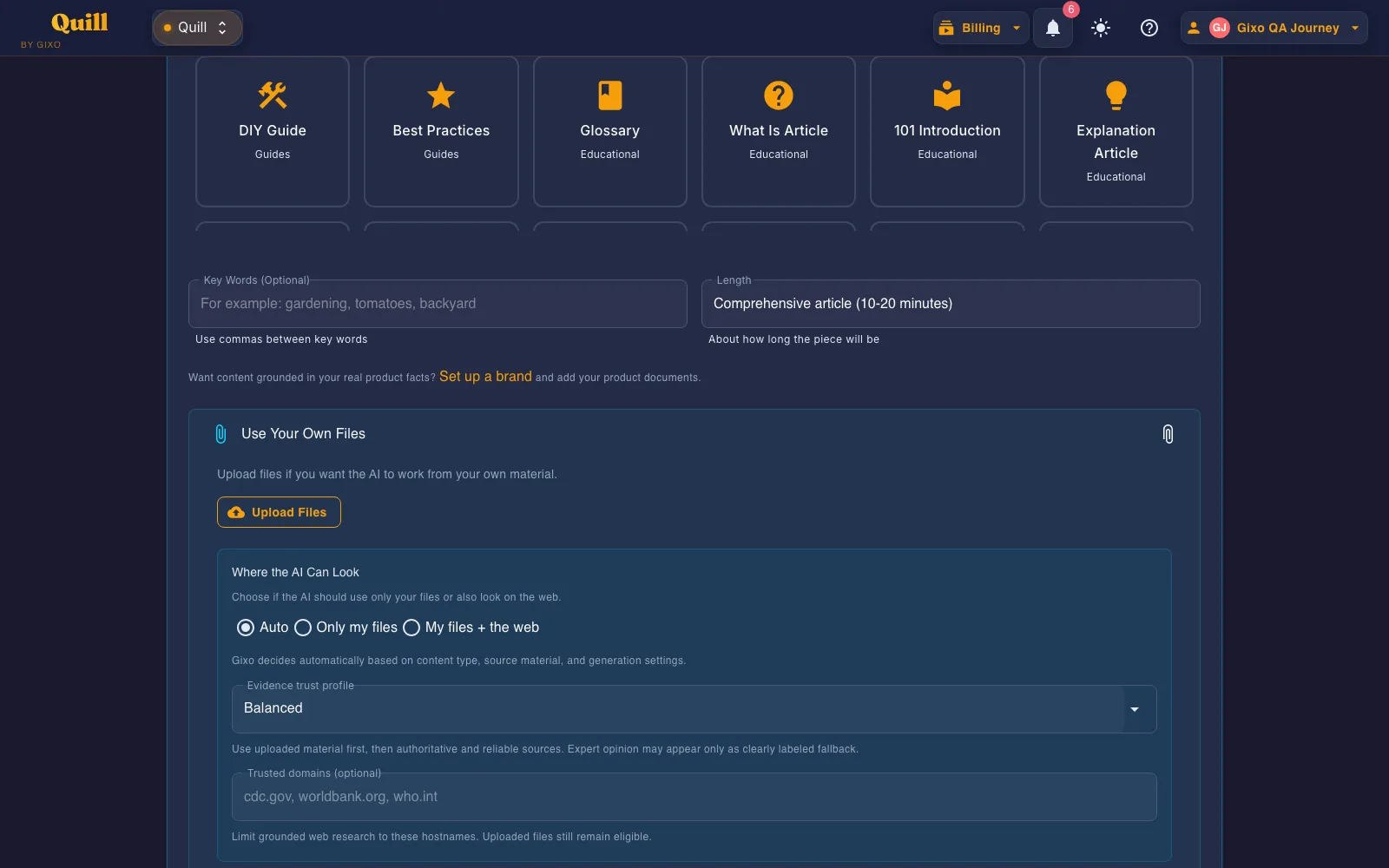
Quill is built for teams that need the loop, not only the draft. Start with a source pack, content type, audience, and brand context. Generate a structured first shot, keep references and review context close to the text, run quality checks, leave comments, refine the page, and publish or export only after the content clears the gate.
This pillar connects the people-and-process layer to the rest of the Quill cluster: evidence grounding, source-to-article production, quality scoring, and brand governance.
Frequently Asked Questions
What is human-in-the-loop AI SEO content?
It is a workflow where AI assists with research, drafting, optimization, and analysis while humans own strategy, source selection, subject-matter accuracy, brand voice, review, and final publication decisions.
Is HITL just editing AI-generated text?
No. Editing is one part of the loop. A strong HITL workflow includes human-led strategy, briefing, source governance, prompt guidance, SME review, SEO review, publication approval, and performance iteration.
How does HITL support E-E-A-T?
Humans add firsthand experience, expertise, source verification, reviewer accountability, and trust signals. AI helps structure and scale the content, but humans create the evidence of quality.
Can HITL be used for YMYL or technical content?
Yes, but the human review layer must be stricter. Qualified SMEs should verify important claims and have final sign-off before legal, financial, medical, technical, or compliance-sensitive content is published.
How do teams measure HITL ROI?
Track cost per article, content velocity, editing time, quality defects, ranking performance, organic traffic, conversions, time to rank, and how often published content needs correction after review.
What skills does the human in the loop need?
A team usually needs strategy, SEO, prompting, subject-matter expertise, editing, source evaluation, analytics interpretation, and workflow ownership. One person does not need every skill, but the process needs all of them covered.
What are the three foundations of human-in-the-loop AI SEO content?
AI for scale (synthesizing research, drafting, outlines, and variants), humans for quality (strategy, SME accuracy, brand voice, and accountability), and SEO for direction (intent, E-E-A-T, topical authority, internal linking, schema, and answer visibility) that together shape the brief and the final quality gate.
What are the four stages of the human-in-the-loop content lifecycle?
Strategy and briefing, drafting and generation, review and optimization, and performance analysis and iteration — a closed loop rather than a one-click drafting event, where humans define acceptance criteria upfront and interpret performance signals to improve the next brief.
Inside Quill
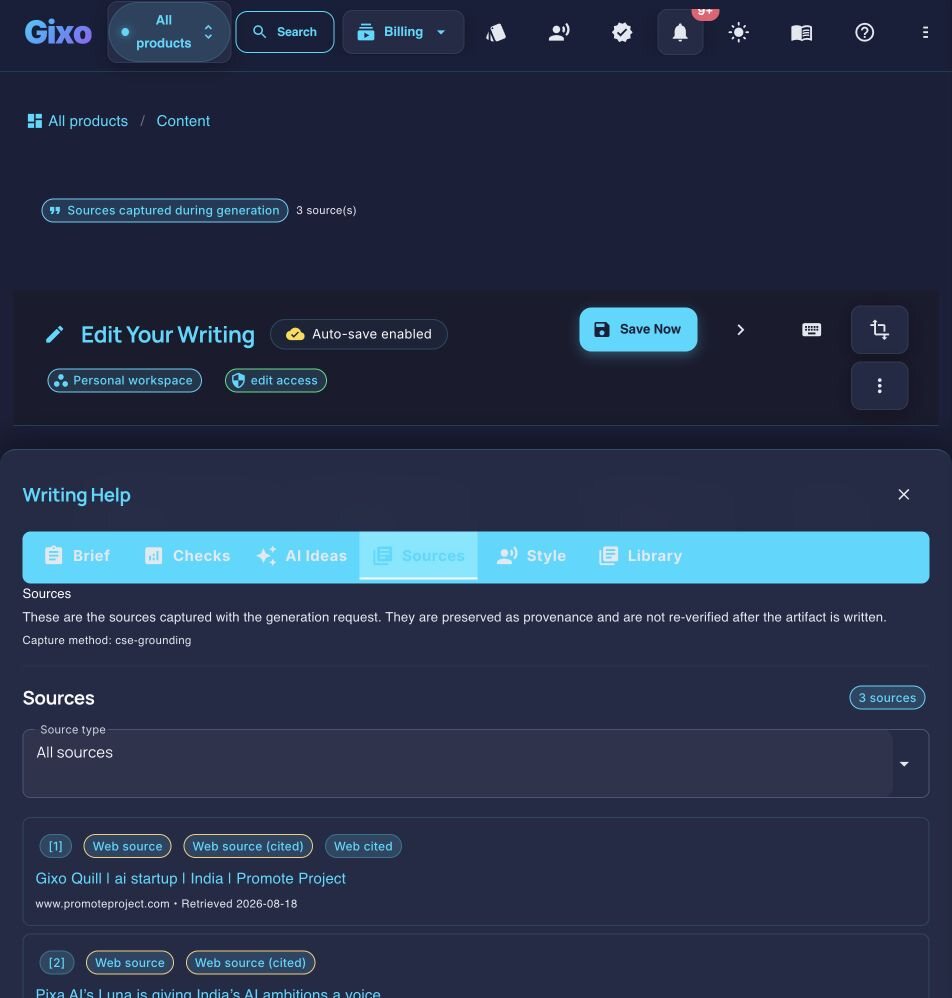
Inspect captured sources beside the working draft
Updated