AI SEO Content Writer
We tested 8 AI SEO content writers side by side on real content tasks. This guide compares Gixo, Surfer SEO, Frase, Scalenut, GrowthBar, Clearscope, MarketMuse, and Dashword across content generation, SEO scoring, citations, brand voice, pricing, and publishing workflows so you can pick the right tool for your needs in 2026.
What Is an AI SEO Content Writer?
An AI SEO content writer is a software tool that combines artificial intelligence text generation with search engine optimization analysis. Instead of writing content first and then optimizing it for search, these tools embed SEO signals directly into the generation process. The result is content that is structured to rank from the moment it is drafted, not after rounds of manual keyword insertion and heading rearrangement.
How It Differs from a General AI Writer
General AI writers such as ChatGPT, Claude, and Gemini produce fluent text, but they have no awareness of SERP competition, keyword density, or content gaps for a specific query. You can ask ChatGPT to write a blog post, and it will produce grammatically correct prose, but it will not know which subtopics the top ten results are covering, what word count tends to rank for that query, or how to structure headings to match search intent. An AI SEO content writer fills that gap by layering real-time SEO data on top of the language model.
Why It Matters for Content Teams in 2026
Content marketing has become intensely competitive. Publishing a well-written article is no longer enough to earn search traffic. Google's algorithms evaluate topical depth, heading structure, entity coverage, freshness, and user engagement signals. Teams that manually optimize content after drafting it spend hours per article on a process that can be partially automated. AI SEO content writers reduce that cycle from hours to minutes, letting writers focus on adding original insights, expert quotes, and first-party data rather than debating keyword placement.
The tools in this guide range from content optimization platforms that score existing drafts to full-stack generators that produce entire articles with SEO baked in. Each approach has trade-offs, and the right choice depends on whether your bottleneck is content creation, content optimization, or content strategy.
What to Look for in an AI SEO Content Writer
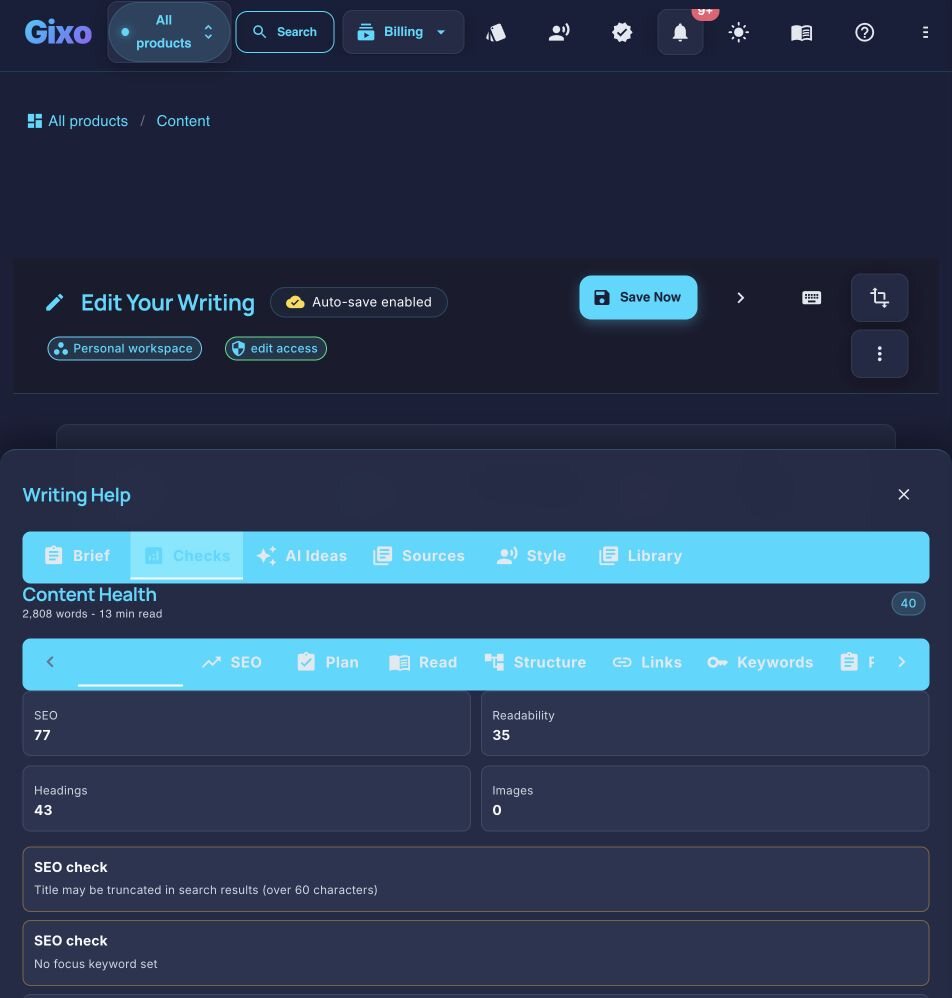
The best AI SEO content writers combine generation quality with real-time SEO intelligence. Here are the six capabilities that separate professional tools from basic AI text generators.
The tool should analyze search intent behind your target keyword and adapt the content structure accordingly. Informational queries need comprehensive guides; transactional queries need comparison tables and CTAs. Tools that ignore intent produce content that ranks for the wrong reason or not at all.
Proper H1 through H4 structure is a fundamental SEO signal. Good tools auto-generate heading hierarchies that include natural keyword variations, create scannable content architecture, and mirror the heading patterns that search engines reward in top-ranking results.
Content that is technically optimized for SEO but painful to read will not retain visitors. Real-time readability scoring helps you balance sentence length, paragraph structure, and vocabulary complexity so that content is accessible to your target audience and keeps dwell time high.
Content structured for FAQ schema, HowTo schema, and article schema markup can earn rich snippets in search results. Rich snippets boost click-through rates significantly. The best tools generate content in formats that map directly to schema types without extra restructuring.
Strong internal linking builds topical clusters that help search engines understand your domain authority. AI tools that suggest relevant internal links based on your existing content library save editors significant time and improve site architecture systematically.
The most effective AI SEO writers analyze what top-ranking content covers for your keyword and identify gaps. By surfacing topics and subtopics that competitors miss, these tools help you create content that offers differentiated value and captures untapped search traffic.
How AI SEO Content Generation Works
From keyword to ranking-ready content in four steps.
Provide your primary keyword. The tool analyzes search intent, related terms, and competitor content to plan the optimal article structure.
AI generates a structured outline with keyword-optimized headings, suggested word count, and content sections designed to outperform existing results.
The tool writes the full article with natural keyword integration, citations, internal links, and meta descriptions. Edit any section with inline AI assistance.
Export or publish directly to your CMS. Content includes all SEO metadata, schema markup, and formatting ready for indexing.
How 8 AI SEO Content Writers Compare
We used each tool to generate long-form SEO articles on competitive keywords. Here is what we found across content quality, SEO optimization, pricing, and workflow integration.
AI SEO Content Writer Feature Comparison
A side-by-side look at the key capabilities across all 8 tools.
| Feature | Gixo | Surfer SEO | Frase | Scalenut | GrowthBar | Clearscope | MarketMuse | Dashword |
|---|---|---|---|---|---|---|---|---|
| SEO Scoring | Built-in | Best-in-class | Yes | Yes | Basic | Best-in-class | Yes | Yes |
| Content Generation | Full articles | Add-on | Basic | Full articles | Blog posts | None | First drafts | Basic |
| Evidence Citations | Automatic | No | No | No | No | No | No | No |
| Brand Voice | Trainable | No | No | No | No | No | No | No |
| SERP Analysis | Basic | Best-in-class | Strong | Yes | Basic | Strong | Domain-level | Yes |
| Content Strategy | Basic | Audit only | Briefs | Clustering | No | No | Best-in-class | Briefs |
| CMS Publishing | Built-in | WordPress, Docs | Limited | WordPress | Limited | WordPress, Docs | Limited | Limited |
| Starting Price | $9.99/mo | $89/mo | $15/mo | $39/mo | $29/mo | $170/mo | $149/mo | $99/mo |
Best AI SEO Content Writer for Each Use Case
Different workflows call for different tools. Here is our recommendation for six common scenarios based on our testing.
What Makes SEO Content Rank in 2026
Choosing the right AI SEO content writer is only half the equation. Understanding what Google actually rewards in 2026 helps you use any tool more effectively. Here is what matters most for ranking content today.
Google's Helpful Content System
Google's helpful content system, which replaced the earlier Helpful Content Update, evaluates whether your content is created primarily for people rather than for search engines. Content that demonstrates genuine expertise, answers real questions, and provides value beyond what ten other articles already say will outperform content that merely covers the same ground with different wording. AI SEO content writers can help you identify what searchers are looking for, but the editorial judgment about what is truly helpful still requires human oversight.
E-E-A-T and How AI Tools Can Help (or Hurt)
Experience, Expertise, Authoritativeness, and Trustworthiness (E-E-A-T) are quality signals Google uses to evaluate content credibility. AI tools help with E-E-A-T when they source citations, structure authoritative headings, and ensure factual accuracy. They hurt E-E-A-T when they generate generic content without first-person experience or expert insight. The best practice is to use AI SEO tools for research, structure, and optimization while layering in your own expertise, data, and perspectives in the editing phase.
Content Depth vs. Keyword Stuffing
There is a meaningful difference between comprehensive content and keyword-stuffed content. Comprehensive content covers a topic thoroughly with relevant subtopics, examples, data, and context. Keyword-stuffed content repeats target phrases at unnatural densities. Modern AI SEO tools use NLP analysis to recommend semantically related terms rather than exact-match repetition, which aligns with how Google's algorithms understand content. If your tool is still recommending you use your exact keyword 15 times in 1,500 words, switch tools.
The Role of Citations and Evidence
Content backed by verifiable sources outperforms content that makes unsupported claims. Citations serve two purposes: they signal trustworthiness to readers, and they create a web of entity connections that helps search engines understand the authority of your content. Most AI SEO content writers do not include citations. Gixo is one of the few tools that automatically sources and attaches evidence, but even if your tool does not, adding references manually is worth the effort for competitive queries.
Internal Linking Strategy
Internal links distribute page authority across your site and help Google discover and understand the relationships between your content. An AI SEO content writer that suggests internal links based on your existing content library saves significant time. Even without automated suggestions, every article you publish should link to at least three to five related pieces of content on your site. Build topical clusters by linking pillar pages to supporting articles and vice versa.
Why Content Freshness Matters
Google's freshness signals mean that regularly updated content often outranks static pages for queries where recency matters. This is especially true for comparison articles, tool reviews, and any content that references pricing, features, or industry trends. Schedule quarterly reviews of your top-performing SEO content to update statistics, add new sections, and refresh meta descriptions. AI SEO tools can help identify which existing pages are most in need of an update based on declining traffic or outdated competitive scores.
Our Testing Methodology
We evaluated each of the 8 AI SEO content writers using a consistent methodology designed to test the capabilities that matter most for SEO-focused content teams.
Content Generation Test
We asked each tool to produce a 1,500-word article targeting the keyword "best project management software for small teams." Tools were evaluated on article completeness, heading structure, keyword integration, readability, and whether the output needed significant editing before publishing. Tools that do not generate content (Clearscope, Dashword) were evaluated on their optimization recommendations when given the same draft.
SEO Scoring Accuracy
We compared each tool's SEO recommendations against the actual content characteristics of the top 10 ranking pages for five different keywords. Tools were scored on whether their term suggestions, heading recommendations, and word count targets aligned with what is actually ranking.
Workflow and Usability
We timed the end-to-end workflow from keyword input to a publish-ready draft in each platform. We evaluated the learning curve, interface clarity, export options, and integration with common CMS platforms. Tools that required less context-switching and fewer manual steps scored higher.
Value Assessment
We calculated the effective cost per article by dividing the monthly subscription price by the number of articles each plan supports. We also factored in whether the tool requires additional subscriptions (such as Surfer AI credits or a separate AI writer) to deliver its core value proposition.
Frequently Asked Questions
Write Content That Ranks
Generate SEO-optimized articles with automatic keyword integration, evidence-based citations, and schema markup from a single prompt.