
Enter a keyword, get a source-grounded SEO article
Start with a target keyword, add the audience and intent you want to serve, and let Quill create a structured draft grounded in relevant web sources. Review the citations, content health, brief coverage, answer readiness, links, and keyword placement before publishing.

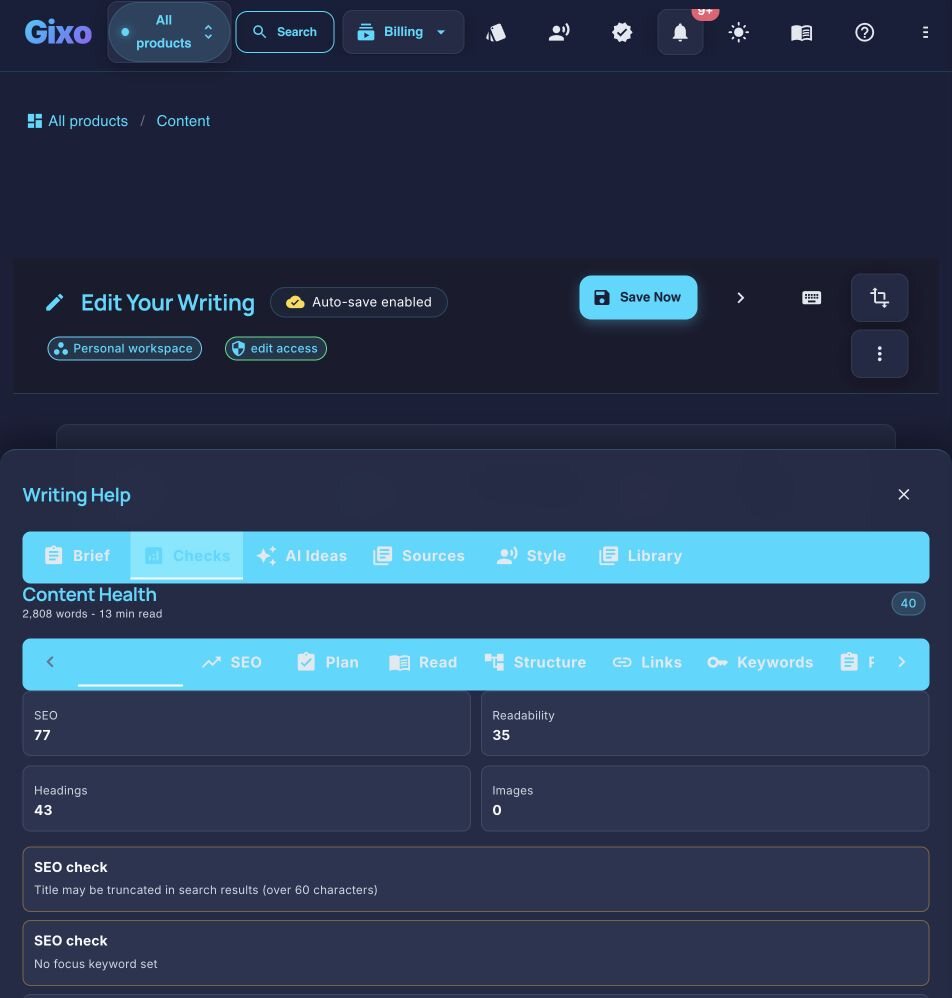
Generating an SEO article from a keyword in Quill means using that keyword as one input to a structured brief, retrieving relevant web sources, and producing a cited draft with headings and natural keyword placement. Quill then checks readability, structure, brief coverage, links, answer readiness, and overlap with your own library. It does not provide live SERP rankings, keyword volume, difficulty, or competitor-gap data, and editors still verify claims and review destination metadata.
What is an SEO article generator?
An SEO article generator turns a keyword, brief, and source material into a structured draft for editorial review. Quill focuses on content production and deterministic checks rather than replacing a SERP database, crawler, or rank tracker.
The phrase covers two unrelated tools — this is the article kind
Search "SEO generator" and the results split into different tool families. Some create markup such as meta tags, JSON-LD, sitemaps, robots files, or slugs. Others help create the article itself. Gixo Quill is the article kind: it generates structured, source-grounded drafts and keeps editorial checks around them. Its delivery workflow can generate and edit destination metadata; the receiving CMS remains responsible for generic page schema and the final published values.
What an SEO generator actually automates
Automated here: retrieving relevant web sources, building a structured draft, grounding it in those sources, attaching citations, applying the chosen format and target length, and running deterministic checks for structure, readability, links, brief coverage, answer readiness, keyword placement, and overlap with your own library.
Not automated, and worth saying plainly: choosing which keyword deserves an article, supplying first-hand experience or proprietary data, verifying that every generated claim is true, earning links, and repairing whatever is slow or unindexable on the site the article lands on. A generator moves the drafting cost. It does not move domain authority, and an article published on a domain that has none will not rank because its outline was good.
What happens when you generate an SEO article from a keyword?
Gixo treats the keyword as one part of the assignment, alongside the audience, intended search job, required topics, source policy, and editorial brief.
Enter the target keyword, then define the audience, likely intent, required questions, and trusted context. Quill does not infer measured competition from the keyword alone.
The selected format and brief guide an H1-H4 outline. Review the proposed structure and add any required subtopics before generating the full draft.
Quill asks the model to place supplied keywords naturally and reports occurrences and density for review. It does not infer an ideal percentage or related-term set from live ranking pages.
Quill grounds the draft in retrieved or supplied sources and keeps those sources visible. A human still verifies source-critical claims before publication.
Review keyword placement, headings, readability, brief coverage, links, answer readiness, and content-library overlap in the workbench.
After human review, generate or edit metadata in the delivery workflow, publish directly to WordPress or Ghost, hand a draft to Medium, or export. Confirm the final values in the destination before going live.
Why starting from a keyword works
The Traditional SEO Content Workflow Is Broken
Most content teams follow a fragmented process: a keyword researcher identifies targets in one tool, a content strategist creates an outline in a document, a writer drafts the article in another tool, and an SEO specialist optimizes it in yet another platform. Each handoff introduces delays, miscommunication, and quality loss. By the time the article is published, it has passed through four tools and three people, taking days or weeks for a single piece.
Gixo connects source research, outlining, writing, deterministic checks, editorial review, delivery metadata, export, and supported publishing in one workspace. Keyword selection, competitor research, factual verification, original experience, and final destination review remain deliberate inputs or review steps rather than hidden automation.
A Structured Brief Turns Research into a Draft
If external SERP or competitor research matters, add its conclusions to the Quill brief as required topics, questions, sources, and exclusions. Quill can then check whether the generated draft covers that brief without claiming it collected ranking data itself.
Strategies that work
SEO Generator: Keyword to Review-Ready Article in 4 Steps
State the keyword, audience, intent, required questions, and any external research conclusions.
Review the proposed structure, target length, and required coverage before generation.
Generate a source-grounded draft with citations, then inspect content-health and workbench checks.
Verify claims, review metadata in the delivery workflow, then publish to WordPress or Ghost, hand a draft to Medium, or export.
Tips for better results
How does Quill's keyword-to-article workflow compare to manual work or a generic prompt?
| Workflow factor | Gixo Quill | Manual Process | Generic Prompt |
|---|---|---|---|
| Keyword research data | External input required | Researcher gathers it | Tool- and mode-dependent |
| Deterministic SEO checks | Built in | Manual or separate tool | Prompt-dependent |
| Grounding and citations | retrieved source set and citations attached | Manual sourcing | Tool- and mode-dependent |
| Heading structure | Format-guided, then reviewed | Manual planning | Prompt-dependent |
| Meta descriptions | Generated or edited in delivery workflow | Manual writing | Prompt-dependent |
| CMS publishing | WordPress/Ghost direct; Medium draft | Manual upload | Copy-paste |
Frequently Asked Questions
Inside Quill
Review concrete content and SEO signals before delivery
Updated