Gixo Quill · content guide
Technical SEO
Technical SEO is everything that determines whether a search engine can crawl, render, index and understand your pages. It rarely makes mediocre content rank — but technical failures routinely stop good content ranking at all, which is why it is checked first.
What your plan includes. Writing, checks, exports, public share links and publishing to WordPress, Ghost and Medium are on every plan, from $10 per seat a month. Comments and Brand Voice need Professional; Brand Kit and bulk need Business.
What it covers, roughly in order of consequence
- Indexability. Robots directives, noindex tags, canonical tags. A wrong canonical or a stray noindex removes a page entirely — the highest-consequence failure and the easiest to miss.
- Crawlability. Internal linking, sitemaps and crawl budget. A page nothing links to is a page that gets found late or not at all.
- Rendering. Whether content exists without JavaScript execution. Client-rendered content is crawled less reliably than server-rendered.
- Duplication. The same content on several URLs splits signals. Parameters, trailing slashes and host variants are the usual culprits.
- Structured data. Schema that helps engines understand what a page is, and increasingly what to quote from it.
- Core Web Vitals. Real, but a tiebreaker. Fixing them will not rescue a page that is not indexed.
Where to look first when something is not ranking
| Symptom | Usual cause | Where to check |
|---|---|---|
| Page not in the index | noindex, canonical pointing elsewhere, or blocked | Search Console URL inspection |
| Indexed but no impressions | Content or intent mismatch, not technical | Query data, then the ranking pages |
| Wrong page ranking | Duplication or cannibalisation | Site search for the query |
| Crawled late or never | No internal links pointing to it | Internal link report |
| Rich result not showing | Invalid or missing structured data | A schema validator |
How Gixo Quill handles this
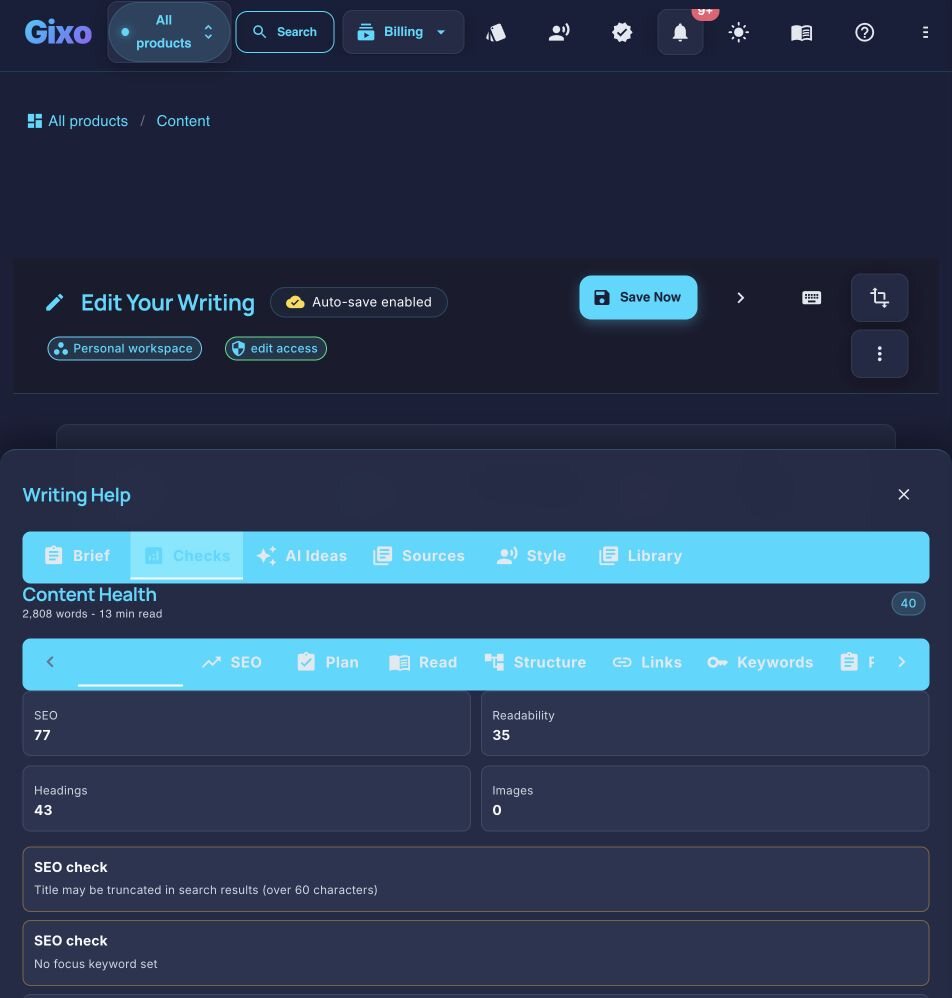
Quill's contribution is content-side rather than site-level: it produces a structured HTML body and keeps deterministic content checks around the draft. Generic Article, FAQ and HowTo schema is added in the receiving CMS; Quill's deterministic schema generation is limited to Product/Offer markup for product descriptions. Rendering, sitemaps, canonicals, crawl budget and final schema deployment sit with the destination platform.
Frequently asked questions
What is technical SEO?
Everything determining whether a search engine can crawl, render, index and understand your pages — indexability, crawlability, rendering, duplication, structured data and performance.
What matters most in technical SEO?
Indexability. A wrong canonical tag or a stray noindex removes a page from search entirely, which outweighs every performance optimisation you could make.
Do Core Web Vitals affect rankings?
They are a genuine but modest factor, best understood as a tiebreaker between comparable pages. They will not rescue a page that is not indexed or does not match intent.
How often should I run a technical audit?
A full audit a couple of times a year, plus checks after any platform migration, template change or URL structure change — which is when most technical damage actually happens.
Is technical SEO enough to rank?
No. It removes obstacles rather than creating demand. Technical work makes good content rankable; it does not make weak content rank.
Related content guides
Start with structured content, then finish technical SEO in the CMS
Quill produces a structured body and can check supplied JSON-LD; the receiving platform remains responsible for rendering, metadata, generic schema, canonicals, sitemaps and crawlability.
Inside Quill
Review concrete content and SEO signals before delivery