
Free content health checker
Paste your article and get a deterministic report in seconds: a 0–100 health score, SEO checks, six readability indices, a publish-readiness checklist, keyword placement, and a link audit — the same rule set Gixo Quill runs inside the paid workspace.
How to use this tool
Who it is for
Editors and content teams doing a repeatable mechanical pre-publish check.
Input
HTML or plain text up to 100,000 characters, plus the title, meta description, content type, and target keywords you want checked.
How it works
Fixed thresholds and formulas inspect structure, readability, keyword placement, links, and publish-readiness signals. The tool does not ask an AI model to grade the draft.
What the output means
The report identifies which deterministic checks passed or failed. A higher score means fewer configured mechanical issues; it does not predict rankings or reader response.
Limitation
It cannot establish factual correctness, originality, usefulness, search demand, or whether the argument will persuade a reader.
Data-handling boundary
Submit only material you are authorized to process. Review the Gixo Privacy Policy for request and service-data handling; do not treat this public checker as a confidential-data room.
Illustrative input
Illustrative: an HTML article with one H1, three H2 sections, two images, internal and external links, a proposed title and meta description, and the target phrase “content operations.”
Illustrative output
Illustrative: the report can flag a missing image alt attribute, a title outside the configured range, a broken in-page anchor, and the target phrase missing from the first paragraph. This is an example of report shape, not a benchmark result.
Ask next: Which failures are mechanical, which require editorial judgment, and which source-critical claims still need human verification?
A content health checker is a free, deterministic tool that scores an article 0-100 by running SEO fundamentals, six readability indices (Flesch Reading Ease, Flesch-Kincaid Grade, Gunning Fog, SMOG, Automated Readability Index, and Coleman-Liau), a publish-readiness checklist, keyword placement, and a link audit against the draft's actual HTML or text. It accepts up to 100,000 characters, requires no account or email, and returns the same score every time for the same draft because every check is rule-based rather than AI-judged. Gixo Quill runs this exact rule set inside its paid content workflow.
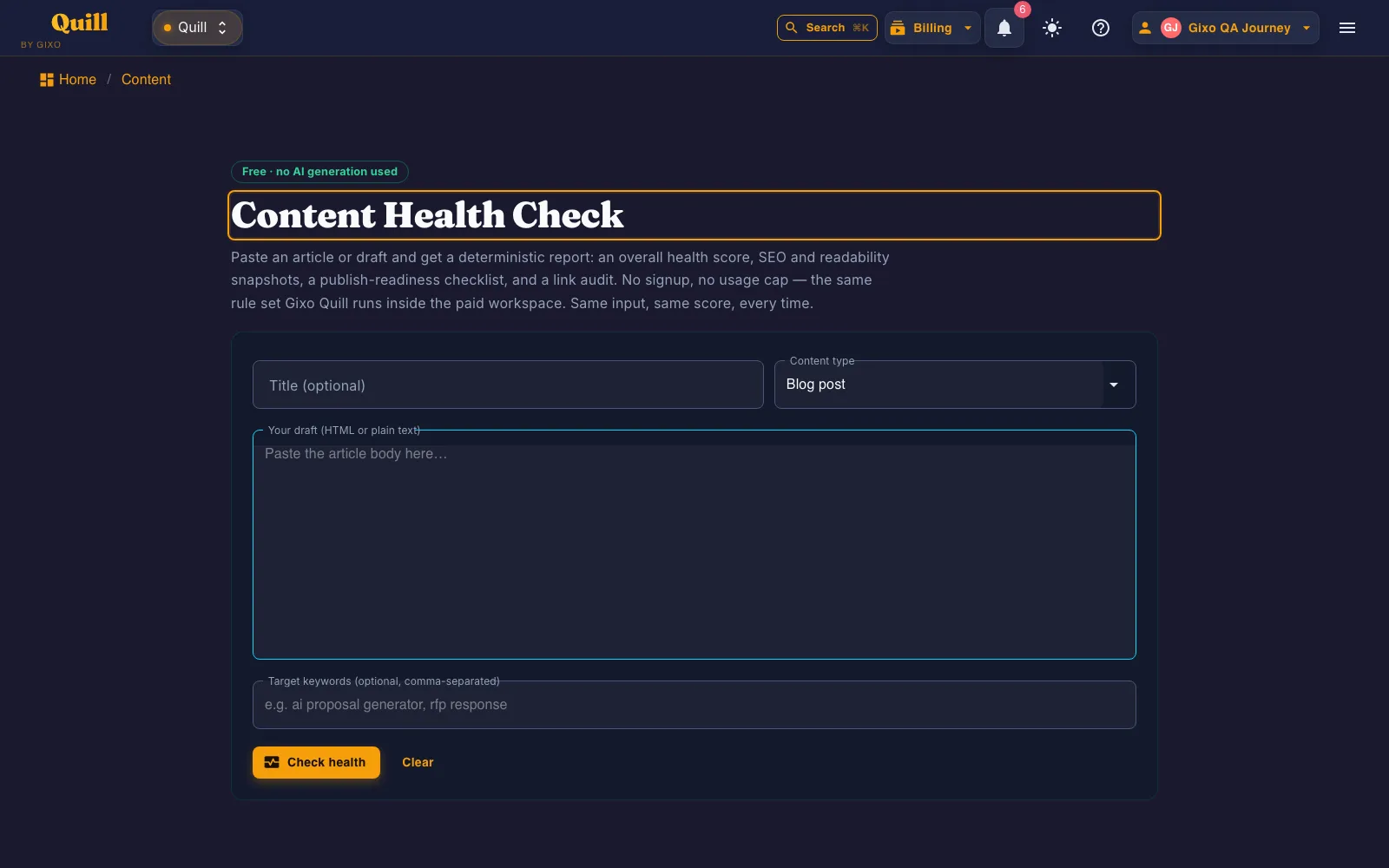
What does a content health checker check, from on-page SEO factors and readability to primary keyword placement?
No black box — these are the actual rule sets behind the score.
Why is a deterministic content health checker better than an AI grader?
Most free "content graders" send your draft to a model and return an opinion — different every run, impossible to act on. This checker is a fixed rule set: the same draft always produces the same score, which means the score works as a progress meter. Fix the missing alt text, re-run, and the number moves because the facts moved.
The honest boundary: a deterministic check can tell you a heading is missing, a sentence runs long, or an anchor is broken. It cannot tell you whether your argument is interesting — that stays your job. Use the report to catch configured mechanical failures before publication; it is not a guarantee that every issue will be found. Up to 100,000 characters per check.
When the gaps need new writing, compare Gixo Quill plans for generation across dozens of structured formats, selectable source and evidence controls, writing guidance, collaboration, export, and publishing workflows.
What does a content health checker score, exactly?
| Check category | What it evaluates |
|---|---|
| SEO fundamentals | Title length (30–60 chars), meta description (120–160 chars), focus keyword in title/meta/content/first paragraph, 300-word floor, H2 headings, image presence |
| Readability (6 indices) | Flesch Reading Ease, Flesch-Kincaid Grade, Gunning Fog, SMOG, Automated Readability Index, Coleman-Liau, plus sentence-length distribution and complex-word share |
| Publish-readiness checklist | Exactly one H1, section headings present, alt text on every image, schema markup present, CTA detected, primary keyword in first 350 characters, title/meta in range |
| Structure completeness | Draft matched against blog post / how-to / ultimate guide / comparison / product review structure guide, word-count target band 65–175% of guide target |
| Link audit | Internal, external, and anchor link counts; broken in-page anchors; missing hrefs; orphan risk with zero internal links |
| Keyword placement | Occurrence count, density, and presence in title/first paragraph/headings per target keyword |
| Input limit | Up to 100,000 characters, HTML or plain text, no account or signup required |
Frequently Asked Questions
Inside Quill
Start with the amount of structure you already have
Updated