
How to Make AI Content Rank
Ranking AI-assisted content in 2026 isn't "AI vs. human" — it's a hybrid workflow. AI does what it's good at (structure, a fast first draft, scale); humans do what only they can (strategy, and the first-hand experience and expertise that earn rankings). The single mindset shift that makes it work: treat the AI draft as 40% scaffolding, not 90% done. Here's the 5-stage workflow, the stage that decides whether you rank, and how to scale it.
To make AI content rank, run it through a 5-stage AI + human hybrid workflow — human-led strategy, an AI-assisted outline, an AI-led first draft, human-critical enhancement, and human-led publication — treating the AI draft as a 40% scaffold, not a finished page. The single mindset shift that decides whether it ranks: editing a draft isn't enough, it must be enhanced with first-hand experience, original data, and a point of view AI can't supply. Google doesn't demote AI assistance — it demotes unhelpful, mass-produced content, so content that clears its "helpful, people-first" bar ranks on the same terms as anything else.
The standard you’re optimizing for: Google’s guidance is to create “helpful, reliable, people-first content” that shows first-hand experience and expertise (E-E-A-T) — a bar AI can help you reach faster but cannot clear on its own. — Google Search Central
How do you make AI content rank?
Google rewards helpful, people-first content regardless of how it was made — but the "by people" part is the catch. Content that exists only to rank, with no real value, is exactly what gets demoted. A hybrid workflow resolves this: AI provides the efficiency, the human provides the purpose and value.
The mistake that sinks most AI content strategies is treating the AI draft as nearly finished — a light proofread away from publishing. It isn't. A ranking-grade strategy treats the draft as a 40% scaffold the human then builds the actual house on: the experience, the data, the voice, and the verification that AI can't supply. Get that division of labour right and you scale quality; get it wrong and you scale spam. (And no AI writer is error-free — you verify before you publish, every time.)
The 5-stage AI + human hybrid workflow
A repeatable assembly line: each stage has a primary operator — a human or the AI — with the other in support.
Keyword research, competitive analysis, search intent, and the unique angle. AI can help brainstorm topic clusters or analyze the SERP, but the strategic decisions are yours — this is where originality is set.
Write a detailed prompt — target keyword, audience, the questions to answer, the E-E-A-T elements to hit — and have the AI draft an outline (H2s, H3s, talking points). Then you critique and sharpen it. A human review at the outline stage saves hours of editing later.
The AI turns the approved outline into a well-structured first draft. This is the efficiency gain — and the only stage where speed lives. Treat the output as a 40% scaffold, not a finished page.
The make-or-break stage. A subject-matter expert and editor fact-check, rewrite for voice, and — the part that ranks — inject first-hand experience, original data, branded examples, and a distinct point of view. This is where E-E-A-T is baked in. (More below.)
Format in your CMS, add internal links, set metadata and on-page SEO. After publishing, watch rankings, traffic, and engagement — and feed what you learn back into strategy. The loop closes.
What are the 5 stages of the AI + human hybrid workflow?
| Stage | Who leads | What happens |
|---|---|---|
| 1. Strategy & ideation | Human-led | Keyword research, competitive analysis, search intent, and the unique angle |
| 2. Structuring & outlining | AI-assisted | AI drafts an outline (H2s, H3s) from a detailed prompt; human critiques and sharpens it |
| 3. First-draft generation | AI-led | AI turns the approved outline into a structured first draft — a 40% scaffold, not a finished page |
| 4. Enhancement & expert review | Human-critical | Subject-matter expert fact-checks, rewrites for voice, and injects first-hand experience, original data, and POV (the make-or-break stage) |
| 5. Publication & optimization | Human-led | Format in CMS, add internal links and metadata, then monitor rankings and feed results back into strategy |
What's the difference between editing and enhancing AI content?
Most AI content fails here — it gets edited when it needs to be enhanced. Editing polishes the scaffold; enhancement builds the house.
| Editing (not enough) | Enhancement (what ranks) |
|---|---|
| Corrects grammar and spelling | Rewrites for voice and flow |
| Checks for factual accuracy | Adds unique insights and opinions |
| Fixes awkward phrasing | Injects first-hand experience (the "E" in E-E-A-T) |
| Ensures the outline is followed | Adds original data, quotes, or case studies |
| Formats for readability | Strengthens arguments with better examples |
How do you write an AI prompt that produces rankable content?
The quality of the AI's output is a direct reflection of the input. "Write an article about SEO" yields generic, unrankable filler. A masterful prompt acts as a detailed brief and should include:
- Role & persona — "Act as a senior SEO strategist with 15 years of experience."
- Objective & audience — who it's for and what it must accomplish.
- Target keyword & search intent — the query and the intent behind it.
- Structure & constraints — required sections, what to include, what to avoid.
- E-E-A-T directives — e.g. "frame the advice from a position of trusted authority; flag where first-hand testing is needed."
The better the brief, the less ambiguity the AI has and the more your enhancement stage can focus on value instead of cleanup.
Scale it: topical-authority clusters — and what is a content pillar?
Once the workflow is solid, the hybrid model lets a small team build the footprint of a much larger one. Topical authority — the signal that your site is a comprehensive expert on a subject — is built fastest with a cluster:
- A pillar page — the definitive guide to the topic.
- Cluster content — "what is X," "how to use X," "best tools for X," "X vs Y," "advanced X."
- Strategic internal linking — cluster pages link up to the pillar; the pillar links down to each. A siloed structure that signals deep expertise.
Use AI to brainstorm the whole cluster, prioritize by demand, run each piece through the 5-stage workflow (experts can enhance related articles efficiently), and interlink meticulously. That's how you cover a topic comprehensively, with E-E-A-T-rich content, faster than a purely manual process allows.
Where an AI writer fits in the ranking workflow
A tool's job in this workflow is the AI stages — outline and first draft (steps 2–3) — and taking the dangerous parts off your plate so your people spend their time on steps 1 and 4, where the ranking value actually comes from.
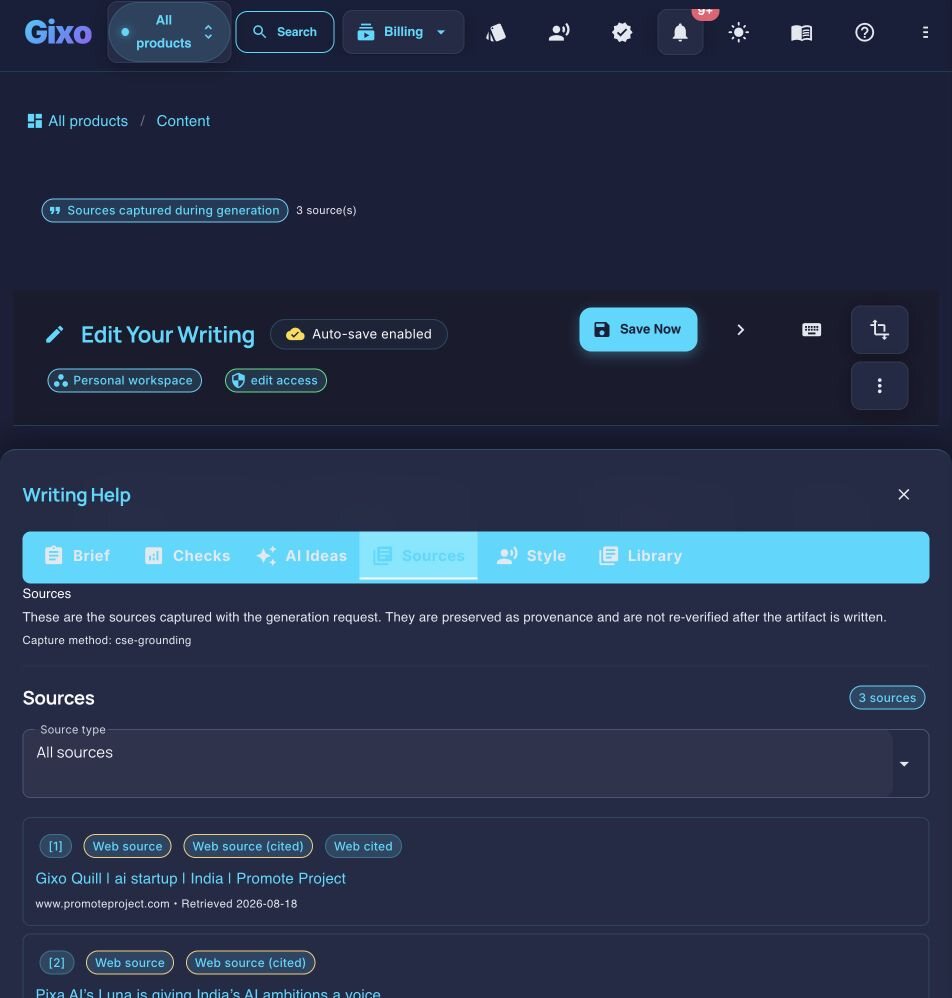
Gixo Quill is built for that: it grounds drafts in provided context and retrieved sources, keeps citations and the source set inspectable, produces structured content, and gives you a quality check before you ship. What it deliberately does not do is the enhancement stage — the experience, the original data, the point of view, and the final verification. That's the human-critical work, and it's exactly the work that earns the ranking. Generic page schema is added and validated in the CMS, except for Quill's deterministic Product/Offer JSON-LD path for product descriptions. No AI writer is error-free; the tool makes the AI stages traceable, and you verify before you publish.
Frequently asked questions
Inside Quill
Inspect captured sources beside the working draft
Updated