
Is AI Content Safe for SEO? Does It Rank on Google?
Short answer, as of June 2026: yes — AI-assisted content ranks, and it's safe, but only when it meets the same bar Google holds all content to: helpful, accurate, and trustworthy. Google doesn't penalize content because AI was involved; it demotes content that's unhelpful, inaccurate, or mass-produced to game rankings. The risk isn't the tool — it's publishing unedited, ungrounded AI at scale. Here's how Google actually evaluates it, and the workflow that keeps it on the right side of the line.
Yes — AI content is safe for SEO and ranks on Google in 2026, as long as it's genuinely helpful, accurate, and reviewed by a human. Google has no "AI penalty": it rewards high-quality content "however it is produced," and demotes only content that's unhelpful, inaccurate, or mass-produced to game rankings. The risk is unedited AI at scale — not the tool.
Straight from the source: Google’s published guidance on AI-generated content says it focuses on “rewarding high-quality content, however it is produced,” while using automation — including AI — to generate content primarily to manipulate rankings breaches its spam policies. The safety question turns on quality and intent, not the tool. — Google Search Central
The short answer
The question in 2026 isn't whether to use AI in content — it's how to use it safely. Google's official, repeatedly-stated stance is that it rewards "helpful, reliable, people-first content," regardless of how it was produced. An excellent, insightful article written with AI assistance can and will outrank a thin, superficial article written entirely by a human.
What Google penalizes is the output, not the tool: low quality, factual inaccuracy, lack of originality, and content whose primary purpose is manipulating rankings — all common failure modes of unedited, mass-produced AI. So "is AI content safe for SEO?" has a precise answer: it's safe when a human-in-the-loop process makes it genuinely better than what's already ranking, and dangerous when AI is treated as a finished product instead of a first draft.
What separates safe AI content from AI content Google demotes?
Google evaluates the output, not the tool — none of these rows ask "was AI used?"
| Factor | Safe (ranks) | Risky (gets demoted) |
|---|---|---|
| Human review | Expert fact-checks & enriches every draft | Auto-published with no human in the loop |
| Purpose | Genuinely helps the reader | Mass-produced to manipulate rankings (scaled content abuse — a named Google spam policy) |
| Accuracy | Claims verified against real sources | Hallucinated stats, wrong dates, invented sources |
| Originality | Adds new data, experience, or insight | Rehashes what already ranks, just reworded |
| E-E-A-T | Named, credentialed author; first-hand experience added | Anonymous, no experience, "AI-only" text |
| Completeness | Fully answers the query | Thin, padded to hit a word count |
| The Google signal | Rewarded by the Helpful Content System | Silently demoted (or manually actioned) by it |
Does Google penalize AI-generated content?
Two frameworks govern this, and neither is "is it AI?"
A site-wide signal that rewards content where visitors feel they had a satisfying experience, and demotes content that doesn't deliver on its promise. It is origin-agnostic — it doesn't care whether a human, an AI, or both wrote the page; it cares whether the page fulfils the searcher's intent.
Experience, Expertise, Authoritativeness, Trust — the model Google's quality raters use. AI has no first-hand Experience and can only simulate Expertise by recombining existing text. Trust — accuracy, honest sourcing, no fabricated facts — is the foundation. The human's job is to supply the E-E-A-T the model can't.
What gets AI content demoted in Google search?
The penalties are real, but specific. AI content gets demoted when it shows the signals of low-effort, manipulative publishing:
- Scaled content abuse — generating many pages primarily to manipulate rankings, with little original value. (This is a named Google spam policy, and it's where pure-automation pipelines die.)
- Factual inaccuracy — hallucinated stats, wrong dates, invented sources. For a search engine whose mission is reliable information, this is fatal to Trust.
- Lack of originality — text that's technically unique in wording but just rehashes what already ranks, adding no new data, experience, or insight.
- Thin, unsatisfying experience — content that doesn't answer the query completely, padded to hit a word count.
The pattern is consistent across real outcomes. A B2B team that runs AI through expert briefs and subject-matter review, adding proprietary data and named expert authors, ranks for hard long-tail terms in months. A retailer that uses AI to turn structured product data into unique, genuinely useful descriptions — with spot-check QA — lifts organic traffic without tripping the scaled-content policy, because each page is distinct and helpful. A pure-automation affiliate network that feeds keywords to an API and auto-publishes with no review spikes briefly, then gets demoted (or manually actioned) once the Helpful Content System catches up. Same tool, opposite results — the difference is the human-in-the-loop.
How to write SEO content with AI: the safe AI SEO content workflow — where you let AI write, and where you don't
Treat AI output as raw material, not a finished product. Human expertise enters at the critical checkpoints; the value is added in steps 1, 3, and 5.
A person does the keyword research, reads the intent, and defines the article's goal and unique angle in a detailed brief. This is where originality is decided.
Generate an outline and rough draft from the brief. Speed lives here — and only here.
A subject-matter expert fact-checks every claim, removes inaccuracies, and adds the things AI can't: first-hand experience, proprietary data, original insight. Gate: does it now have real E-E-A-T? If not, back to review.
An editor refines voice and flow; SEO ensures the structure, headings, and targeting are sound — and that the page is parsable enough to be cited.
A last gatekeeper checks quality, coherence, accuracy, and brand alignment before anything ships.
Ship it, then watch performance and engagement — the real test of whether it was helpful.
And now there's a second audience: Google's AI Overviews
With AI Overviews (formerly SGE) at the top of results, you're no longer only competing for a blue link — you're competing to be cited as a source inside Google's AI answer. That raises the premium on exactly the things above: clear headings, questions answered directly, and unique data, statistics, or insight the model sees as worth citing. The paradox is that the best way to "optimize" for Google's AI is to build content with E-E-A-T so high it stands out as a pillar of trust in a sea of synthesized text — and to make it structured and verifiable enough that a machine can parse and quote it cleanly.
Where tooling helps — and where it can't
A tool can't give your content first-hand experience or human expertise. It can take the dangerous parts off your plate so your people spend their time on the parts that actually move E-E-A-T.
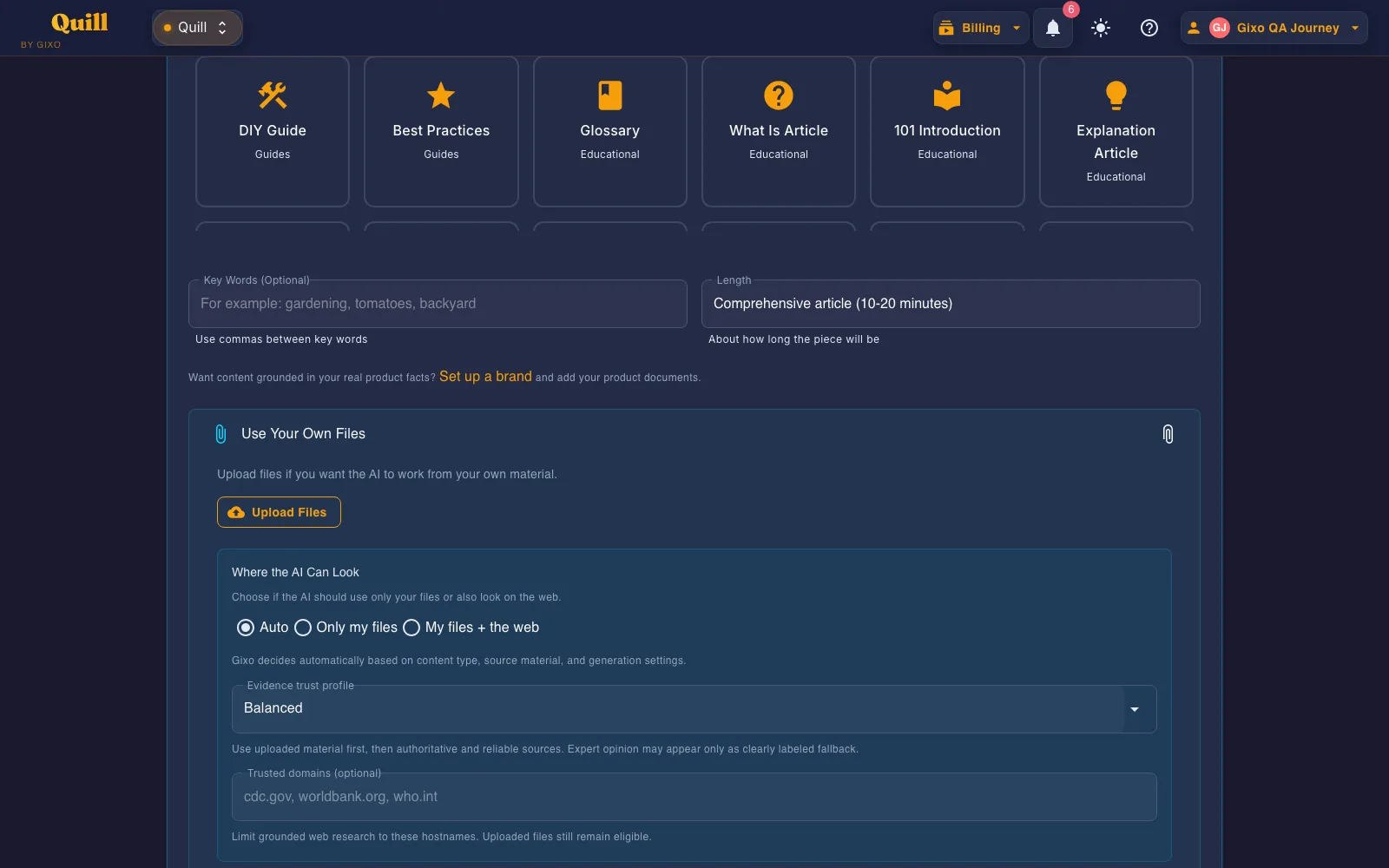
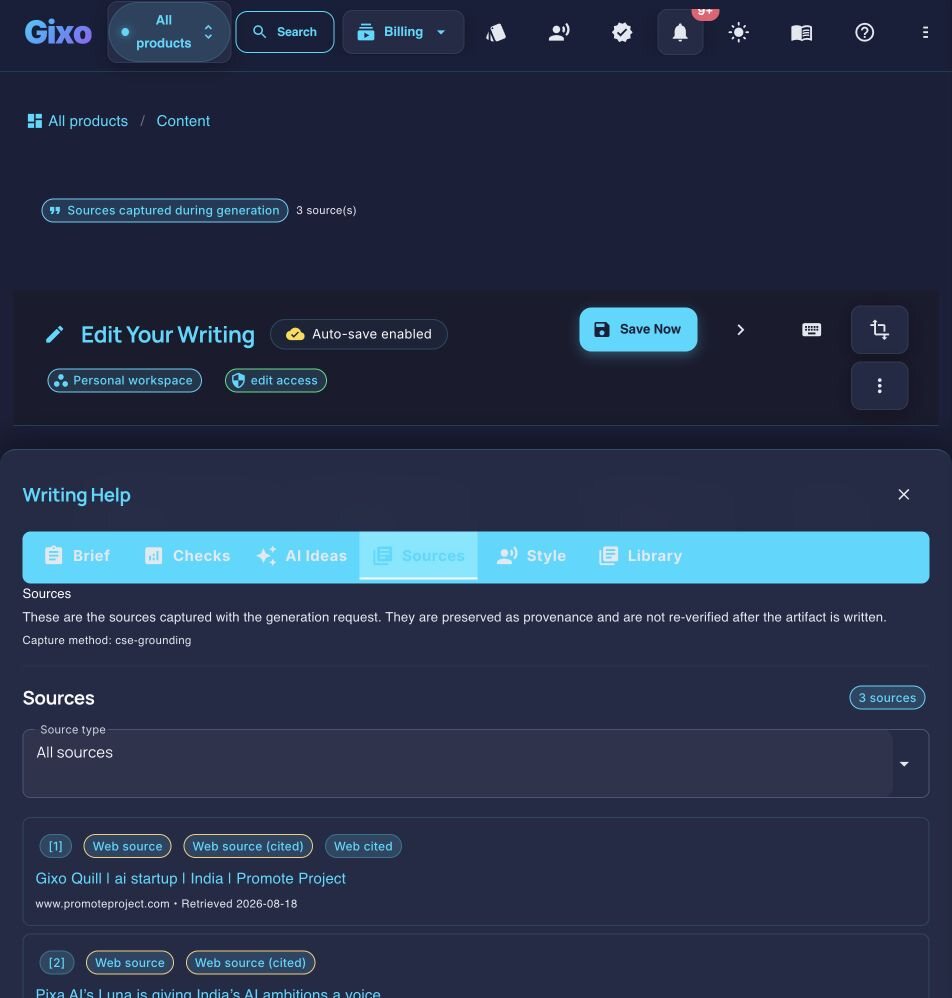
The single biggest SEO risk with AI is an unsupported figure or source that wrecks Trust. Gixo Quill grounds generation in provided context and retrieved Luna sources, then keeps the source set and citations visible. That makes review traceable, but it does not guarantee the model never invents or misstates a fact — editors still verify every claim.
Clear structure, visible sources, semantic HTML, and appropriate structured data make a page easier to inspect and parse. Quill generates structured content and detects generic schema already present; editors add and validate Article, FAQ, or HowTo schema in the CMS. Product descriptions are the exception: Quill can build deterministic Product/Offer JSON-LD from entered product data.
The low-quality signals Google demotes are catchable in advance. Gixo's content quality scorecard and health checker flag the readiness gaps — thin sections, missing structure, weak coverage — so you fix them before they cost you, not after.
It does not replace your subject-matter experts. Genuine experience, expert nuance, original data, and a named accountable author are the human's job (steps 1, 3, 5 above). Any tool that claims to make AI content "automatically E-E-A-T safe" is selling the thing Google specifically checks for.
Myths that get sites demoted
- "Google penalizes all AI content." No. It forbids spam, not AI. It rewards expert-vetted, original output whatever tool made it.
- "My AI content is undetectable, so I'm fine." Irrelevant — Google demotes on quality signals (thin, inaccurate, unhelpful), not on "is this AI?" Detection isn't the threat; low quality is.
- "AI replaces my writers and experts." It replaces the blank page, not the expertise. Remove the human and you remove the E-E-A-T.
- "Publishing more, faster is how you win." Volume without quality is the definition of scaled content abuse — the fastest route to a site-wide demotion.
- "An 'edited by a human' disclaimer makes it safe." A label isn't a process. Safety comes from the actual editing, fact-checking, and enrichment — not from claiming it.
Frequently asked questions
Inside Quill
Inspect captured sources beside the working draft
Updated