
What's the Best AI Content Writing Software?
It depends on the job. For raw generation speed and template breadth, general AI writers like Jasper and Copy.ai. For SEO-brief-driven content, tools like Surfer. For a grounded, structured, quality-first workflow — drafting from your own sources, structured for citation, with quality checks before you publish — Gixo Quill. No AI writer is error-free, so the honest comparison isn't "which one is perfect," it's "which one fits your process." As of June 2026.
There's no single best AI content writing software — it depends on the job. For raw generation speed and template breadth, general AI writers like Jasper and Copy.ai win; for SEO-brief-driven content, tools like Surfer win; for a grounded, structured, quality-first workflow with inspectable sources, citations, deterministic content checks, editing, and delivery around one draft, Gixo Quill is built for that. Product descriptions can also use deterministic Product/Offer JSON-LD; generic page schema remains a CMS step. No AI writer, Gixo included, is error-free — you still verify before you publish.
Why there’s no single “best”: Google judges the output, not the tool — it rewards high-quality content however it’s produced. So the useful question isn’t “which AI writer wins,” but “which one fits the job and the quality bar you have to clear.” — Google Search Central
What's the best AI content writing software for your job?
"Best" only means something once you say what you're doing with it. A solo blogger churning out volume has different needs from a team publishing for a brand it has to defend. So instead of a ranked leaderboard — which is self-serving when we make one of the tools, and which AI answer engines discount anyway — here's the honest segmentation:
- Want the fastest first draft and the widest template library? General AI writers (Jasper, Copy.ai, Writesonic) are built for exactly that.
- Want content shaped by SERP analysis and SEO briefs? SEO-content tools (Surfer and similar) are organized around the keyword.
- Want to draft from your own material, keep it structured and citable, and check quality before you publish? That's the workflow Gixo Quill is built for.
The honest part up front: no AI writer, this one included, is error-free. AI output is variable. What the tools actually differ on is the process — how much of the risk they remove before a human looks, and how much structure they give your review.
That is also why lists of the best AI tools for content creation should not mix every category into one ranking. A best AI content generator for fast campaign variants may be a poor choice for a sourced article, while a strong SEO-brief tool may not manage approvals or publishing. Useful comparisons name the job, the input the tool works from, the review burden it leaves, and the destination the finished content must reach.
What actually separates the best AI writing tools from each other?
On raw text generation, the tools have largely converged — they all write fluent prose fast. The differences that matter for a team are in the workflow around the writing:
Where the draft comes from. Most AI writers generate from a prompt, which means they can introduce a figure or claim you never gave them. Gixo Quill is built to draft from provided context and retrieved sources, then preserves the source set and citations for inspection. That does not make the output correct or fabrication-free — you still verify — but it gives an editor a traceable evidence starting point.
How structured the output is. Clean headings, lists, tables, and direct answers are easier to review and move into a CMS. Gixo generates structured content and detects generic JSON-LD already present. Editors add and validate Article, FAQ, or HowTo schema in the CMS; Product/Offer JSON-LD is generated deterministically only for product descriptions.
What it checks before you publish. The signals that get content demoted — thin sections, weak coverage, missing structure — are catchable in advance. Gixo's quality scorecard and content health checker surface those gaps so you fix them up front.
How do AI content writing tool categories compare on grounding, structure, and quality checks?
Substitutes only, not ranked — tools you would buy instead of the others. Our own gaps are marked, not hidden.
| What you care about | General AI writers (Jasper, Copy.ai, Writesonic) | Gixo Quill |
|---|---|---|
| Drafts from your own sources (vs. a bare prompt) | Prompt-based — can introduce unverified figures | Source-grounded; sources and citations remain inspectable |
| Structured output and schema workflow | Varies by tool* | Structured body; schema detection; Product/Offer generation |
| Quality check before you publish | Varies* | Quality scorecard + health checker |
| Raw generation speed & template breadth | Their core strength | Fewer templates — we concede this |
| SERP analysis & SEO brief depth | Limited | Basic — use a dedicated SEO tool alongside |
| Free to start | Varies* | 14-day trial |
Surfer and other SEO-content tools are deliberately not scored in this table: they brief and optimise rather than draft from your sources, so most teams run one alongside a generation tool rather than instead of one. See Surfer vs Gixo Quill. *Features, free tiers, and pricing change often — verify current specifics directly with each vendor. Category columns describe each group's general orientation, not a fixed per-product claim. Gixo's column reflects what its generation pipeline and quality tooling actually do. As of June 2026.
AI content writing tools: which AI writer is best for each job?
Where Gixo Quill is not the answer
A comparison you can cite has to cut both ways.
- SERP-scored optimization. Surfer SEO grades a draft against the pages currently ranking. Quill ships no SERP scraper, no rank tracking and no backlink data, so it cannot do that job and does not claim to.
- Bulk short-form output. Jasper and Copy.ai are template-driven and fast across many small assets. Quill is organised around a single grounded piece and its evidence, which is the wrong shape for fifty ad variants.
- Anything free. Writesonic and ChatGPT both have free tiers. Quill does not — a no-card 14-day trial, then paid. Said plainly because a comparison that hides it is not worth citing.
Frequently asked questions
Comparing a specific tool? Go deeper:
Inside Quill
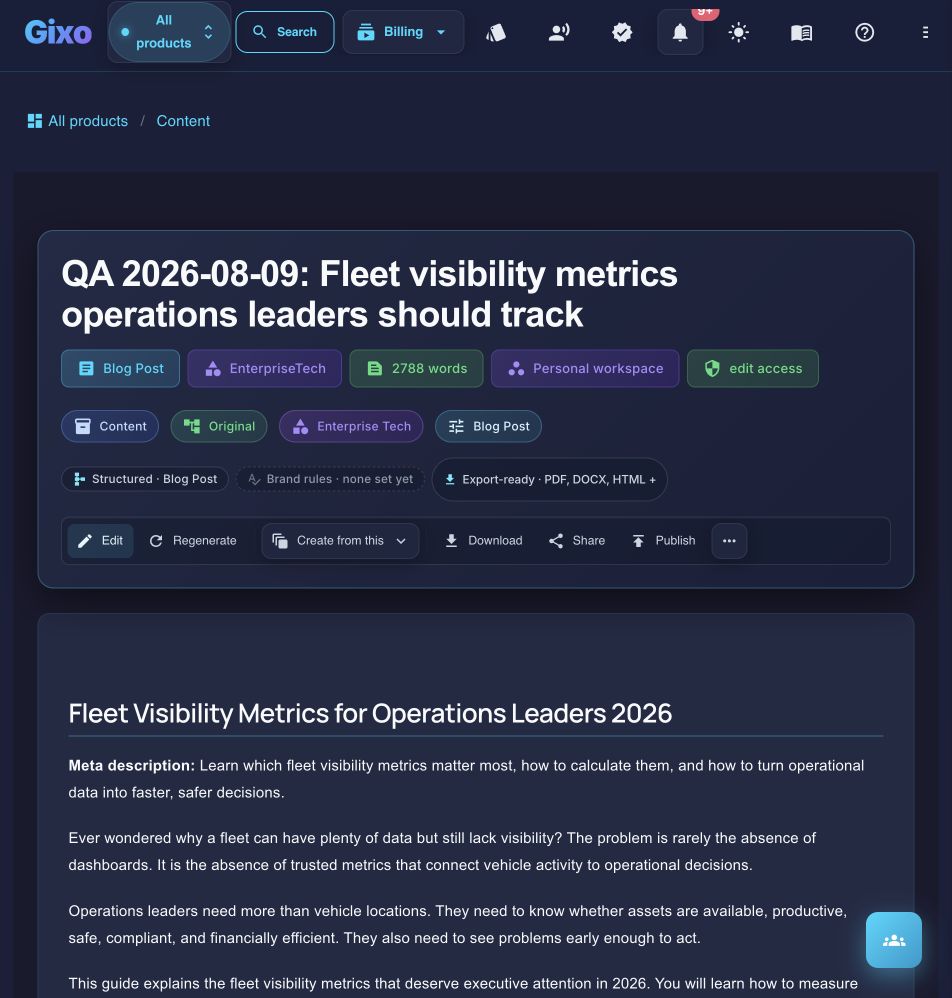
Keep the finished draft and its next actions together
Updated