
AI content governance for brands
AI content governance is the set of policies, workflows, roles, and platform controls that keep brand content accurate, on-voice, source-backed, safe, and accountable as teams scale AI-assisted production.
What your plan includes.Brand Voice is on Professional plans and above — from $79 per seat a month, minimum three seats. Writing, checks, exports, public share links and publishing are on every plan. The 14-day trial works like Starter, so it does not include Brand Voice.
Reviewed 2026
AI content governance is the set of policies, workflows, roles, and platform controls that keep brand content accurate, on-voice, source-backed, safe, and accountable as teams scale AI-assisted production. It rests on four pillars — policy and guidelines, process and workflow, people and roles, and platform and controls — mapped against a risk-tier model (low, medium, high) that decides how much review each piece of content needs. The goal is not to slow teams down but to make the safe path obvious: which sources to use, which claims need review, who approves high-risk content, and what quality gate every piece must clear before publishing.
What is AI content governance, and why does it matter?
AI content can scale output faster than a brand can review it. Without governance, teams publish unsupported claims, inconsistent voice, stale facts, duplicated pages, unclear disclosure, and content nobody owns after it goes live.
Good governance does not slow the team down. It makes the safe path obvious: which sources to use, which claims need review, who approves high-risk content, what the brand voice allows, and what quality gate every piece must clear.
What are the four pillars of AI content governance?
Policy and guidelines
Define acceptable use, prohibited use, disclosure rules, privacy limits, source rules, claim standards, and industry-specific review requirements.
Process and workflow
Create risk tiers, intake rules, evidence requirements, review paths, approval states, revision history, and publishing gates.
People and roles
Assign clear ownership across content, brand, SMEs, legal, compliance, product marketing, SEO, and publishing.
Platform and controls
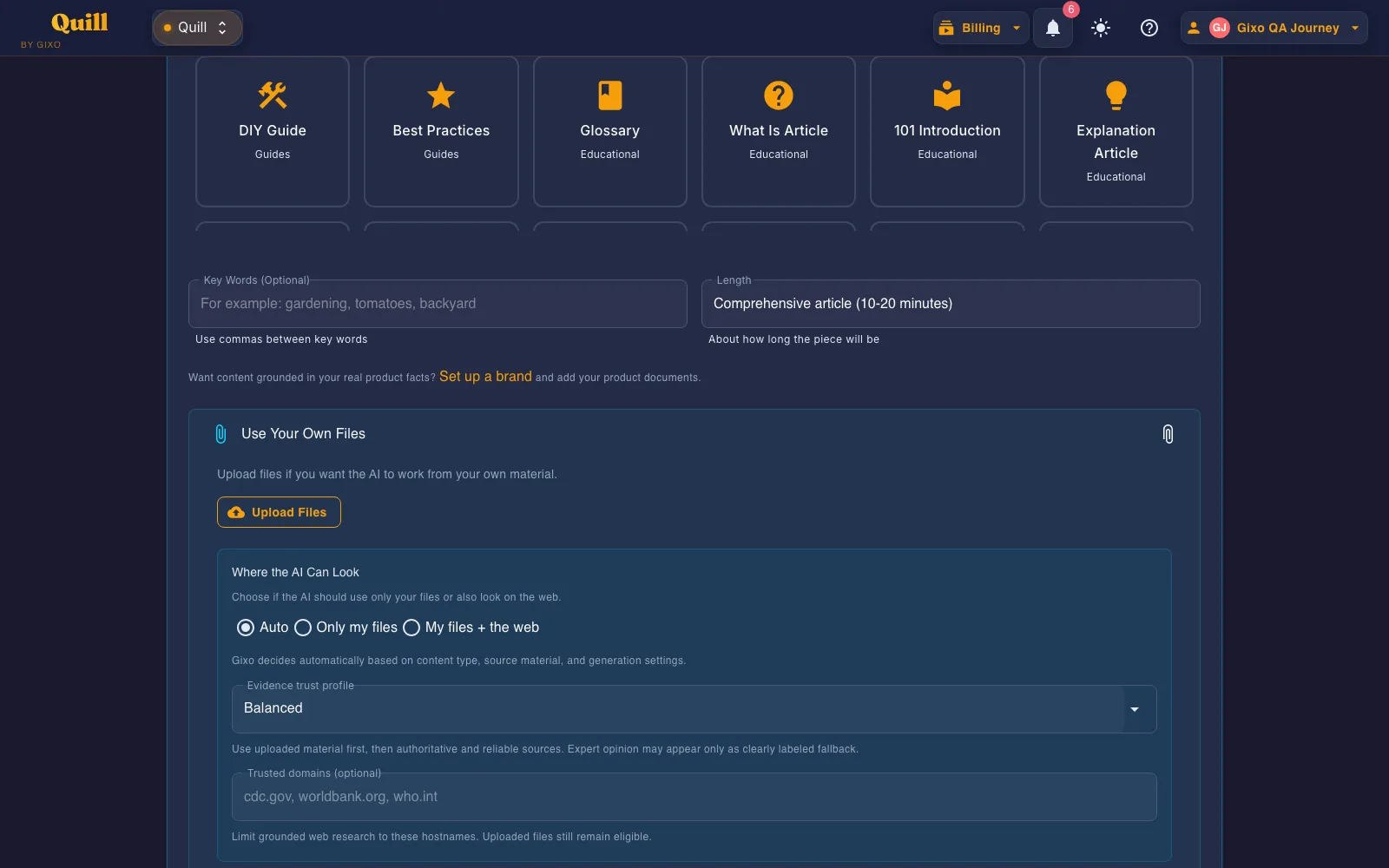
Use tools that preserve source context, brand voice, permissions, comments, versions, references, quality checks, and export or publishing history.
How do you build a risk-tier model for AI content governance?
| Risk tier | Examples | Governance requirement |
|---|---|---|
| Low | Internal drafts, outlines, social variations, non-claim-heavy edits. | Light editorial review and basic quality checks. |
| Medium | Blog posts, landing pages, product education, customer-facing explainers. | Source attachment, brand review, SEO and readability checks, named owner approval. |
| High | Legal, medical, financial, security, compliance, pricing, competitive, or claims-heavy content. | SME review, evidence verification, legal or compliance approval where appropriate, and a documented publish gate. |
What your AI content policy and content guidelines should cover
Allowed and prohibited use
Specify which tasks AI can support and which content types require extra review or cannot be generated without human drafting.
Source requirements
Name authoritative source systems, freshness windows, citation expectations, and rules for conflicting evidence.
Brand voice standards
Define voice, terminology, banned phrasing, claims style, reading level, tone by audience, and examples of approved output.
Review and approval
Map risk tiers to reviewers, approval states, version history, escalation, and publication permissions.
Disclosure and attribution
Clarify when AI assistance should be disclosed and how sources, quotes, data, images, and customer examples are attributed.
Monitoring and remediation
Define how content is audited after publication, how issues are corrected, and how policy changes get rolled into the workflow.
How Quill helps governance show up in the work
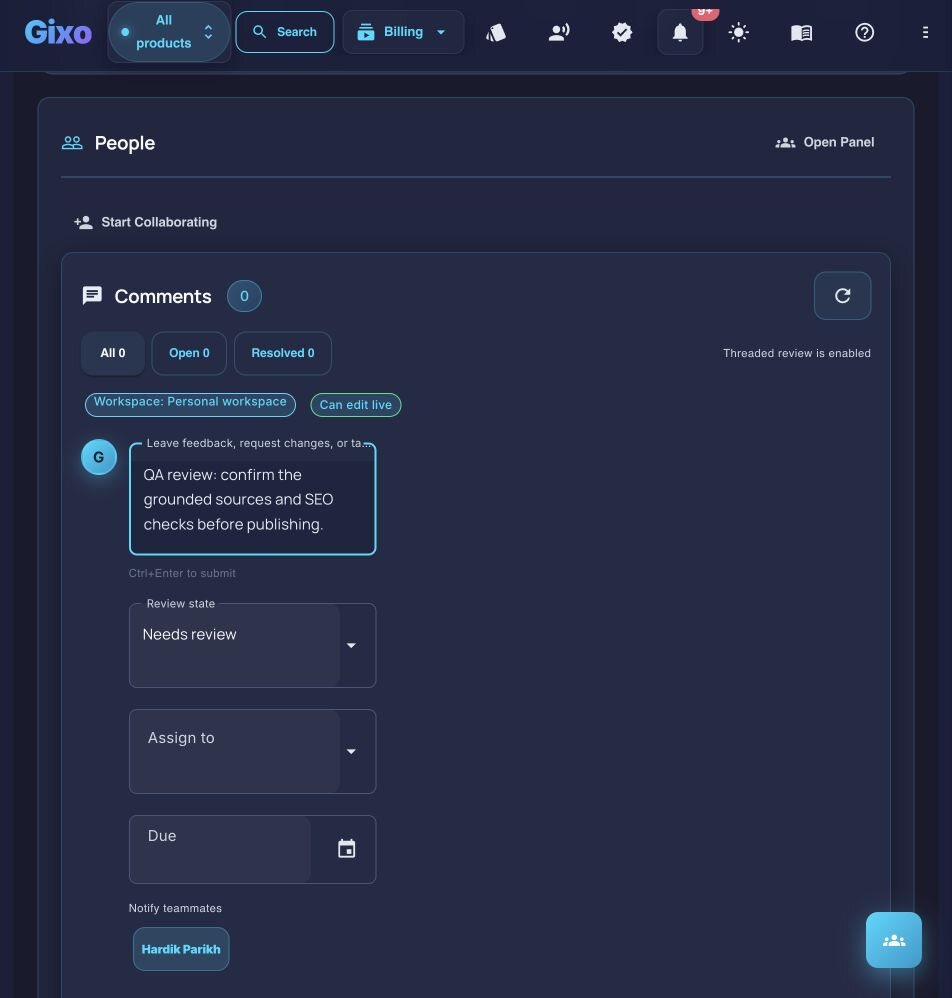
Governance fails when it lives in a PDF nobody opens. Quill brings the governance surface closer to production: source material, brand voice, references, comments, review workflow, versions, quality checks, export, and publishing live around the content itself, mapped to the same three risk tiers (Low, Medium, High) defined above rather than a single one-size-fits-all review step.
That means a team can scale AI-assisted content while still giving reviewers the evidence and control they need to stand behind the final asset.
Frequently Asked Questions
What is AI content governance?
AI content governance is the policy, workflow, role, and tooling system that controls how AI-assisted content is created, reviewed, approved, published, monitored, and corrected.
Who should own AI content governance?
A content or marketing leader often owns the program, with input from brand, legal, compliance, product, SEO, and subject-matter experts. Ownership should be explicit before scale.
Does every AI-assisted page need legal review?
No. Review should match risk. High-risk claims need more scrutiny; low-risk drafts may only need editorial review and basic checks.
What is the first step?
Start with a short acceptable-use policy, a source rule, a risk-tier matrix, and a publish-readiness checklist. Then embed those decisions into the production workflow.
What should an AI content governance policy cover?
Based on this page's own framework: allowed and prohibited use, source requirements (authoritative systems, freshness windows, citation expectations), brand voice standards, review and approval mapped to risk tiers, disclosure and attribution rules, and a monitoring/remediation process for auditing and correcting content after publication.
How does governance actually get enforced day to day, not just written down?
Per this page, governance fails when it only lives in a policy document nobody opens. It needs to be embedded in the production workflow itself -- source material, brand voice, references, comments, review workflow, versions, quality checks, export, and publishing living around the content, not in a separate PDF.
What does AI governance in content workflows actually look like in practice?
In practice it is the four pillars on this page -- policy and guidelines, process and workflow, people and roles, and platform and controls -- applied inside the same tool the content is produced in, with each piece routed through a Low, Medium, or High risk tier rather than treated as a separate compliance step after drafting.
Inside Quill
Prepare review ownership and feedback in context
Updated