
Evidence-grounded AI content workflow
An evidence-grounded workflow makes the source material the center of content production. The model helps draft and structure the piece, but facts come from a curated corpus, retrieved evidence, visible references, and human review.
An evidence-grounded AI content workflow is AI-assisted content production where claims are constrained by a curated source set, retrieved evidence, and reviewer verification instead of relying on the model's memory or general training data. The model drafts and structures the piece, but source material, retrieved facts, visible references, and human review remain the authority. It runs as five stages: curate the corpus, retrieve evidence before drafting, generate with citation discipline, review claims (not just prose), and audit the loop.
What does evidence grounding change about AI content?
AI content gets risky when the model is treated as the source of truth. Evidence-grounded content reverses that relationship. The model is the drafting layer; your documents, research, product facts, customer language, and approved references are the authority.
That distinction matters for SEO, AEO, and GEO because answer engines prefer extractable, specific, source-backed claims. A generic draft can sound polished and still be impossible to trust. A grounded draft gives reviewers something inspectable: the claim, the supporting evidence, the reference, and the decision trail.
What are the five stages of an evidence-grounded AI content workflow?
Use this as the operating model for any high-stakes content program that uses AI.
| Stage | Name | What happens |
|---|---|---|
| 1 | Curate the knowledge corpus | Collect product docs, customer proof, policies, research, competitive context, support language, and approved examples; remove stale, duplicated, or unapproved sources before generation begins |
| 2 | Retrieve evidence before drafting | Pull the most relevant facts, passages, examples, and constraints for each section, attached to the exact claim being written |
| 3 | Generate with citation discipline | Model uses the evidence, preserves distinctions, avoids unsupported claims, and keeps references visible |
| 4 | Review claims, not just prose | Editors verify facts, dates, names, examples, claims, and omitted caveats before style cleanup |
| 5 | Audit and improve the loop | Track weak sources, recurring hallucination patterns, missing brand facts, and reviewer corrections; feed learning back into corpus, retrieval rules, prompts, and quality gates |
Curate the knowledge corpus
Collect product docs, customer proof, policies, research, competitive context, support language, and approved examples. Remove stale, duplicated, or unapproved sources before generation begins.
Retrieve evidence before drafting
For each section, pull the most relevant facts, passages, examples, and constraints. The goal is not more context. It is the right context attached to the exact claim being written.
Generate with citation discipline
Ask the model to use the evidence, preserve distinctions, avoid unsupported claims, and keep references visible. Drafting speed is useful only when the reviewer can inspect why a sentence is there.
Review claims, not just prose
Editors verify facts, dates, names, examples, claims, and omitted caveats. Style cleanup comes after factual review, not before it.
Audit and improve the loop
Track weak sources, recurring hallucination patterns, missing brand facts, and reviewer corrections. Feed that learning back into the corpus, retrieval rules, prompts, and quality gates.
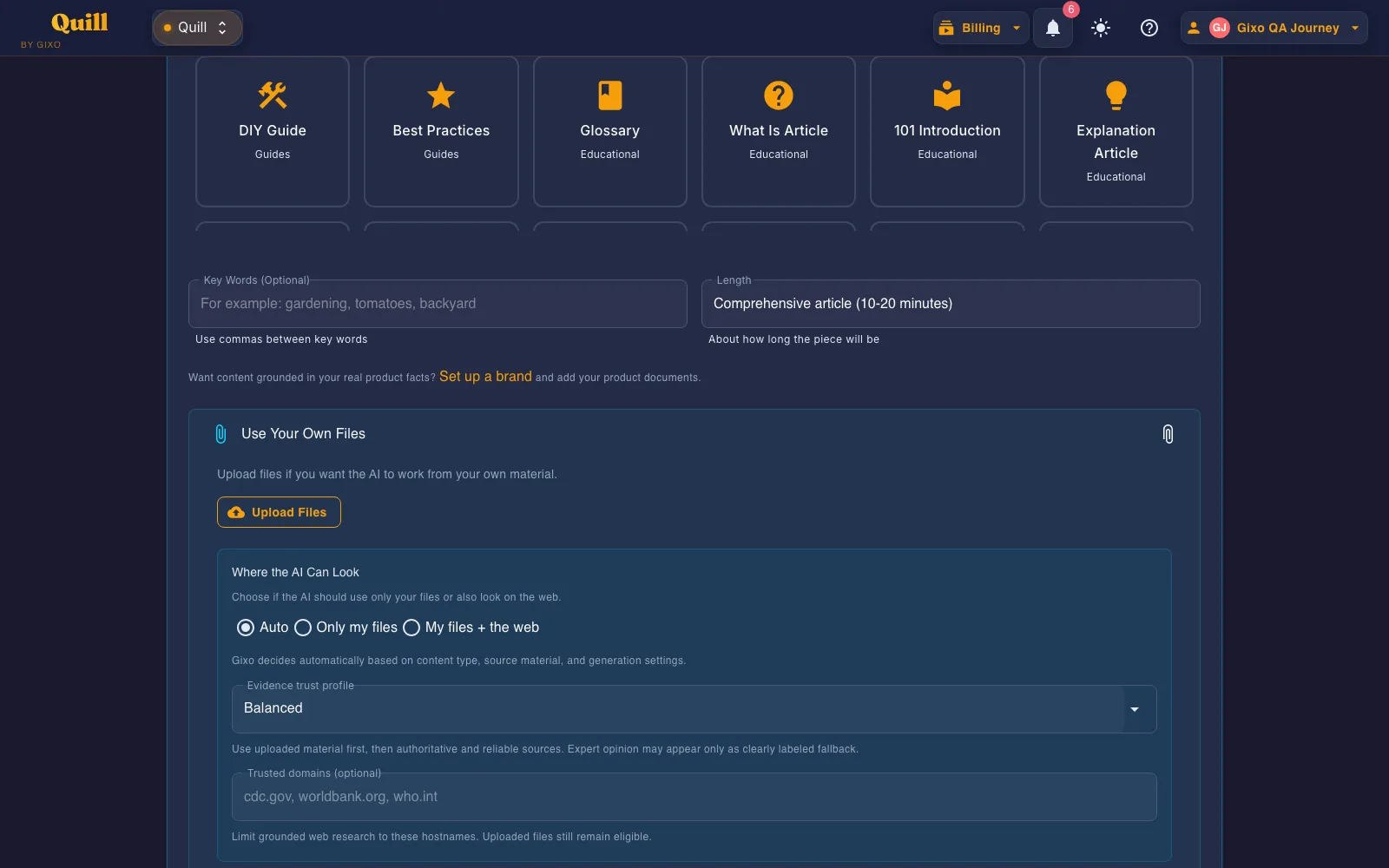
What retrieval looks like before a word is drafted
Stage 1 and 2 of the workflow above, as they appear in Quill: scope the sources, set an evidence trust profile, and name trusted domains before generation starts.
What do you need to decide before scaling an evidence-grounded workflow?
Allowed sources
Define which source types are authoritative, which are background only, and which are never allowed. Product copy, legal claims, pricing, medical, financial, and security content need stricter rules.
Evidence conflict rules
Decide what happens when two sources disagree. Usually the newest approved internal source wins, but regulated claims may require a named owner or external primary source.
Human review thresholds
Not every draft needs the same review depth. Segment content by risk, audience, and distribution channel so editors spend more time where mistakes matter most.
Citation visibility
Choose whether references appear publicly, internally, or both. Even when public citations are not needed, reviewers still need source trails while approving claims.
Freshness policy
Set expiration windows for facts that change, such as pricing, feature coverage, regulations, and benchmarks. A source can be valid and still be too old for the claim.
Publish-readiness gate
Do not let generation equal publication. Require a deterministic quality check and named human approval before the piece ships.
How this maps to Gixo Quill: AI-powered content creation with the sources attached
Quill is built around this source-first model: bring source material, generate a structured first shot, keep evidence and references attached, run deterministic content checks, and finish the piece in the same editor and review workflow. That is different from a blank prompt box, where the burden of sourcing, verifying, editing, and publishing falls back onto the team manually.
The product does not remove human judgment. It gives reviewers a better object to review: a structured draft with visible grounding, brand voice, checks, comments, versions, export, and publishing paths attached.
Frequently Asked Questions
What is evidence-grounded AI content?
It is AI-assisted content where claims are constrained by a curated source set, retrieved evidence, and reviewer verification instead of relying on the model's memory or general training data.
Is this the same as retrieval-augmented generation?
Retrieval-augmented generation is one technical method. Evidence-grounded content is the broader editorial workflow: source governance, retrieval, drafting, citation, review, and continuous improvement.
Do all pages need public citations?
No. Some pages need public references; others only need internal evidence for reviewers. The important part is that every important claim can be traced and verified before publishing.
How does this help AEO and GEO?
Answer engines can lift clearer answers when pages contain specific, well-structured, source-backed claims. Grounding helps teams produce those claims without publishing unsupported model output.
What are the five stages of an evidence-grounded AI content workflow?
Curate the knowledge corpus, retrieve evidence before drafting, generate with citation discipline, review claims (not just prose), and audit and improve the loop. Each stage keeps source material as the authority while the model handles drafting and structure.
What should a team decide before scaling an evidence-grounded AI content program?
Six things: which sources are allowed (and which are never allowed for regulated claims like pricing, legal, medical, financial, or security content), how to resolve evidence conflicts, how deep human review needs to be by risk and channel, whether citations are public or internal, how fresh a source must be before it expires, and what gate must pass before generation is treated as publish-ready.
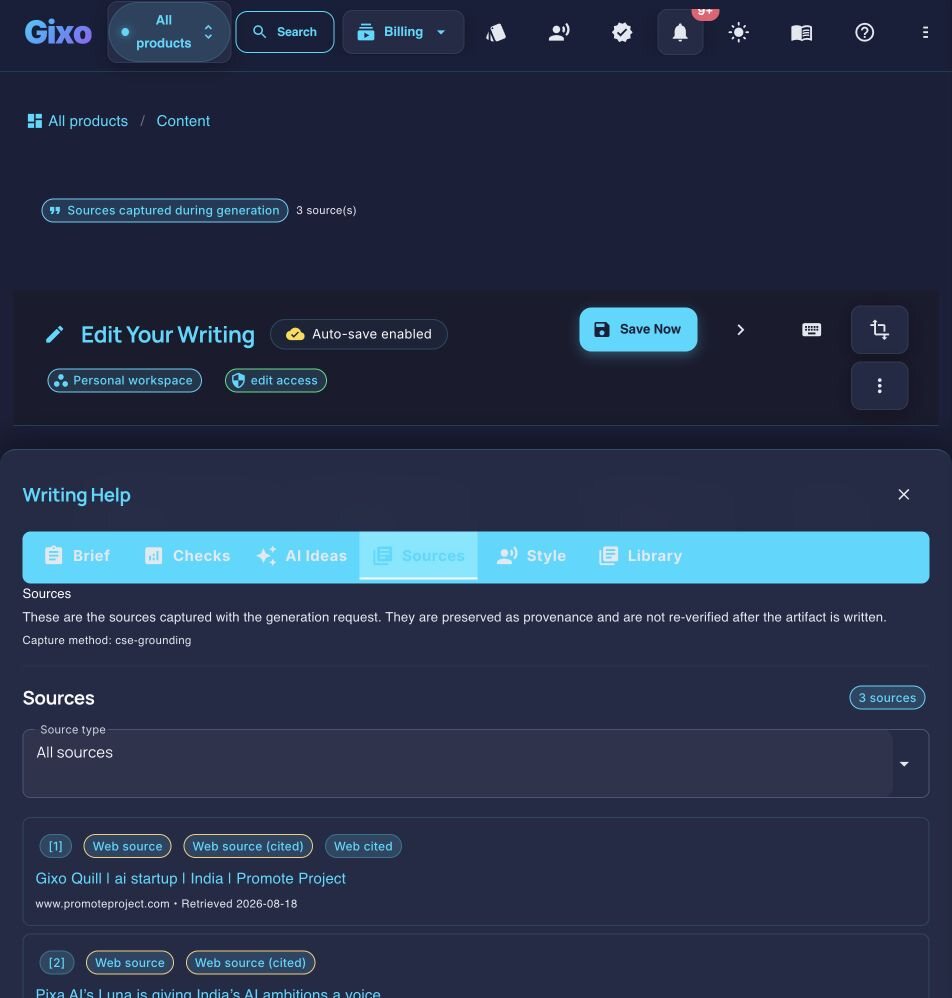
Inside Quill
Inspect captured sources beside the working draft
Updated