The section-by-section structure of an SEO proposal that actually wins the client — audit findings,
strategy, deliverables, timeline, KPIs, and pricing, with what belongs in each. Use it as a checklist,
or generate a tailored version from your own audit and scoping notes with Gixo Arc.
An SEO proposal is the document an agency or freelance consultant sends a prospect to win an SEO engagement. A strong one moves from their problem to your plan: it opens with the opportunity you found in an audit, lays out the strategy and specific deliverables, sets a realistic timeline and the KPIs you'll be judged on, and states the investment and terms. The template below covers all of it. Gixo Arc builds this structure from your actual audit and scoping files rather than a generic prompt, so the first draft reflects the real engagement — then you review and price it.
Arc · real output
From a supplied scope to a proposal you can inspect.
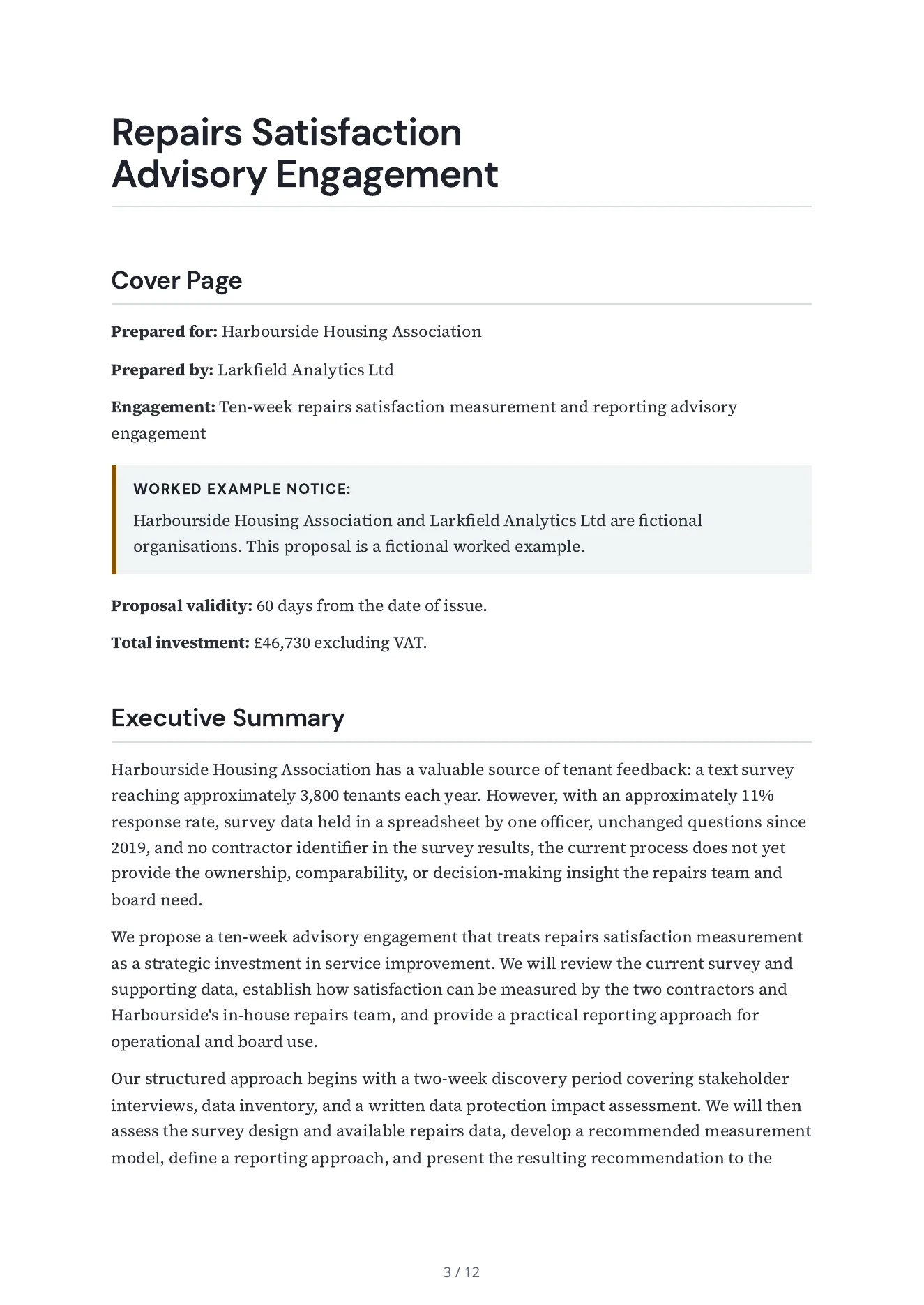
Related worked example · Consulting proposal: repairs satisfaction measurement, Harbourside Housing Association. View full size ↗
Read a real exported proposal alongside the brief Arc received. The example keeps supplied scope, commercial assumptions and reviewer responsibility visible.
Consulting proposal: repairs satisfaction measurement, Harbourside Housing Association
A ten-week advisory engagement for an invented housing association: situation, approach and phases, a requirement-by-requirement compliance matrix, deliverables, timeline, team, terms, and a fee built phase by phase from the bidder's day rates, with the days of each role shown.
Inspect the source brief or data
Propose a ten-week advisory engagement for Harbourside Housing Association, on behalf of Larkfield Analytics Ltd, that answers the association's brief: review the current repairs survey, recommend how to measure repairs satisfaction by contractor, and leave a reporting approach for the repairs team and the board. Build the fee for each phase from the standard rates in the evidence file (the days of each role times the day rate) and show those days. Add nothing the evidence file does not state. Put a notice on the cover page that the buyer and the bidder are fictional and the proposal is a worked example. Inputs: the buyer's document (brief-harbourside-housing.md); the bidder's evidence file (larkfield-evidence.md); commercial terms: value 46,000 to 52,000 GBP, valid for 60 days, payment terms 'Invoiced monthly in arrears, payable within 30 days.'; deal context: The buyer and the bidder in this proposal are fictional, and this proposal is a worked example. The engagement lead presents to the buyer's board in the ninth week.
A separate reviewer agent read its 177 claims against the bidder's evidence file, the buyer's brief and the deal terms: 115 are supported, 58 add design detail or an inference, 4 are in no input (it calls the fee fixed) and none contradicts one. Every price line recomputes. It is not a person's review.
Prepare the source pack
Choose the proposal kind and supply the buyer brief, approved evidence, delivery assumptions and commercial terms. For RFP work, retain the issued requirements and separate known answers from missing evidence.
Review the proposed response
Inspect scope, exclusions, requirements and price assumptions. Use reviewable edits and saved comparisons; an unresolved buyer question needs an owner or an explicit qualification.
Package the reviewed version
Inspect the actual PDF, Word or HTML output. Tracked delivery activity and a recorded deal outcome answer different questions; verify the recipient, permissions and current approval state before sharing.
Buyer requirements and response ownership
Keep buyer RFP files separate from bidder evidence and approved reusable answers. Inspect extraction coverage, requirement source locations, questionnaire previews and submission limits. Response work can carry an SME owner, due date, escalation owner and required reviewer decisions. Compare an addendum with the source before changing a response.
Commercial schedules and recurring totals
Review each line's quantity, rate, unit, optional status and one-off, monthly or annual recurrence. Inspect recurrence totals and the estimated first-year total separately. Currency, supplied tax input and commercial assumptions need review. When importing Business metrics, select and review the source values before applying them to the schedule.
Buyer edition and submission package
Choose the current saved response or an approved edition. Inspect retained attachments, filled questionnaires, the compliance matrix and the package preview. A release manifest identifies stored delivery bytes. For tracked links, review recipient access, expiry, password and permissions separately from delivery activity and the recorded opportunity outcome.
A draft or readiness check is not approval of pricing, legal terms or a delivery commitment. Arc proposal drafting does not imply CRM, CPQ or tax-calculation automation.
Explore a specific workflow
What a winning SEO proposal includes — the search engine optimization proposal structure
Eight sections, in order. Keep it client-first: lead with their opportunity, not your agency bio.
SEO proposals for an ongoing retainer and for a one-off technical project use the same eight sections of a search engine optimization proposal; the scope, timeline and pricing sections are where they differ.
1
Executive summary — the opportunity
Two or three sentences naming the prospect's biggest SEO opportunity in their own terms (traffic left on the table, rankings competitors own, a technical issue capping growth). This is the hook — write it last, once you know the story the rest of the proposal tells.
2
Audit findings — where they are today
The evidence. A short, prioritised summary of the current state: technical health, indexation, on-page and content gaps, backlink profile, and the highest-impact issues. Specifics from a real audit here are what separate a credible proposal from a template; vague findings read as boilerplate.
3
Strategy & approach
How you'll turn those findings into results — usually across technical SEO, on-page and content, and authority/links — plus your target keyword themes and the priority order. Tie each strand back to a finding in section 2 so the plan clearly answers their actual problems.
4
Scope & deliverables
The concrete list of what you will do and produce — e.g. technical fixes, a content calendar, X optimised pages per month, link outreach, monthly reporting. Be explicit about what's in and out of scope; unstated assumptions are where SEO engagements go sideways.
5
Timeline & roadmap
A phased plan (e.g. foundations in months 1–2, content and authority in 3–6) that sets honest expectations. SEO compounds, so state when to expect early signals versus meaningful movement — over-promising fast rankings is the fastest way to lose the client later.
6
KPIs & reporting
How success is measured and how often you'll report. Name the metrics you'll be accountable for (organic traffic, rankings for target terms, conversions/leads where you can attribute them) and the cadence. Agreeing the scoreboard up front prevents the "what am I paying for?" conversation in month three.
7
Pricing & investment
Your commercial terms, framed as an investment against the opportunity in section 1. Whether it's a monthly retainer, project fee, or tiered options, tie the price to the scope and outcomes so it reads as value, not cost. Offering two or three tiers lets the client choose a level rather than a yes/no.
8
Terms & next steps
Contract length, what's needed to start, and a single clear call to action. Make saying yes easy: one obvious next step (sign, book a kickoff) beats a wall of legal text. Keep detailed terms in an appendix or linked agreement.
What makes an SEO proposal win (and what loses it)
Lead with their opportunity, grounded in a real audit. The proposals that win open on the client's specific problem with evidence, not on the agency's history. Real findings from an actual audit make section 1 and 2 credible; generic claims make the whole document feel like a template.
✓ Be specific about deliverables and scope — vague scope is where SEO retainers sour.
✓ Set honest timeline expectations; SEO compounds, so name when signals appear vs. when results land.
✓ Agree the KPIs and reporting cadence up front.
✗ Don't promise "#1 rankings" or fixed traffic numbers you can't control.
✗ Don't bury the price or the next step under boilerplate.
✗ Don't send the same document to every prospect — a proposal that could be anyone's is nobody's.
Generate a tailored SEO proposal
Upload your audit and scoping notes, and Gixo Arc drafts this structure around the real engagement — then you review, price, and send. Not a blank template: a first draft grounded in your files.
An SEO proposal is the document an agency or freelance consultant sends a prospect to win an SEO engagement. It moves from the client's problem to your plan: the opportunity found in an audit, the strategy and specific deliverables, a realistic timeline and the KPIs you'll be judged on, and the investment and terms.
What should an SEO proposal include?
An executive summary of the opportunity, audit findings, strategy and approach, a clear scope and deliverables list, a phased timeline, the KPIs and reporting cadence, pricing, and terms with a next step. The strongest ones lead with the client's specific problem, backed by real audit findings, rather than the agency's background.
How long should an SEO proposal be?
Long enough to cover the eight sections and no longer — typically a handful of pages. Depth belongs in the audit findings and scope; everything else should be tight. A focused proposal a busy prospect actually reads beats a 30-page document they skim.
How do I price an SEO proposal?
Tie the price to the scope and the opportunity, not to hours. Monthly retainers are common for ongoing SEO; project fees suit one-off work like a technical overhaul. Offering two or three tiers lets the client pick a level of investment rather than accept or reject a single number.
Should I include specific ranking or traffic guarantees?
No. Rankings depend on factors outside your control, so guaranteeing "#1" or a fixed traffic figure is a credibility risk and sets up a fight later. Commit to the work and the KPIs you'll report against, and set honest expectations about the timeline instead.
Can I generate an SEO proposal automatically?
Yes — Gixo Arc builds this structure from your uploaded audit and scoping files, so the draft reflects the actual engagement rather than a generic template. It produces a professional first draft in minutes; you still review, price, and tailor it before sending.