
Prepare the source pack
Choose the proposal kind and supply the buyer brief, approved evidence, delivery assumptions and commercial terms. For RFP work, retain the issued requirements and separate known answers from missing evidence.
Arc · worked guide
An investment proposal is a funding request supported by a description of the opportunity, proposed use of funds, supplied evidence, scenarios, risks and the decision requested from the recipient. It is more detailed than a short pitch deck and does not replace independent financial, legal or commercial diligence.
Choose an Investment proposal →A worked workflow
This fictional request asks a sponsor to consider a GBP 25,000 pilot. The proposal should let the reader inspect what would be funded, the assumptions, the risks and the next decision. It contains no investment-performance result.
Supply the amount, use of funds, intended audience, scope, assumptions and decision requested.
Inspect: The ask and the use-of-funds total must agree. A contingency is an allocation, not evidence that a risk has disappeared.
Keep supplied facts, untested assumptions and scenario calculations clearly labelled.
Inspect: Do not turn an illustrative sales scenario into existing traction or infer an investment return from the funding request.
Describe execution dependencies, what the pilot would test and circumstances that would stop further spending.
Inspect: The proposal should leave unanswered diligence questions visible, including ownership, terms and whether any financial projection has a reliable basis.
Read the draft as a request for a decision, inspect source references and open the Word/PDF output.
Inspect: An investment proposal, a pitch deck and a diligence report serve different reading tasks; choose the format the recipient requested.
Fictional planning example. An Arc draft does not establish valuation, investment suitability, investor interest or expected returns.
Arc · inspectable review specimen
An investment proposal explains the requested resources, what they fund, the alternatives and the evidence needed for a decision. A scenario is not a promised return.
Authored fictional instructional sample. The downloadable Word file is rendered through Gixo’s real document exporter. This is separate from the captured product workflows on this page.
Fictional internal proposal: allocate GBP 26,000 to a limited workshop-platform pilot. This is an internal planning example, not a securities offer or investment recommendation.
| Use | Supplied budget (GBP) | Release condition |
|---|---|---|
| Build | 14,000 | Reviewed scope and owner |
| Testing | 6,000 | Usable pilot and test plan |
| Launch preparation | 6,000 | Review of test findings |
| Total | 26,000 | No unallocated contingency is included |
Compare a smaller manual pilot, a staged build and deferral. Customer demand, operating costs and support effort are not yet established. There is no revenue forecast or return guarantee in this specimen.
Require a named budget owner, stage review dates, a stop condition and a record of which assumptions changed. Record approval separately from the proposal itself.
Authored fictional internal investment proposal, not financial advice, an offer, an AI-generation receipt or an observed return.
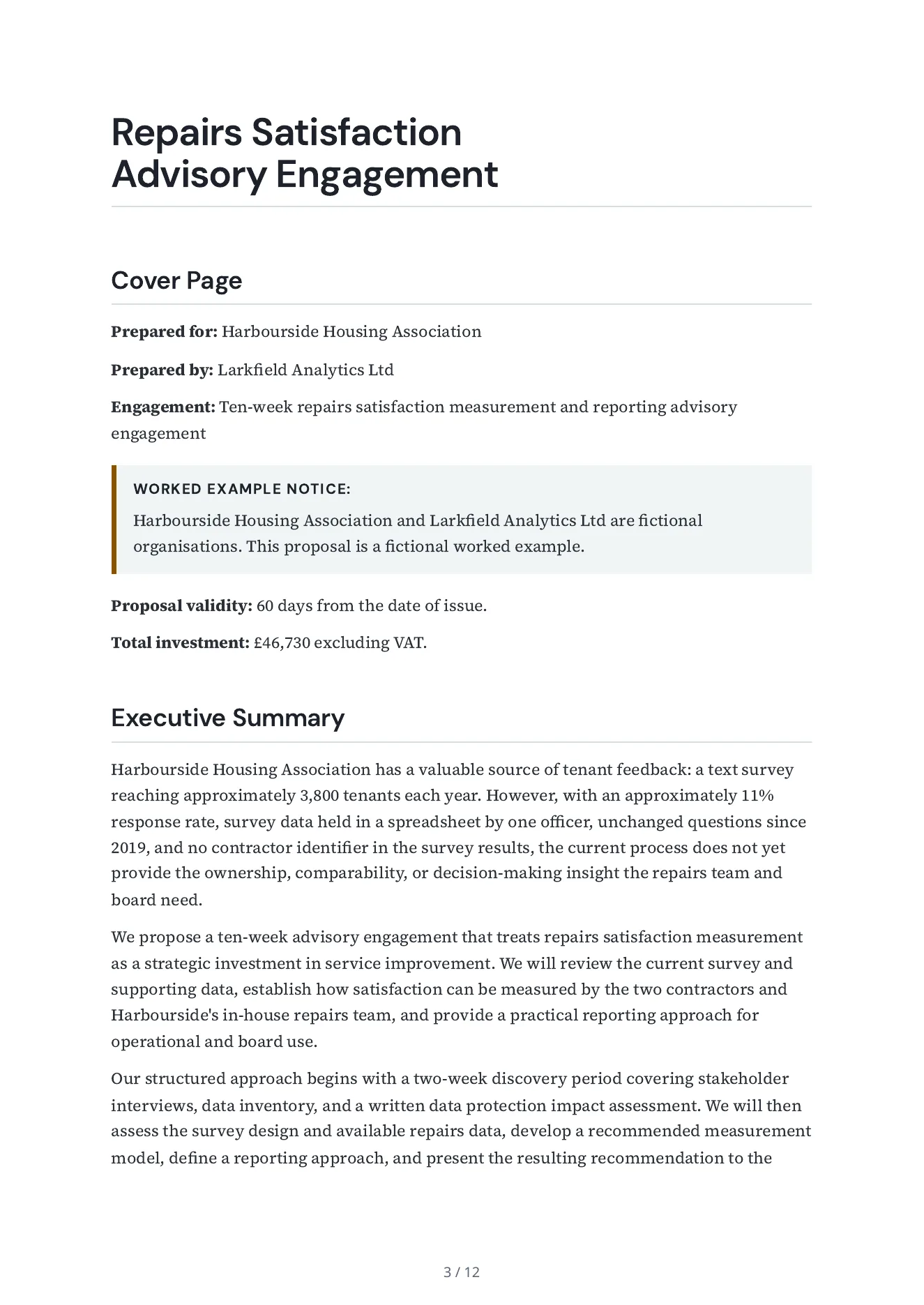
Read a real exported proposal alongside the brief Arc received. The example keeps supplied scope, commercial assumptions and reviewer responsibility visible.
A ten-week advisory engagement for an invented housing association: situation, approach and phases, a requirement-by-requirement compliance matrix, deliverables, timeline, team, terms, and a fee built phase by phase from the bidder's day rates, with the days of each role shown.
Propose a ten-week advisory engagement for Harbourside Housing Association, on behalf of Larkfield Analytics Ltd, that answers the association's brief: review the current repairs survey, recommend how to measure repairs satisfaction by contractor, and leave a reporting approach for the repairs team and the board. Build the fee for each phase from the standard rates in the evidence file (the days of each role times the day rate) and show those days. Add nothing the evidence file does not state. Put a notice on the cover page that the buyer and the bidder are fictional and the proposal is a worked example. Inputs: the buyer's document (brief-harbourside-housing.md); the bidder's evidence file (larkfield-evidence.md); commercial terms: value 46,000 to 52,000 GBP, valid for 60 days, payment terms 'Invoiced monthly in arrears, payable within 30 days.'; deal context: The buyer and the bidder in this proposal are fictional, and this proposal is a worked example. The engagement lead presents to the buyer's board in the ninth week.
A separate reviewer agent read its 177 claims against the bidder's evidence file, the buyer's brief and the deal terms: 115 are supported, 58 add design detail or an inference, 4 are in no input (it calls the fee fixed) and none contradicts one. Every price line recomputes. It is not a person's review.
Choose the proposal kind and supply the buyer brief, approved evidence, delivery assumptions and commercial terms. For RFP work, retain the issued requirements and separate known answers from missing evidence.
Inspect scope, exclusions, requirements and price assumptions. Use reviewable edits and saved comparisons; an unresolved buyer question needs an owner or an explicit qualification.
Inspect the actual PDF, Word or HTML output. Tracked delivery activity and a recorded deal outcome answer different questions; verify the recipient, permissions and current approval state before sharing.
Keep buyer RFP files separate from bidder evidence and approved reusable answers. Inspect extraction coverage, requirement source locations, questionnaire previews and submission limits. Response work can carry an SME owner, due date, escalation owner and required reviewer decisions. Compare an addendum with the source before changing a response.
Review each line's quantity, rate, unit, optional status and one-off, monthly or annual recurrence. Inspect recurrence totals and the estimated first-year total separately. Currency, supplied tax input and commercial assumptions need review. When importing Business metrics, select and review the source values before applying them to the schedule.
Choose the current saved response or an approved edition. Inspect retained attachments, filled questionnaires, the compliance matrix and the package preview. A release manifest identifies stored delivery bytes. For tracked links, review recipient access, expiry, password and permissions separately from delivery activity and the recorded opportunity outcome.
A draft or readiness check is not approval of pricing, legal terms or a delivery commitment. Arc proposal drafting does not imply CRM, CPQ or tax-calculation automation.
This filled example is an editorial explanation of the structure. The related real product output above is separately identified.
| Part | Example and review point |
|---|---|
| Applicant | Fictional Northbank Workshop Ltd; invented company used only to illustrate structure. |
| Ask | An illustrative 120,000 funding request. The amount is a supplied assumption, not a valuation. |
| Use of funds | Equipment 60,000; installation 20,000; working capital 40,000. Total 120,000. |
| Evidence required | Approved supplier quotations, capacity assumptions, historical trading records and an identified source for each market claim. |
| Decision requested | Whether to proceed to diligence on the proposed terms; no promised return or automatic approval. |
Give every projection its period, source, calculation basis and sensitivity. Explain what changes under an adverse scenario, what remains unknown and who must approve the assumptions. Put the actual ask and use of funds near the beginning, then support them with readable evidence and qualifications. Arc’s Investment type can organize supplied material into a first draft; inspect the exported proposal and its commercial terms before circulation. A persuasive narrative is not evidence that an investment is suitable or that a return will occur.
Updated