
Proposal analyzer guide
A free, deterministic readiness check for your proposal draft — section coverage, RFP compliance, a 9-point checklist, and more. No AI generation and no signup.
How It Works
From draft to readiness score in four steps.
Add the proposal draft you want checked, and tell the analyzer which of the 21 proposal types you're writing so it knows which sections to expect.
If you're responding to an RFP, paste that text in too. This unlocks the requirement/compliance matrix — the analyzer still scores you without it.
The analyzer runs all six checks and returns a 0-100 readiness score in a named band, plus a specific list of what's missing or unaddressed.
Address the flagged items and run it again. It's free with no signup, so there's no limit on how many passes you take before you send the proposal.
Key Features
Six deterministic checks, every one of them explainable.
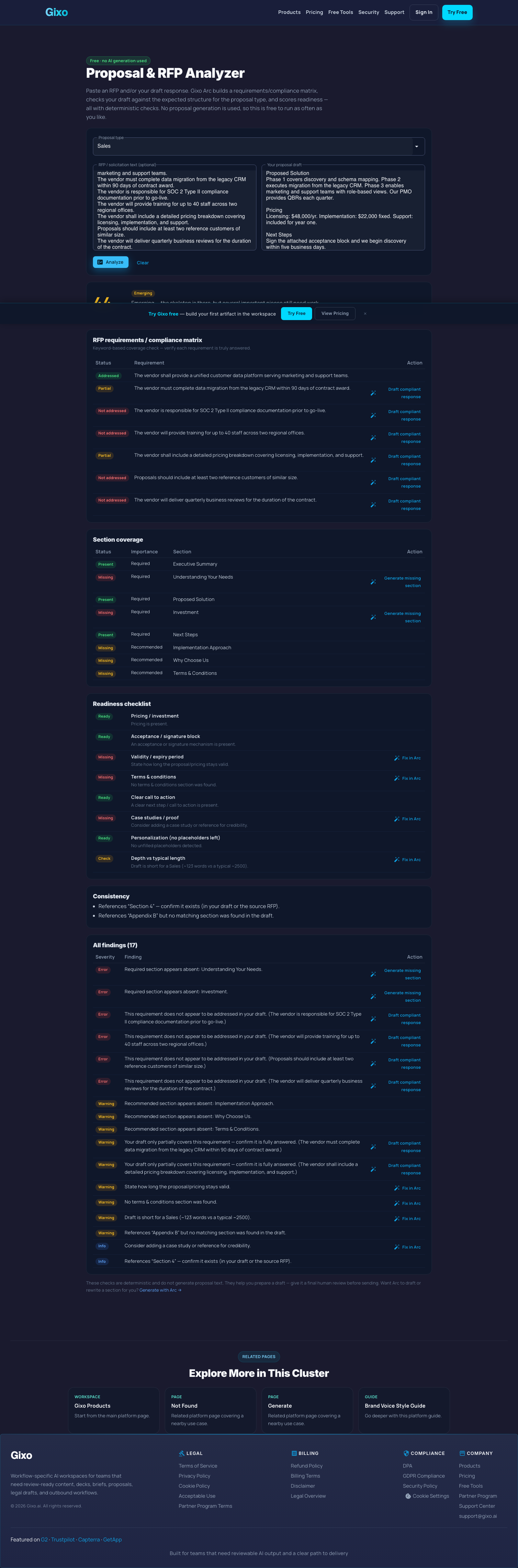
Detects headings in your draft — real HTML h1-h6 tags or heuristic text-heading detection — and checks them against the required and optional sections defined for your proposal type. Weighted 70% required sections, 30% recommended sections.
When you provide RFP text, the analyzer splits it into statements, detects obligation language ("shall," "must," "required to," "will provide," "responsible for," "should") and list items, extracts up to 60 distinct requirements, and checks each one against your draft using token overlap — Addressed, Partially Addressed, or Not Addressed.
Checks for pricing/investment, an acceptance or signature block, a validity/expiry period, terms and conditions, a clear call-to-action, a table of contents, case studies or social proof, no unfilled placeholders, and length roughly matching the target word count.
Flags acronyms or terms used two or more times that aren't defined anywhere in the draft and aren't already in a common allow-list like RFP, SOW, NDA, or SLA — the kind of thing a reviewer would circle in red.
Flags any "see Section X" or "see Appendix Y" reference where no heading X or Y actually exists in the draft — the broken-link problem, but for proposal documents.
Every one of these checks is regex and token-overlap logic — there's no LLM call anywhere in the analyzer. That matters because every score and flag is traceable to a specific rule you can inspect and reason about, not a black-box AI judgment that changes between runs. It's also why the analyzer is free to run.