
Proposal & RFP analyzer for Gixo Arc
Paste your proposal draft — and optionally the RFP it answers — and get a 0–100 readiness score in seconds: which expected sections are missing, which RFP requirements your draft actually addresses, and the mechanical failures (undefined acronyms, broken cross-references, leftover placeholders) that make evaluators stop reading.
How to use this tool
Who it is for
Proposal and bid teams checking an existing draft before submission.
Input
A proposal draft, the matching proposal type, and optionally the source RFP. Paste only documents you are authorized to process.
How it works
Deterministic rules compare headings with the selected proposal-type model, run the fixed readiness checklist, and use token overlap for up to 60 extracted RFP obligations.
What the output means
The report shows a readiness band, section and checklist gaps, and—when an RFP is supplied—Addressed, Partially Addressed, or Not Addressed rows. These are mechanical coverage signals.
Limitation
Token overlap is not semantic or legal compliance review. The tool does not judge response quality, certify RFP compliance, rewrite the proposal, or predict a win.
Data-handling boundary
The public analysis runs on submitted text without creating an account or calling an AI model. Review the Privacy Policy for request and service-data handling, and do not submit material you lack authority to process.
Illustrative input
Illustrative: a consulting-proposal draft plus an RFP containing delivery, timeline, pricing, and reporting obligations.
Illustrative output
Illustrative: the matrix can mark the delivery language as Addressed, timeline as Partially Addressed, and reporting as Not Addressed while also flagging a missing validity period. This is not a real customer result.
Ask next: Which Not Addressed rows need substantive writing, who owns final compliance review, and which win themes or pricing choices require human judgment?
A proposal analyzer is a free, deterministic tool that scores a proposal draft 0–100 for submission readiness — checking section coverage against 21 proposal-type templates, extracting up to 60 RFP requirements to see which ones the draft actually addresses, and running a fixed 9-point readiness checklist (pricing section, signature block, validity period, and more). It runs on rule-based checks, not AI judgment, so the same draft always produces the same score. Readiness bands run Not Ready, Emerging, Close, and Ready.
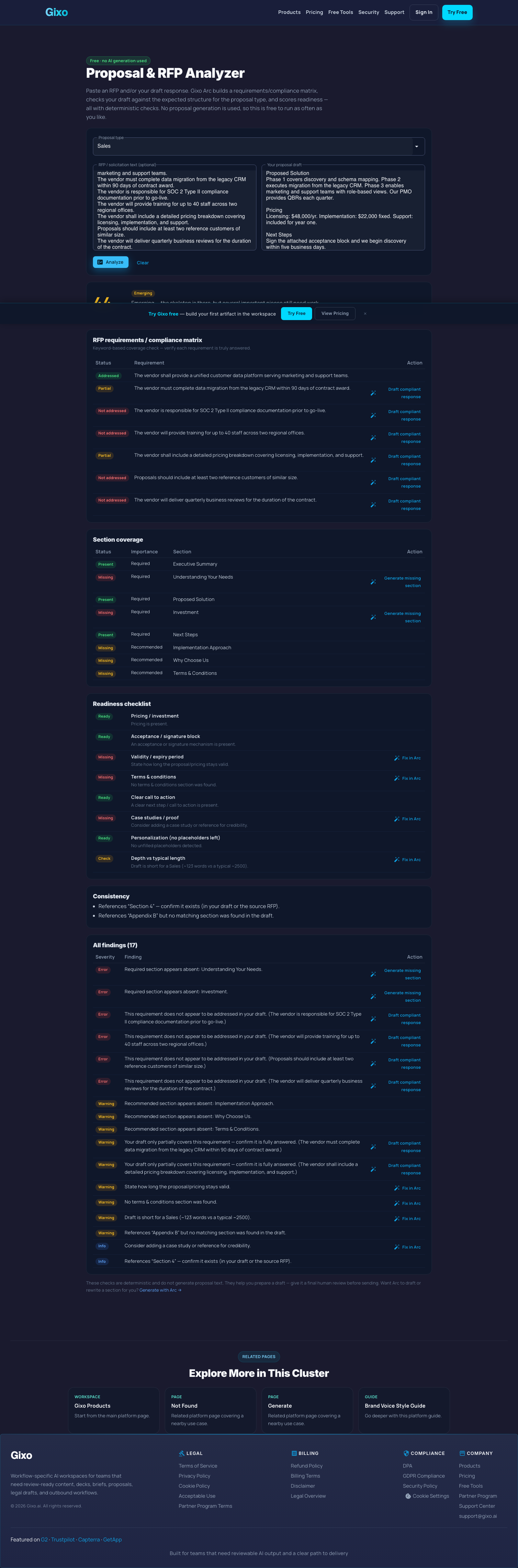
A real analyzer run: readiness score and band, section coverage for the selected proposal type, and the RFP compliance matrix — produced in seconds, no account.
What does a proposal analyzer check, exactly?
No black box. These are the actual rule sets the analyzer runs — the same ones Gixo Arc uses internally.
What does the free proposal analyzer check?
| Check | What it measures | Threshold / detail |
|---|---|---|
| Section coverage | Draft headings vs. the expected-section model for the selected proposal type (21 types) | 70% weight on required sections, 30% on recommended |
| RFP requirement coverage | Token overlap between draft and up to 60 extracted obligation statements ("shall", "must", "required to", etc.) | Addressed ≥66%, Partially Addressed 34–66%, Not Addressed <34% |
| 9-point readiness checklist | Pricing/investment section, acceptance/signature block, validity period, terms & conditions, CTA/next steps, table of contents, case studies/social proof, no leftover placeholders, appropriate length | Pass/fail per item |
| Undefined acronyms | Acronyms used 2+ times but never defined on first use | ~80-term common-knowledge allowlist (RFP, SLA, API, GDPR, etc.) excluded |
| Broken cross-references | References to a Section, Clause, Article, Appendix, Exhibit, Schedule, Attachment, or Annex not present in the draft | Flagged individually |
| Composite readiness score | With RFP: 40% sections + 35% checklist + 25% requirement coverage. Without RFP: 55% sections + 45% checklist | Bands: Not Ready 0–39, Emerging 40–59, Close 60–79, Ready 80–100 |

The compliance matrix: every obligation statement extracted from the RFP, with your draft's coverage status next to it.
What can a deterministic proposal check tell you — and what can't it?
This analyzer is honest about what it is. Requirement coverage is measured by token overlap, not semantic understanding — it tells you whether your draft engages each requirement's language, not whether your answer is good. It extracts at most 60 requirements per RFP, and it doesn't rewrite anything. Inside Arc, the same deterministic checks become a proposal workflow: gaps become sections to draft, review, and export.
Use it the way proposal teams use a compliance pass: as the mechanical gate before the persuasion work. Every "Not Addressed" row is a section you write before submission. Every undefined acronym and broken cross-reference is a 30-second fix that would otherwise read as carelessness. The judgment calls — pricing strategy, win themes, tone — stay yours.
When the gaps need new writing, Arc can draft from your RFP and source files with evidence bound to what you uploaded, then support editing and human review before PDF, DOCX, or HTML export. A 14-day Arc trial is available without a credit card.
Proposal analyzer or generator — which do you need?
| You have | Use | Cost |
|---|---|---|
| A draft you wrote (or inherited) and a deadline | Arc analyzer — find the mechanical gaps before the evaluator does | Product-owned workflow |
| An RFP and source documents, but no draft yet | Gixo Arc — generate a structured first draft grounded in your files | 14-day free trial, then a paid plan |
| A draft that scored "Close" with three sections missing | Both — generate the missing sections, paste back, re-run the analyzer | Arc trial and paid workflow |
Frequently Asked Questions
Reviewed 2026 — checks and weights on this page reflect the current Gixo Arc analyzer.
Updated