
Prepare the source pack
Choose the proposal kind and supply the buyer brief, approved evidence, delivery assumptions and commercial terms. For RFP work, retain the issued requirements and separate known answers from missing evidence.
Arc · worked guide
A research proposal explains the question a study would answer, why that question matters, how the work would be conducted and what resources it would require. A useful format makes the proposed method and its limits inspectable. Follow the receiving institution’s required sections and funding rules before using a general template.
Choose the Research proposal type →A worked workflow
A research proposal needs a question that the proposed method can answer. This fictional study concerns one product’s onboarding and has no collected results. The receiving institution’s required format and approval rules take precedence.
Choose the Research proposal structure and supply the question, audience, existing material, method, schedule and budget.
Inspect: The draft should concern new administrators using this onboarding flow; it must not claim to represent every customer or prove why conversion changes.
Describe the task participants would attempt, the observations that would be recorded and how the team would code interview notes.
Inspect: Task completion, observed confusion and reported experience are different measures. State which measure answers each part of the question.
Separate preparation, recruitment, sessions, analysis and reporting. Retain dependencies such as consent, participant eligibility and approved recording arrangements.
Inspect: Show the supplied effort and budget assumptions. Do not present a proposed session date or recruitment target as an accomplished milestone.
Review missing sources, limitations, consent, storage and decision criteria; compare the saved draft with its actual export.
Inspect: A complete section list is not sufficient if the method cannot answer the question or the budget omits a stage.
Fictional research-planning scenario. Arc assists proposal drafting; it does not conduct the study, enroll participants or create research findings.
Arc · inspectable review specimen
A research proposal connects a question to a method, an evidence plan, a schedule and a budget. State what the study cannot establish before presenting the expected deliverables.
Authored fictional instructional sample. The downloadable Word file is rendered through Gixo’s real document exporter. This is separate from the captured product workflows on this page.
Fictional study: can a revised onboarding checklist reduce unresolved handoff questions in a four-week volunteer pilot? The proposed study concerns 24 volunteers, not the whole organization. Its results would be descriptive; no causal claim is justified without an appropriate comparison design.
Record weekly support-request counts, task completion and the reason for every unresolved question. Keep a consistent definition of a request and record exposure. Obtain appropriate consent and review data handling before recruitment. No participant has been recruited for this specimen.
| Stage | Work | Deliverable |
|---|---|---|
| Week 1 | Confirm question, definitions and permissions | Reviewed protocol and collection sheet |
| Weeks 2–5 | Observe the four-week pilot | Source-labelled weekly table and issue log |
| Week 6 | Review missing observations and alternative explanations | Findings memo with limitations |
Research time: 36 hours × GBP 60 = GBP 2,160. Coordination: 4 hours × GBP 40 = GBP 160. Materials allowance: GBP 180. Total: GBP 2,500 before any applicable taxes. These are supplied planning assumptions, not market rates.
Approve or revise the proposed scope and resource envelope. Do not describe the proposal as a completed study or its hypotheses as findings.
Authored fictional research-proposal specimen rendered through the document exporter. It is not a completed Arc research generation or an approved research protocol.
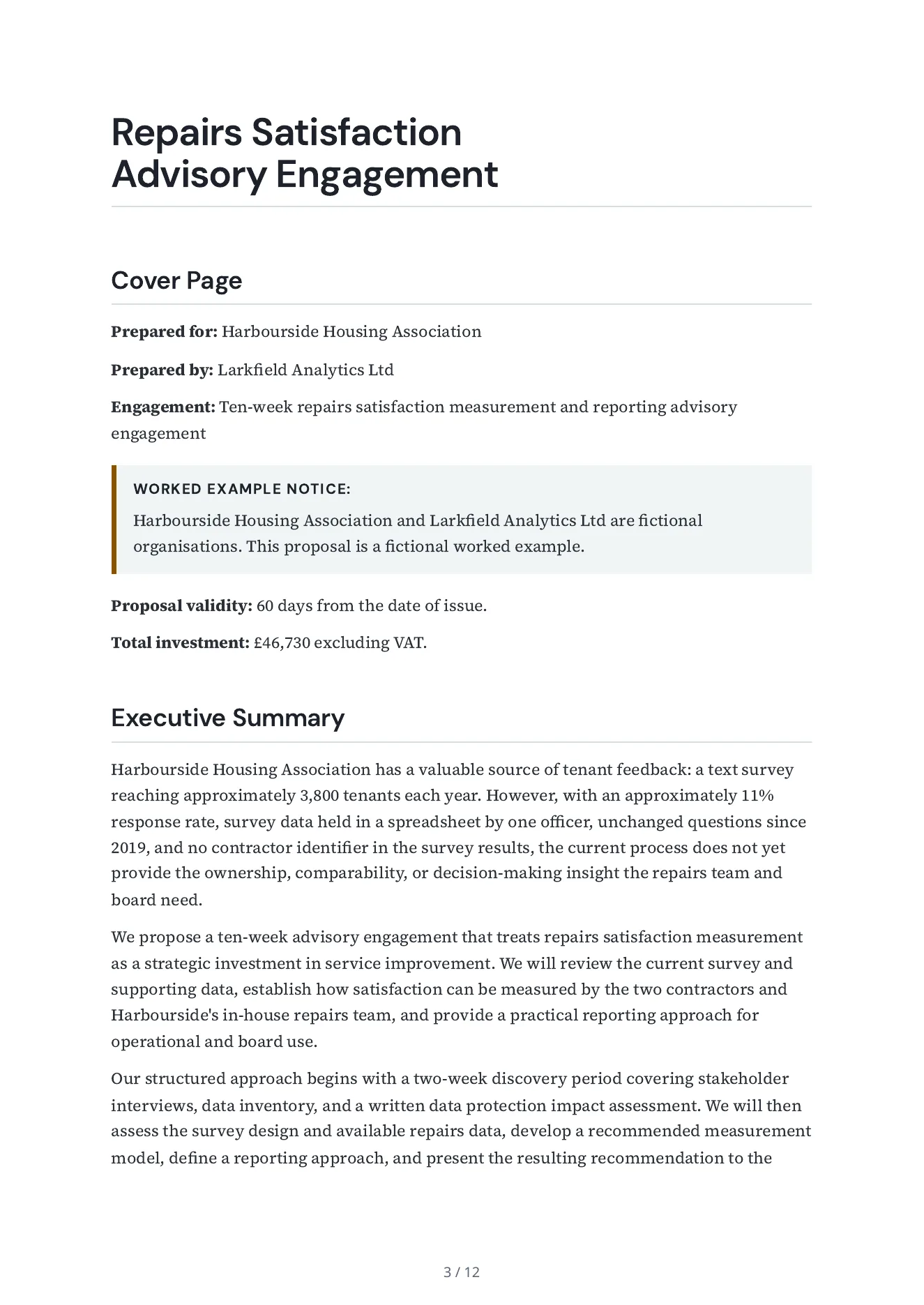
Read a real exported proposal alongside the brief Arc received. The example keeps supplied scope, commercial assumptions and reviewer responsibility visible.
A ten-week advisory engagement for an invented housing association: situation, approach and phases, a requirement-by-requirement compliance matrix, deliverables, timeline, team, terms, and a fee built phase by phase from the bidder's day rates, with the days of each role shown.
Propose a ten-week advisory engagement for Harbourside Housing Association, on behalf of Larkfield Analytics Ltd, that answers the association's brief: review the current repairs survey, recommend how to measure repairs satisfaction by contractor, and leave a reporting approach for the repairs team and the board. Build the fee for each phase from the standard rates in the evidence file (the days of each role times the day rate) and show those days. Add nothing the evidence file does not state. Put a notice on the cover page that the buyer and the bidder are fictional and the proposal is a worked example. Inputs: the buyer's document (brief-harbourside-housing.md); the bidder's evidence file (larkfield-evidence.md); commercial terms: value 46,000 to 52,000 GBP, valid for 60 days, payment terms 'Invoiced monthly in arrears, payable within 30 days.'; deal context: The buyer and the bidder in this proposal are fictional, and this proposal is a worked example. The engagement lead presents to the buyer's board in the ninth week.
A separate reviewer agent read its 177 claims against the bidder's evidence file, the buyer's brief and the deal terms: 115 are supported, 58 add design detail or an inference, 4 are in no input (it calls the fee fixed) and none contradicts one. Every price line recomputes. It is not a person's review.
Choose the proposal kind and supply the buyer brief, approved evidence, delivery assumptions and commercial terms. For RFP work, retain the issued requirements and separate known answers from missing evidence.
Inspect scope, exclusions, requirements and price assumptions. Use reviewable edits and saved comparisons; an unresolved buyer question needs an owner or an explicit qualification.
Inspect the actual PDF, Word or HTML output. Tracked delivery activity and a recorded deal outcome answer different questions; verify the recipient, permissions and current approval state before sharing.
Keep buyer RFP files separate from bidder evidence and approved reusable answers. Inspect extraction coverage, requirement source locations, questionnaire previews and submission limits. Response work can carry an SME owner, due date, escalation owner and required reviewer decisions. Compare an addendum with the source before changing a response.
Review each line's quantity, rate, unit, optional status and one-off, monthly or annual recurrence. Inspect recurrence totals and the estimated first-year total separately. Currency, supplied tax input and commercial assumptions need review. When importing Business metrics, select and review the source values before applying them to the schedule.
Choose the current saved response or an approved edition. Inspect retained attachments, filled questionnaires, the compliance matrix and the package preview. A release manifest identifies stored delivery bytes. For tracked links, review recipient access, expiry, password and permissions separately from delivery activity and the recorded opportunity outcome.
A draft or readiness check is not approval of pricing, legal terms or a delivery commitment. Arc proposal drafting does not imply CRM, CPQ or tax-calculation automation.
This filled example is an editorial explanation of the structure. The related real product output above is separately identified.
| Part | Example and review point |
|---|---|
| Working question | Fictional example: Which onboarding steps do first-time users find unclear? |
| Scope | One product’s existing onboarding flow; no claim about all users or other products. |
| Method | Review permitted support notes, prepare an interview guide, recruit eligible participants and record how responses will be analyzed. |
| Evidence | List the actual prior studies and documents supplied. Mark missing references rather than inventing citations. |
| Schedule and budget | Separate preparation, recruitment, data collection, analysis and reporting; enter approved effort, rates and dependencies for each stage. |
State what would count as evidence and what the chosen method cannot establish. Separate a proposed participant count from people already recruited. Identify consent, privacy, ethics and organizational approvals that require review before collection begins. Arc can draft a Research proposal from supplied context; it does not conduct the study or create valid findings. Use the proposal to request a decision on the planned work, and revise the method or resource request when the source assumptions change.
Reference: UKRI EPSRC proposal guidance. Checked 20 October 2026.
Updated