
Gixo Arc · User guide
Everything you need to draft and deliver proposals in Arc
Proposal drafts grounded in your own files, a response workspace for formal bids, tracked delivery and a free completeness check, with a link to each screen.
Start here
What Arc is
Arc writes first drafts of proposals from your own source material. Pick one of 21 proposal types — a sales proposal, an RFP response, a renewal, a consulting proposal, a grant or a government bid — and upload the RFP, past proposals, case studies and pricing schedules. Arc builds a structured draft that follows the section plan for that type. Web search is off, so the draft comes from your files, and details they don't support are left marked TBD for a reviewer to fill in.
For formal bids, the Arc response workspace adds a requirement-and-response matrix with owners, reviewers, due dates and evidence, plus win themes, bid scoring, review gates, a reusable answer library and submission readiness. When the proposal is ready, send a tracked link, request signatures or download it. And anyone can run the free Proposal Completeness Check on a draft or an RFP without an account.
Your Arc dashboard
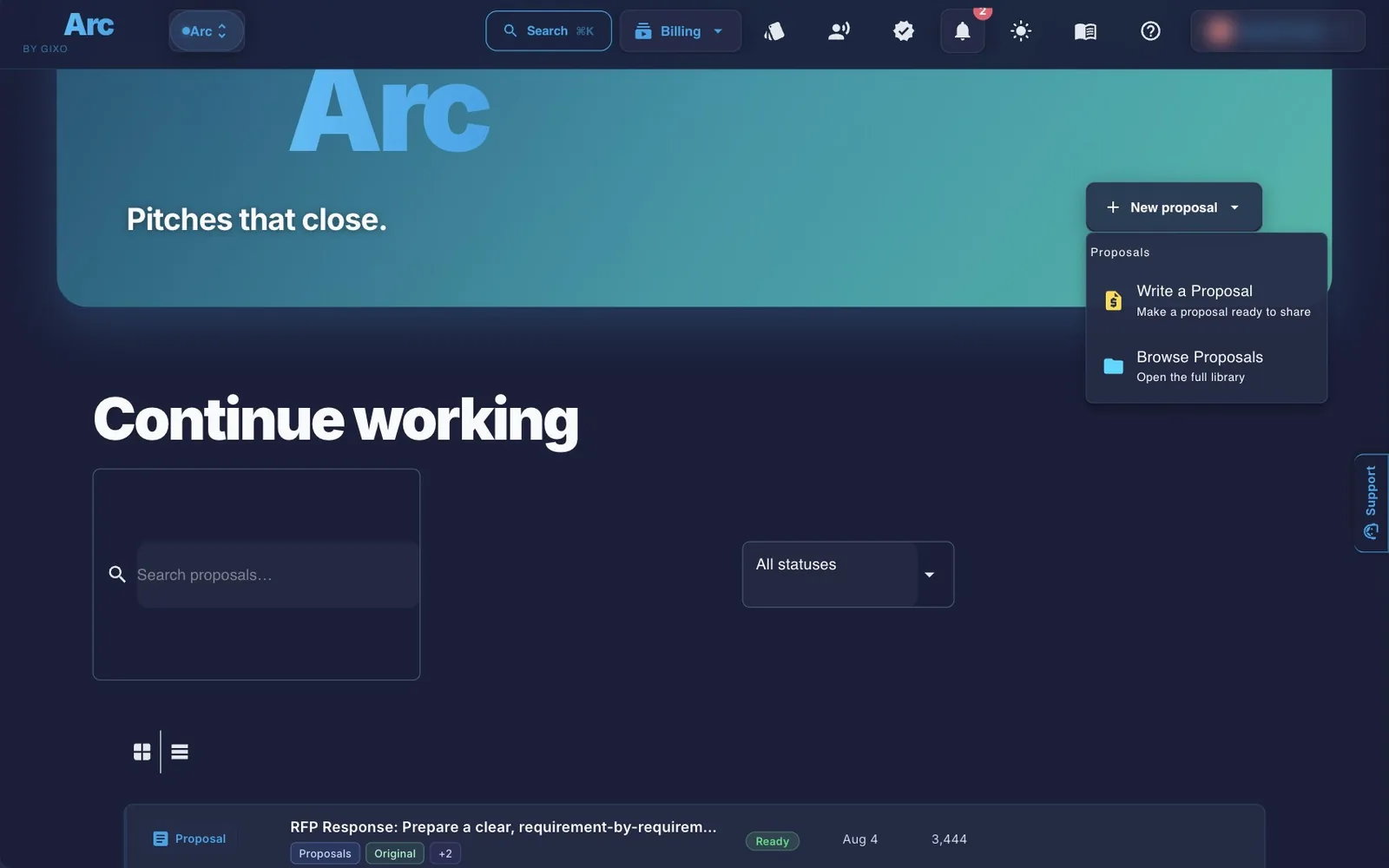
New proposal at the top starts a draft. Continue working lists your proposals, with search and status filters (Ready, Generating, Needs attention), and Recent Proposal Deliveries shows the tracked links you've sent, with Copy tracked link. The side navigation also links to Arc projects and the Arc answer library.
Writing a proposal
Three steps, all on one page. Generating the draft uses plan capacity.
1. Select Proposal Type
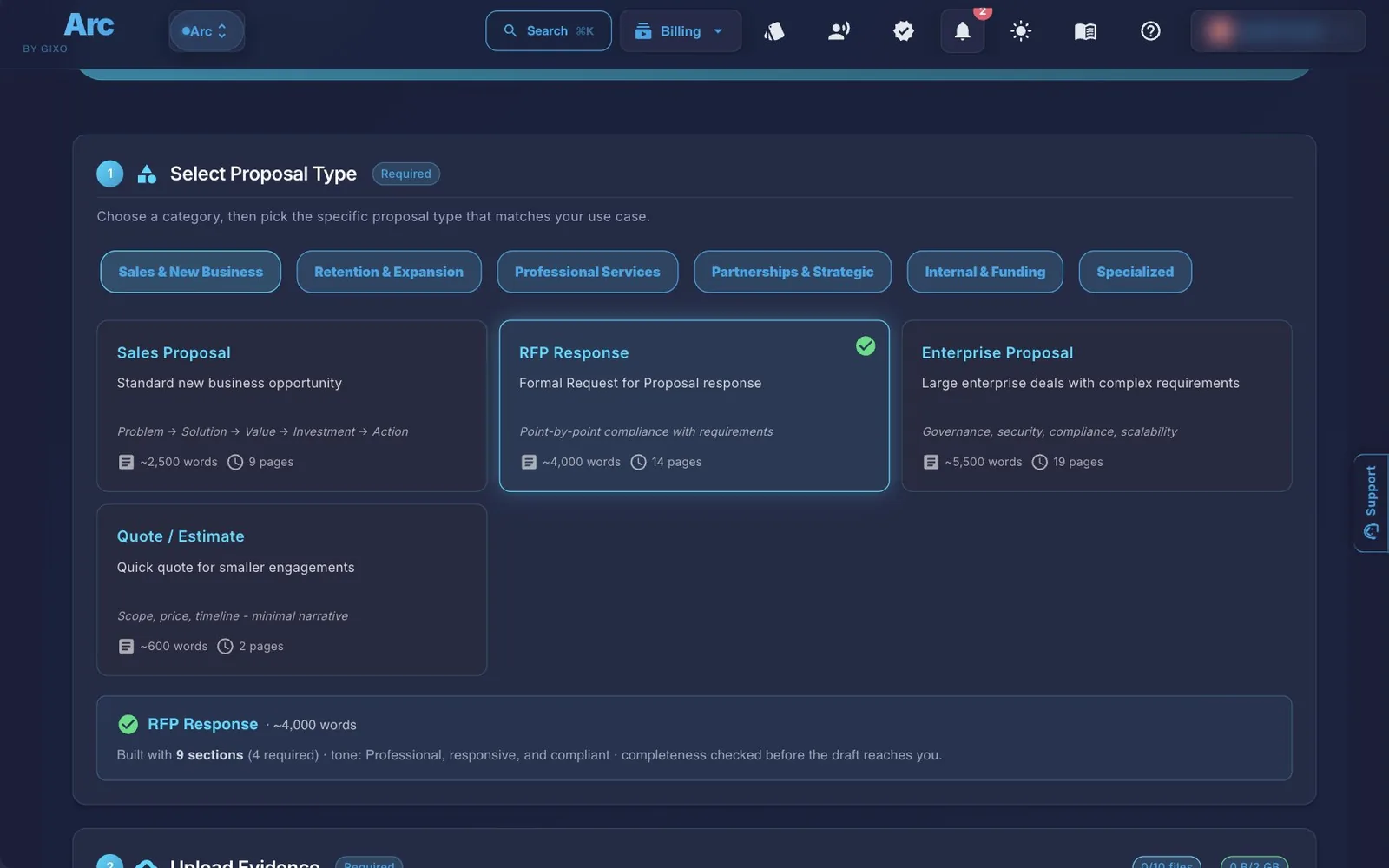
Pick a category, then the type. Each type comes with its own section plan, target length and tone.
| Category | Types (about how many words) |
|---|---|
| Sales & New Business | Sales Proposal (2,500) · RFP Response (4,000) · Enterprise Proposal (5,500) · Quote / Estimate (600) |
| Retention & Expansion | Renewal Proposal (1,800) · Expansion Proposal (1,500) · Win-Back Proposal (1,200) |
| Professional Services | Consulting Proposal (2,200) · Project Proposal (2,000) · Retainer Proposal (1,800) · Staffing Proposal (1,200) |
| Partnerships & Strategic | Partnership Proposal (2,500) · Joint Venture Proposal (3,000) · Sponsorship Proposal (1,800) |
| Internal & Funding | Internal Business Case (2,000) · Grant Proposal (3,500) · Investment Proposal (3,000) |
| Specialized | Government Proposal (5,000) · Research Proposal (4,000) · Creative Proposal (1,800) · Tech Implementation Proposal (3,500) |
2. Upload Evidence
Upload up to 10 files, 500 MB each and 2 GB in total: PDF, Word, PowerPoint, Excel, CSV, text, images, and saved emails (.eml and .msg). Give each file a Source role — buyer RFP or questionnaire, buyer addendum or attachment, pricing schedule, submission instructions, company policy, product documentation, case study, past proposal, legal or commercial terms, or team credential — so Arc knows how to use it. The draft's structure comes from the proposal type, not from any template you upload. To see how it works first, click Try with a sample RFP.
3. Context & Generate
These are optional. Say what the proposal is for, then add any Regulatory / Compliance Context — jurisdiction, applicable laws or standards, specific references — which steers the draft but isn't treated as evidence. Commercial Context takes a value range, how many days the proposal stays valid (1–365), the currency (USD, EUR, GBP, CAD or AUD) and payment-terms guidance. Then click Generate Proposal. Arc opens the draft in a tab on your all-products dashboard as soon as it starts.
If Generate stays greyed out
Every uploaded file needs extracted text before Arc can draft. If a file still shows Processing or No text extracted, wait and use Check status, or remove the file.
Working on the draft
A proposal opens in a read view with an action bar: Edit, Regenerate, Create from this, Share (the send icon, which creates a tracked link — see below) and Download. More actions holds Older versions, Import a new version, Copy Link and Delete this. The page also shows the proposal's delivery history and a Signatures panel.
| In the editor | What it does |
|---|---|
| Proposal Help | A side panel with Requirements (and Open Arc workspace), AI Ideas, Sources, Style and Library, which adds approved facts, claims and sources to your writing. |
| Selection AI | Select text to rewrite it another way, make it simpler and clearer, add detail, fix grammar and spelling, or make it more professional or more casual. |
| Versions | Save a Version and Version History, in the editor's More menu. |
The Arc response workspace
For formal bids, the response workspace turns the RFP into a matrix you can work through as a team. Open it from the editor's Requirements tab, or from Arc projects. The first time you open it, Build workspace asks for the opportunity name, buyer, RFP or tender number and submission deadline. Choose Formal response or Sales / services mode.
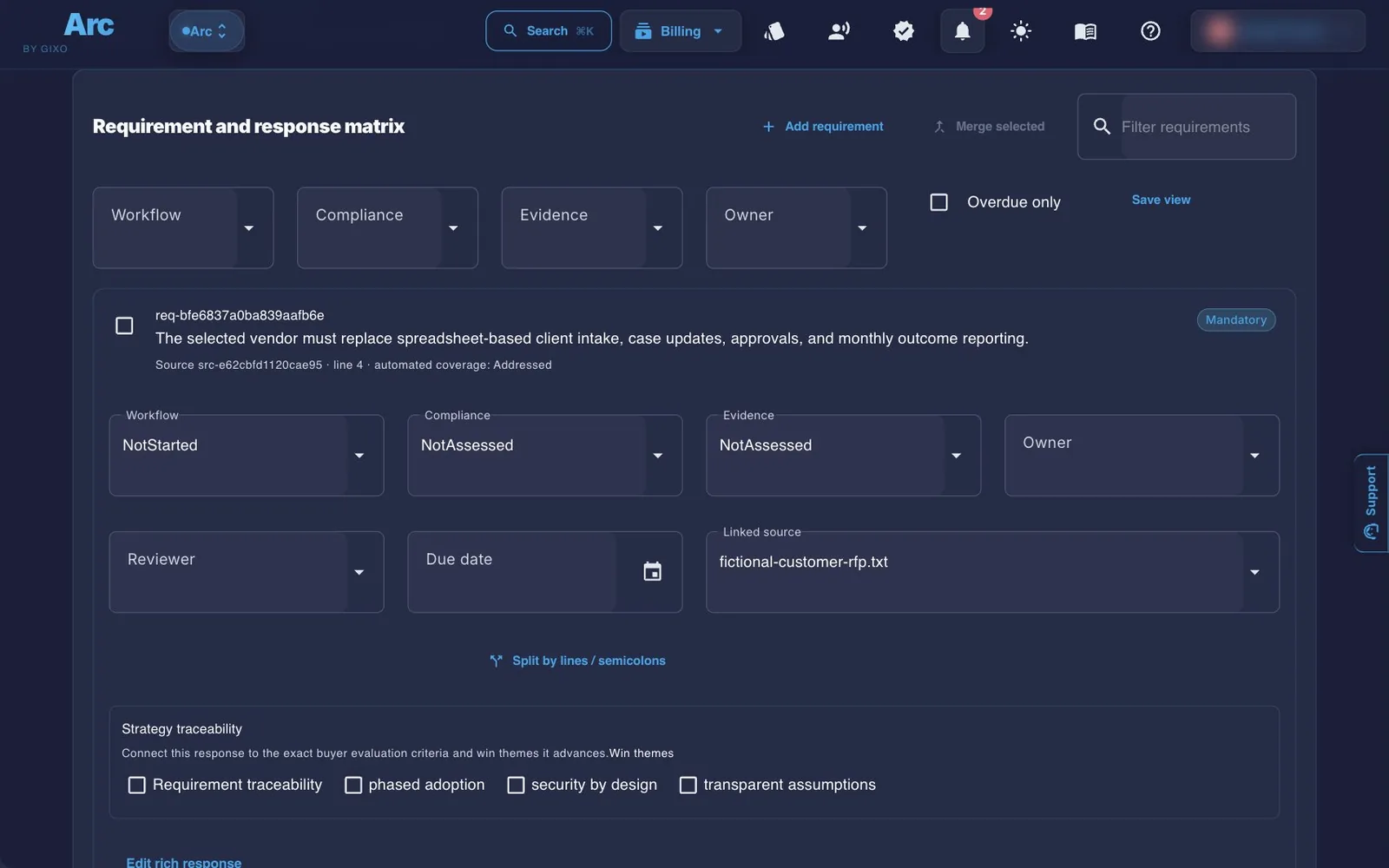
- Requirement and response matrix. Each requirement has an owner, a reviewer, a due date, a structured or rich response, and evidence. Find reusable answer pulls from your answer library, and Save response to library adds a good answer to it. You can add and merge requirements, filter by workflow, compliance, evidence, owner or overdue items, and save views.
- Ask Arc about this response. Arc drafts a suggested response for the requirement, which stays unapplied until you review it. It uses plan capacity.
- Strategy. Record the bid decision, score qualification criteria from 0 to 5, and list stakeholders, competitors, differentiators and win themes, each with a buyer-facing message and proof.
- Review gates. Apply a template, set a decision, reviewer and due date for each gate, and notify pending reviewers.
- Submission readiness. A readiness percentage, a package preflight, a Compliance matrix CSV and a Response pack PowerPoint. When the bid is ready, Create submission snapshot and Create approved release produce an unchangeable release bundle and a tracked link to that edition for the buyer.
- Saving. The status line shows All changes saved. If a save doesn't go through, a recovery draft is offered back to you.
Arc projects tracks active bids, those due in the next seven days, average readiness, win rate and open pipeline. The Arc answer library holds approved answers, with approve and request-changes steps and an audit CSV export. gixo.ai/arc/library
Delivering the proposal
Tracked links
Share — the button with the send icon — opens Create Tracked Proposal Link. Fill in the recipient's name and email (used for tracking), choose View only or View & download, and optionally add an expiry date and a password. Give it a Delivery label and click Create Link. Gixo doesn't email the link, so copy it and send it yourself. The recipient can read the proposal and click Accept proposal, and your delivery history shows when it was opened, downloaded and accepted.
Signatures
In the Signatures panel, click Request signatures. Add up to 10 signers (name, email and optional role) and an optional message, then click Freeze document & send. Each signer gets a personal email link to a fingerprinted PDF snapshot of the document as it stands at that moment. It's a simple electronic signature, not a qualified or certificate-based one. Afterwards you can void the request or download the sealed copy.
Downloads
Download opens the export page. The formats are PDF, DOCX, HTML, Markdown, JSON and plain text, and the text formats can also be copied. There are six proposal themes — Executive Sales, Consulting Engagement, RFP Response, Grant / Public Sector, Partnership / Strategic and Tech Implementation — plus Business, Technical and Legal templates, and a bibliography is included by default. The response workspace adds the compliance matrix (CSV), the response pack (PowerPoint) and release bundles.
Plans and your trial
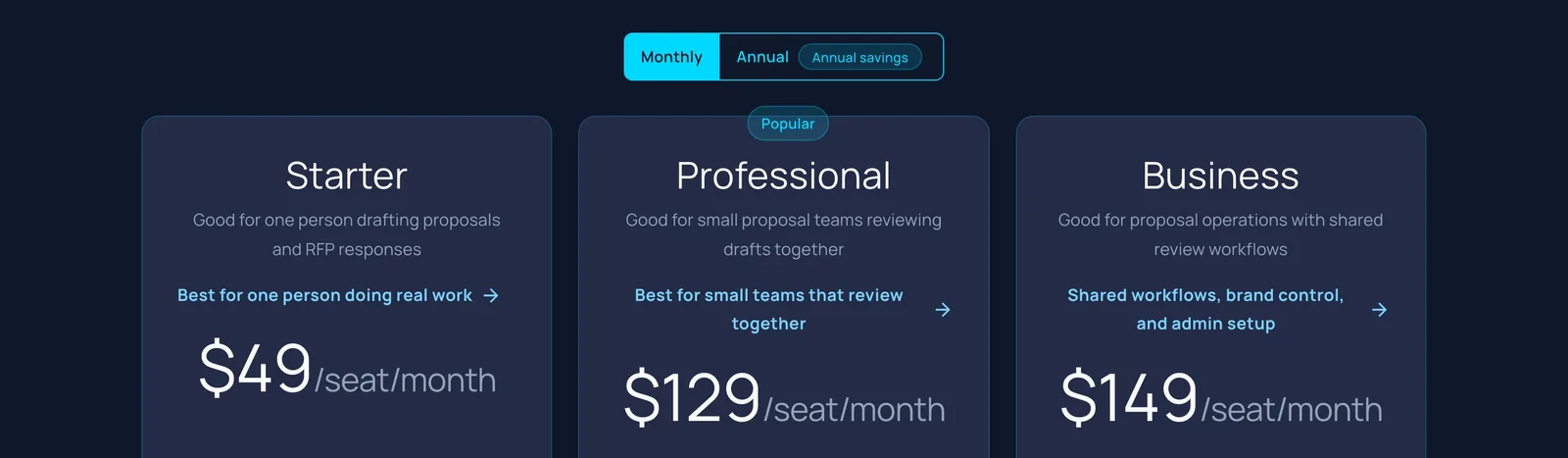
Arc is priced per seat, in US dollars. Every plan includes drafting capacity that resets each month; your subscriptions page shows a usage bar rather than counts.
| Plan | Per seat, monthly | Per seat, annual | Minimum seats |
|---|---|---|---|
| Starter | $49 | $490 | 1 |
| Professional | $129 | $1,299 | 2 |
| Business | $149 | $1,499 | 5 |
| Enterprise | $179 | $1,799 | 10, through Azure Marketplace or a private offer |
- Every plan includes proposal drafting, the response workspace, tracked links, signature requests and exports.
- Comments, including comments on requirements in the workspace, start at Professional.
- The 14-day trial needs no card, and each email address gets one. It works like Starter and takes you straight to Create Proposal. After it ends, your proposals stay open to you, and drafting pauses until you choose a plan.
Free tools, no account needed
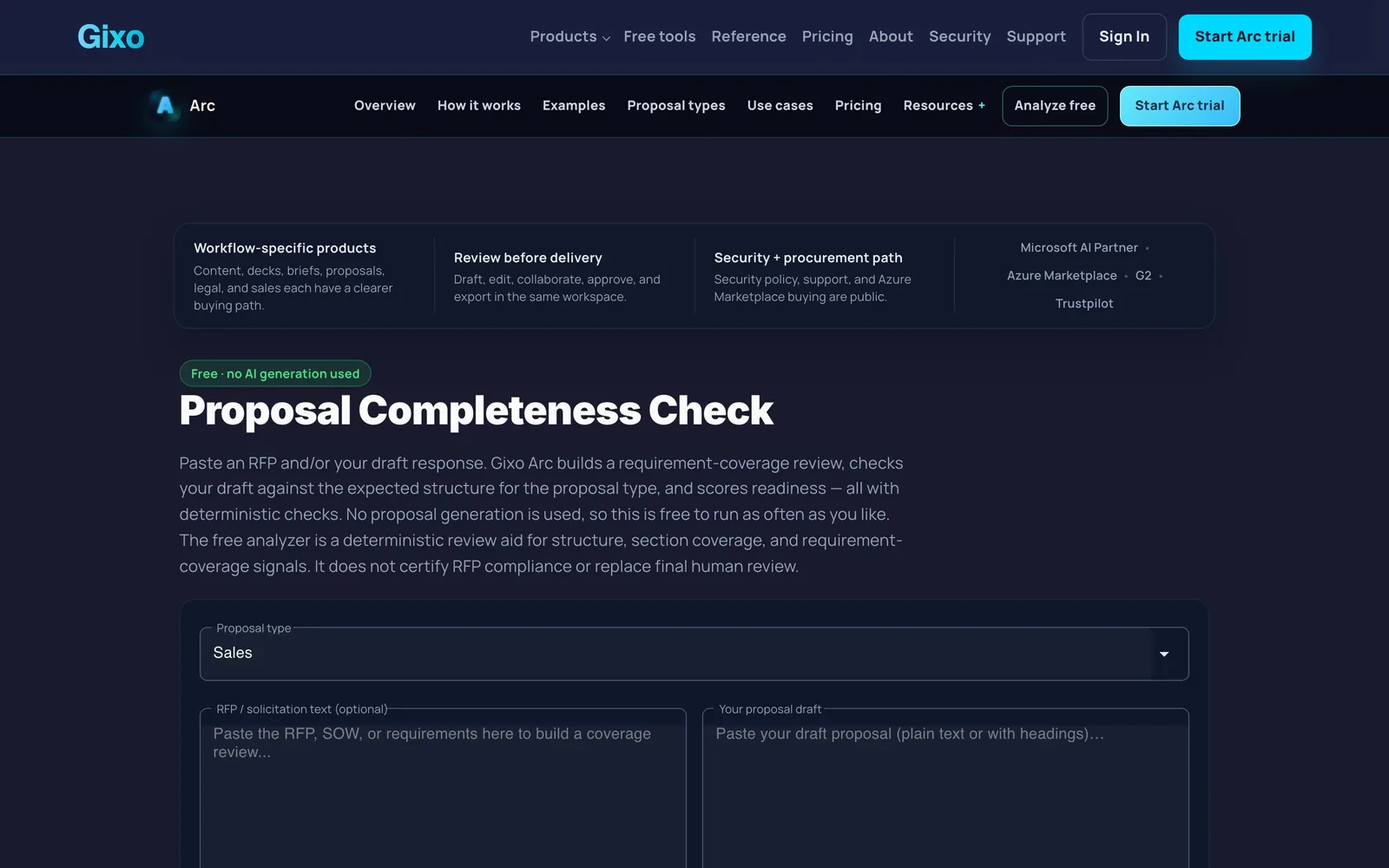
Proposal Completeness Check
Choose one of the 21 proposal types and paste your draft, the RFP, or both (up to 150,000 characters each). Arc scores readiness from 0 to 100 — Not ready below 40, Emerging 40–59, Close 60–79, Ready 80 and above — and reports RFP requirement coverage, section coverage, a readiness checklist and consistency findings. It uses fixed rules and no AI, so it doesn't draw on any plan. Requirement coverage is matched on keywords and concepts, so check each requirement yourself. The PDF report needs a sign-in.
| More free tools | What it does |
|---|---|
| RFP Requirement Extractor gixo.ai/tools/rfp-requirement-extractor | Pulls explicit submission requirements, deadlines, “musts” and response instructions out of an RFP. |
| Bid / No-Bid Scorecard gixo.ai/tools/bid-no-bid-scorecard | Scores an opportunity on fit, access, evidence, capacity, risk and economics. |
| Proposal Version Diff gixo.ai/tools/proposal-diff | Writes a section-by-section change log between two versions of a proposal. |
| Statement of Work (SOW) Template Builder gixo.ai/tools/sow-builder | Builds a scope with numbered deliverables, acceptance criteria, dependencies and change control. |
| Capability Statement Builder gixo.ai/tools/capability-statement-builder | Assembles a one-page capability statement and checks common government-supplier identifiers. |
Tips
- Label your sources. The source role on each file tells Arc what the buyer asked for and what counts as your evidence.
- Search TBD before you send. Anything your files don't support is left marked TBD.
- Check the readiness score first. Paste your draft into the free completeness check before you create a tracked link.
- The dashboard lists your latest 72 proposals, and its search covers those.
Quick links
| Arc dashboard | gixo.ai/dashboard/arc |
| Create Proposal | gixo.ai/proposals/create |
| Arc projects | gixo.ai/arc/projects |
| Arc answer library | gixo.ai/arc/library |
| Proposal Completeness Check | gixo.ai/arc/analyze |
| All free tools | gixo.ai/tools |
| Arc plans | gixo.ai/products/proposals#plans |
| Help and support | gixo.ai/support |
Current as of 14 September 2026 and checked against the Arc code. If a screen doesn't match what you see, the product has moved on — tell us at gixo.ai/support and we'll update this guide.