
Skip to content
Sign In Try Free
Workflow-specific products Content, decks, briefs, proposals, legal, and sales each have a clearer buying path.
Review before delivery Draft, edit, collaborate, approve, and export in the same workspace.
Security + procurement path Security policy, support, and Azure Marketplace buying are public.
Books use case

Start from a training manual template, then write, review, and distribute the manual

Training manual writing software is a tool for producing structured, reviewable instructional manuals — onboarding guides, SOP handbooks, and enablement documentation — rather than a single blog post or generic doc file. Gixo Folio approaches this as a book-like workflow: a manuscript brief, ordered chapters, a full in-workspace review pass, and export to EPUB, editable DOCX, chapter PDF, HTML, Markdown, or SCORM. It is built for instruction-first, sequence-driven content, with localized editions available once the source manual is finalized. A training manual template is the section-by-section structure the manual needs before drafting starts — purpose and scope, prerequisites, roles, the process split into ordered modules, troubleshooting, reference, and a revision log. In Gixo Folio that template becomes the manual's chapter plan itself instead of a separate document you copy from.
Instruction-first Built for step-by-step manuals, enablement guides, and structured internal training.
Reviewable The manual can be reviewed end to end in the workspace before export.
6 exports EPUB, editable DOCX, chapter PDF, HTML, Markdown, and SCORM support different training handoff needs.
89 Localized editions are available after the source manual is ready.
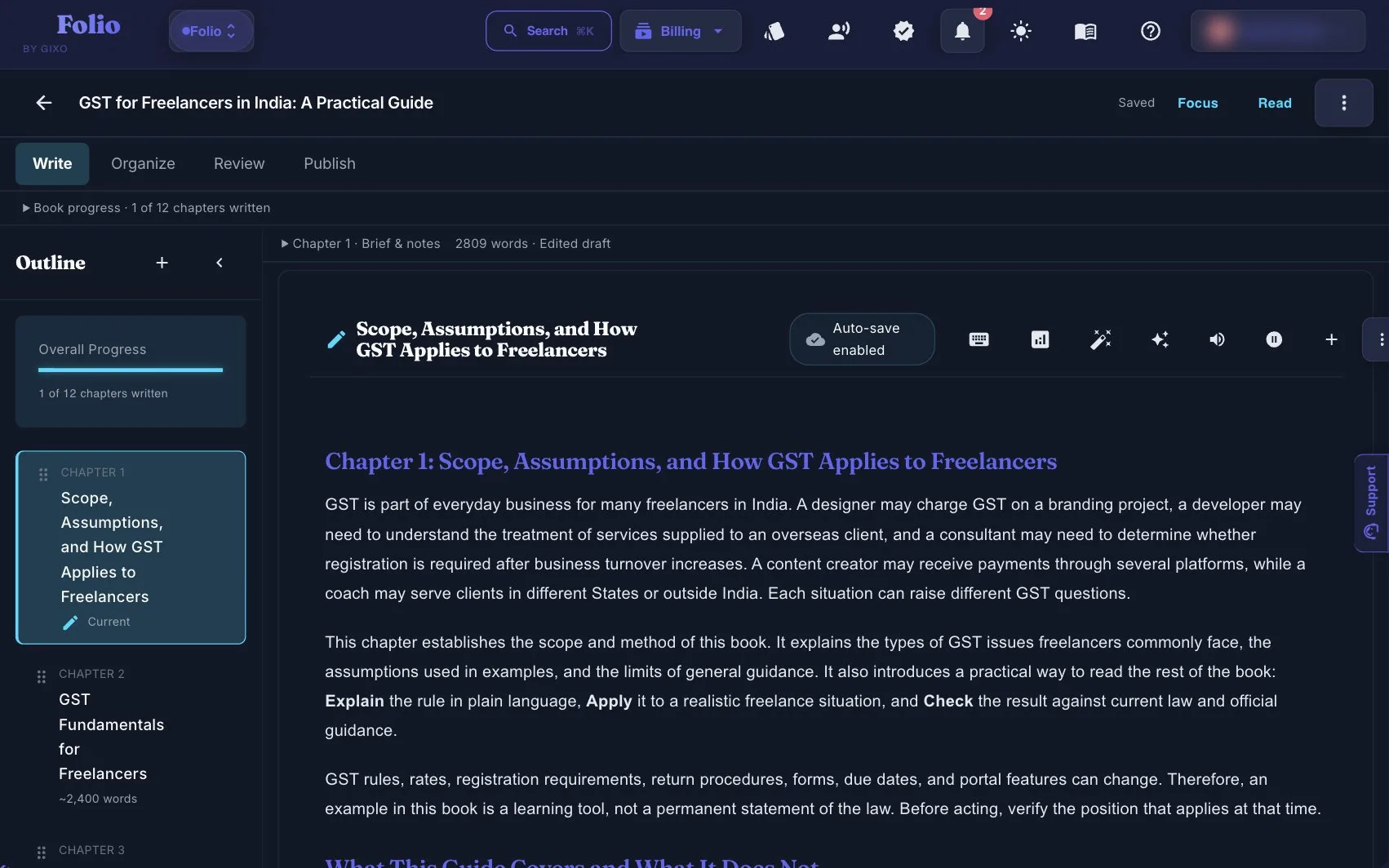
Gixo Folio — a real Gixo Folio book workspace showing chapter-by-chapter progress and available editions
A real Gixo Folio book workspace — chapter-by-chapter progress, plus editions and optional add-ons like an international or audiobook edition.
01Brief the book
02Shape the outline
03Draft chapters
04Review the manuscript
05Export the edition
Folio is a strong fit whenThe manuscript still needs structure, revision, and a finish line.

Use the persistent book workspace when the outcome is a real guide, authority book, training manual, client asset, or exportable edition.

Consider another tool whenYou only need one narrow part of the publishing job.

If your manuscript is already finished and you only need specialist formatting or a dedicated fiction system, a focused tool may be the simpler choice.

What does a training manual need to get right?

Operational clarity matters more than flashy generation.

Scope
Start with the process or capability being taught
A training manual works only when the scope and intended user are clear before drafting starts.
Sequence
Break the manual into usable learning units
The chapter order should mirror how the learner or operator actually encounters the process.
Consistency
Keep terminology and steps aligned
A chapter-based workflow helps maintain consistency across sections, procedures, and references.
Review
Read it like a trainee
Reviewing the full manual in the workspace catches missing prerequisites, unclear steps, and weak transitions before export.
Delivery
Export to the format the organization needs
Use PDF for static distribution or SCORM when the manual needs e-learning handoff.
Localization
Expand only after the source manual is stable
Create localized editions across 89 locale variants once the primary version is correct.

What is the workflow for writing a training manual?

The better the operational sequence, the better the manual.

1
Define the learner and task
Clarify who the manual is for and what they must be able to do after using it.
2
Map the instructional sequence
Create the chapter plan around the real workflow, not just the information you want to include.
3
Draft and tighten the procedures
Generate the first draft quickly, then revise for precision, consistency, and usability.
4
Review and export
Review the manual in the workspace as an operator or trainee would, then export the final version in the right format.

How does Gixo Folio compare to generic training document tools?

A manual needs manuscript discipline, not just fast text.

Decision areaGixo FolioGeneric training doc tool
Instruction flowBuilt around ordered chapters and reviewOften document-first, not manual-first
TemplateThe template becomes the editable chapter planA static file you copy into a document
Review passReview the full manual in the workspace before exportUsually fragmented
Export pathsEPUB, editable DOCX, chapter PDF, HTML, Markdown, SCORMVaries
LocalizationSupported across 89 localesOften handled elsewhere
Best forOnboarding, SOP handbooks, enablement guidesGeneral document drafting
Why manuals need a book-like workflow
Instruction benefits from chapter discipline

Training manuals are often treated like a pile of documents, but they work better when they are structured like a coherent instructional book. That means ordered chapters, consistent terminology, and a real review pass before distribution.

This is where a book workflow becomes useful.

Why Gixo Folio fits training manuals
The manual can move from plan to export inside one system

Gixo Folio gives the manual a defined brief, chapter structure, revision path, export flow, and later edition support. That is especially useful when the manual is large enough that stitching together isolated docs becomes a maintenance problem.

It is a better fit than treating the manual as disconnected content pieces.

A training manual template you can copy
A working section structure — adapt the module count to the process

Cover and control page — manual title, version number, owner, last-reviewed date, and who the manual is for. Section 1, Purpose and scope — what the manual covers, what it deliberately does not, and what the reader should be able to do after using it. Section 2, Prerequisites — the access, tools, permissions, and prior training a reader needs before step one. Section 3, Roles and responsibilities — who performs each part of the process and who to escalate to. Sections 4 onward, The process in ordered modules — one module per stage of the real workflow, each with its own objective, numbered steps, a worked example or screenshot, and a check that confirms the step actually worked. After the modules: Troubleshooting — the failure modes people actually hit, each with the fix. Reference — glossary, forms, checklists, and links to the source policies. Revision log — what changed, when, and by whom, so the manual can be maintained instead of rewritten.

The pattern — scope, prerequisites, roles, ordered modules, troubleshooting, reference, revision log — holds for onboarding guides, SOP handbooks, and compliance manuals alike. Change the module count to fit the process being taught, and keep each module small enough that a trainee can finish it in one sitting.

Adapting the training manual template
The same skeleton, weighted differently by manual type

An onboarding manual front-loads context: purpose, roles, and prerequisites carry more weight than procedural depth, because the reader is orienting before they operate. An SOP handbook inverts that — scope is a paragraph, and almost everything else is ordered modules with numbered steps and a verification check at the end of each one. A compliance or policy manual keeps the reference and revision-log sections the other two often skip, because the audit question is which version was in force on a given date. A client-facing training guide adds one section the internal versions do not need: a short note on how to use the manual, because the reader has no colleague to ask.

Gixo Folio does not hand you a static file to fill in and then leave you to it. The template is entered as the manual's chapter plan, where chapters can be added, renamed, reordered, or removed while the manuscript is still cheap to change. The structure then stays attached through drafting and revision, survives the full review pass, and exports as EPUB, editable DOCX, chapter PDF, HTML, Markdown, or SCORM — so the template you started from is still the shape of the file you hand over.

Test each module before release
A manual is only useful when the reader can complete the task

Read every module as the intended learner. Confirm the prerequisite is available, the numbered steps use the same terms as the interface, the worked example matches the current process, and the final check proves the task worked. Record the version and review date so the manual can be maintained after launch.

That release check is where a structured manuscript becomes operational training rather than a long document that merely describes the process.

Frequently Asked Questions

Can Gixo Folio be used for training manuals?
Yes. It is a strong fit for structured manuals, enablement guides, SOP handbooks, and onboarding material that benefits from chapter discipline.
Does it support SCORM export?
Yes. Gixo Folio supports SCORM alongside PDF, EPUB, HTML, and Markdown.
Can teams review the manual before export?
Yes. Reader mode and comments make it easier to treat the manual as one coherent document before export.
Can I localize a training manual later?
Yes. Once the source manual is final, Gixo Folio supports localized editions across 89 locale variants.
What is training manual writing software?
Training manual writing software is software built to produce structured, ordered instructional documents — such as onboarding guides, SOP handbooks, and enablement material — rather than a single freeform document. Gixo Folio treats a training manual as a manuscript: it starts from a defined scope and learner, is organized into chapters that mirror the real process being taught, gets reviewed end to end in the workspace, and exports to EPUB, editable DOCX, chapter PDF, HTML, Markdown, or SCORM for e-learning handoff.
How is training manual writing software different from a generic document editor?
A generic document tool is document-first: it produces one file at a time with no built-in chapter structure or manual-wide review pass. Training manual writing software like Gixo Folio is manual-first — it maintains chapter order, consistent terminology, and a single review pass across the whole manual before export, and it supports SCORM export specifically for e-learning delivery, which generic document tools do not.
What should a training manual template include?
A usable training manual template includes a control page (title, version number, owner, last-reviewed date), a purpose and scope section, prerequisites, roles and responsibilities, the process broken into ordered modules with numbered steps and a check at the end of each, a troubleshooting section, a reference section for glossary and forms, and a revision log. The module sequence should mirror the order in which the reader actually encounters the process, not the order the information happened to be written down.
Is a training manual template the same as an SOP template?
They overlap but are weighted differently. An SOP template is procedure-first: short scope, then numbered steps for one process, with a verification check at the end. A training manual template covers a whole capability rather than a single procedure, so it carries more context up front — purpose, prerequisites, and roles — and usually holds several ordered modules plus troubleshooting and reference sections. Gixo Folio handles both as chapter plans; the SOP handbook simply uses shorter chapters.
Does Gixo Folio give me a downloadable training manual template?
Not as a separate file to download. The section structure on this page is the template to work from, and in Gixo Folio you enter it as the manual's chapter plan — adding, renaming, reordering, or removing chapters — so it stays attached to drafting, revision, and review instead of being copied into another document. If you need the structure as a reusable file, export the finished manual as editable DOCX and use it as the starting shape for the next one.
Need structured manual software instead of another loose document tool?
Use the Books pricing page if the manual is a real project, or review the guide to see how the manuscript workflow handles planning, review, and export.

Updated