
Sign In Try Free
Workflow-specific products Content, decks, briefs, proposals, legal, and sales each have a clearer buying path.
Review before delivery Draft, edit, collaborate, approve, and export in the same workspace.
Security + procurement path Security policy, support, and Azure Marketplace buying are public.
Books use case

An AI self-help book generator for transformation-led books that need structure

An AI self-help book generator is software that turns a topic and a reader transformation into a structured self-help manuscript — a chapter journey, practical exercises, a revision pass, and a final export — rather than just generating generic advice text. Gixo Folio works this way: it helps you define the promise, sequence the chapter progression, draft with prompts or reflection points, review the full manuscript in the workspace, and only then export it. The difference from a generic generator is that the book is built around the reader's transformation and chapter movement, not just topic-based content output.
Transformation-first The manuscript should be built around the reader outcome, not just advice volume.
Structured journey Each chapter should move the reader toward a clear shift or practice.
Review-led The book can be reviewed end to end in the workspace before export.
89 Localized editions can follow once the source manuscript is complete.
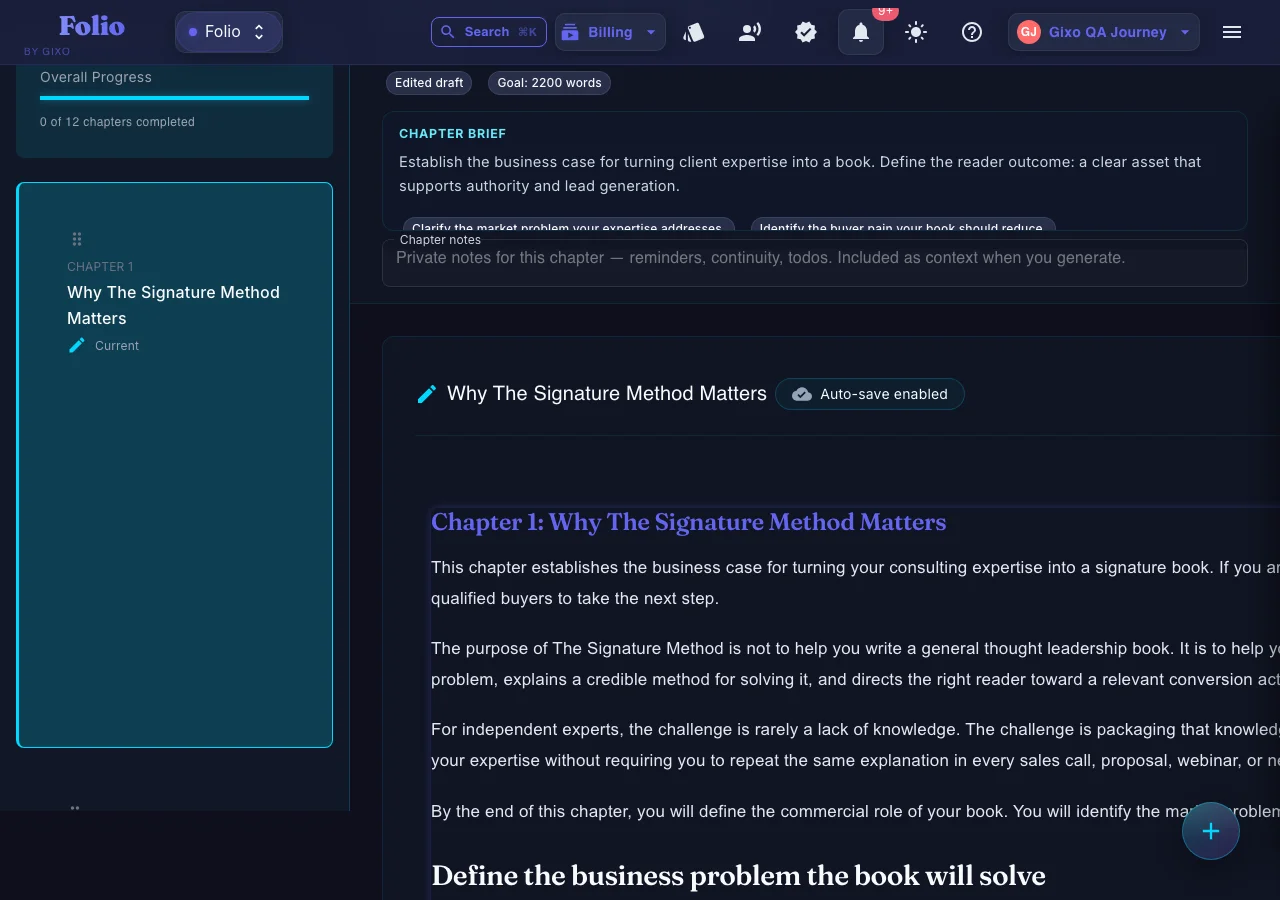
Gixo Folio — a real nonfiction chapter drafted inside Gixo Folio's editor
A real chapter drafted inside Gixo Folio's editor — one chapter at a time, with full editing control before moving to the next.
01Brief the book
02Shape the outline
03Draft chapters
04Review the manuscript
05Export the edition
Folio is a strong fit whenThe manuscript still needs structure, revision, and a finish line.

Use the persistent book workspace when the outcome is a real guide, authority book, training manual, client asset, or exportable edition.

Consider another tool whenYou only need one narrow part of the publishing job.

If your manuscript is already finished and you only need specialist formatting or a dedicated fiction system, a focused tool may be the simpler choice.

What does a strong AI self-help book workflow need?

Self-help books fail when the advice is generic and the chapter journey is weak.

Promise
Define the transformation clearly
Start with what should change for the reader by the end of the book.
Chapter journey
Sequence the reader's progress
The order of chapters should reflect how the reader grows, practices, or changes.
Practicality
Include prompts, exercises, or reflection points
The manuscript is stronger when it gives the reader something to do, not just more to read.
Revision
Remove vague or repetitive advice
Use revision to sharpen the manuscript into a clear, useful reader experience.
Export
Choose the right final file after review
Export only when the self-help manuscript reads as one coherent journey.
Expansion
Create more editions later
Once the source version is finished, build additional editions across 89 locale variants.

What is a practical process for writing an AI self-help book?

The clearer the transformation, the stronger the manuscript becomes.

1
Define the reader change
Clarify the shift the book is supposed to help the reader make.
2
Map the chapter progression
Turn that shift into a chapter sequence with clear movement and practical checkpoints.
3
Draft and refine the guidance
Use AI for momentum, then revise for specificity, clarity, and usefulness.
4
Review and export
Review the full manuscript in the workspace and only then export the finished version.

How does Gixo Folio compare to a generic self-help book generator?

The big difference is whether the book is designed around transformation or just content output.

Decision areaGixo FolioGeneric generator
Starting pointReader transformation and chapter journeyTopic prompt
Practical progressionChapter-based movement and exercisesOften flatter
ReviewReview in the workspace before exportOften skipped
Final fileExport built into the workflowUsually requires more tools
Best forStructured self-help and practical reader journeysFast motivational drafts
Edition expansionLocalized editions available once the source manuscript is complete (89)Not specified
Why self-help books are easy to get wrong
Advice without progression feels generic

A self-help manuscript often starts sounding repetitive when the reader journey is not clear. Without a strong transformation arc, the book becomes a collection of tips rather than an experience the reader can follow.

That is why chapter structure matters so much here.

Why Gixo Folio is a good fit
The manuscript can be built around the actual reader journey

Gixo Folio helps you define the promise, shape the chapter path, draft quickly, revise for practical value, review the whole book, and then export it. That gives the self-help manuscript a clearer spine than a one-shot generator typically provides.

It is a better fit for serious transformation-led books.

Frequently Asked Questions

Can AI help me write a self-help book?
Yes. AI can help with structure, chapter drafting, and revision speed, especially when the reader transformation is clearly defined.
What makes a self-help book good enough to publish?
A clear promise, a practical chapter journey, strong revision, and a real reader review pass before export.
Can Gixo Folio include exercises or prompts?
Yes. It is well suited to practical chapters that include exercises, reflection points, and guided action.
Can I export or translate the finished self-help book?
Yes. Gixo Folio supports final export and later editions across 89 locale variants.
What is an AI self-help book generator?
It is a tool that helps turn a reader transformation and topic into a structured self-help manuscript, including a chapter journey, practical exercises or reflection points, a revision pass, and a final export -- rather than just producing generic advice text from a prompt.
How is Gixo Folio different from a generic AI self-help book generator?
Gixo Folio starts from the reader's transformation and a chapter journey rather than a topic prompt, includes chapter-based practical progression (exercises, reflection points), supports reviewing the full manuscript in the workspace before export, and has export built into the workflow -- where generic generators are often positioned around fast motivational drafts with review and export handled elsewhere.
Need a self-help workflow that preserves the reader journey?
Use the Books pricing page if the manuscript is a real project, or review the guide to see how planning, drafting, and export connect.