Skip to content
Folio
Sign In Get started
Workflow-specific products Content, decks, visuals, briefs, proposals, legal, books, and project delivery each have a clearer buying path.
Review before delivery Draft, edit, collaborate, approve, and export in the same workspace.
Security + procurement path Security policy, support, and Azure Marketplace buying are public.
Books alternative

Compare Novelcrafter with Folio for the book workflow you need

Novelcrafter documents Codex/worldbuilding, AI writing and research, plus DOCX and Markdown novel export. Gixo Folio is the better alternative when you want a simpler, opinionated path from book brief to chapter review to final export without setting up a story system first.

Simpler setup Start from a book brief and chapter plan instead of a heavier codex model.
Monthly Subscribe for the months you need AI chapter drafting. Your own book downloads do not require an active plan.
Export-ready The final workflow centers on finished manuscript files, not just drafting depth.
Solo-owner Built for a single owner with lightweight review, not publisher operations.
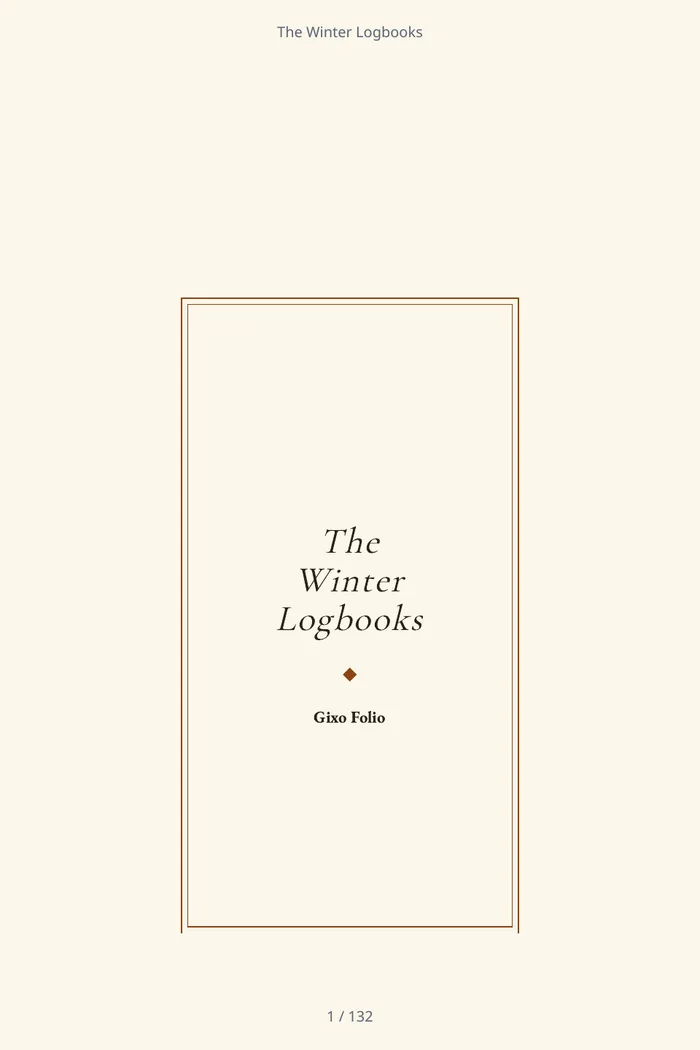
The cover of The Winter Logbooks, a novella Folio wrote: the title in a double frame above the author line.
A finished book to inspect · Novella

The Winter Logbooks

A quiet, character-driven novella in five chapters. A retired harbour pilot who has not spoken to his sister for years is asked by a young archivist to explain the entries in the old harbour office logbooks, and as they catalogue them the two learn how the town came to make a decision it never talks about. Folio wrote it from one paragraph; each chapter runs 4,890 to 6,860 words where the brief asked for about 4,500.

5 chapters · 30,103 words · 132-page PDF. It has not been edited, so judge the prose and the file for yourself.

Inspect the source brief

A quiet, character-driven novella set in a small harbour town over one winter. A retired harbour pilot who has not spoken to his sister for years is asked by a young archivist to explain the entries in the old harbour office logbooks. As the logbooks are catalogued, the two of them learn how the town came to make a decision it never talks about. Five chapters of about 4,500 words each, in close third person, for adult readers of literary fiction. Audience: Adult readers of quiet literary fiction. Tone: Reflective and warm. Everything in the book is invented: the town, the people, the organisations and the events. Use no real person, organisation, place or event, and no statistics or quotations.

Read the sample review notes

Screened mechanically for what the brief forbade (a real person, organisation, place, event, statistic or quotation) and found none: every capitalised name is a character, place or heading in the book. Nobody has edited the text, and nobody has read it for quality.

Review scenes and canon against the current manuscript

The standalone-novel workflow connects intake, scene purpose, book-local canon and editorial reading. Test the workflow with your own passage before trusting a longer draft.

Shape the scenes

Map selected passages to scenes with purpose, point of view, time and location. Move or merge current scenes and retain cut text in the stash.

Scene metadata and structure do not guarantee narrative quality; stale selections need remapping.
Keep canon book-local

Record when a claim applies and who knows it. Review proposed, approved or uncertain Story Bible entries with their evidence and history.

This is book-local context, not an automatic cross-book series consistency engine.

Review before changing prose

Use Quick AI or Power Edit for a selection, Ask Folio for reviewed chapter changes, and a continuity pass for quoted advisory findings.

Saved before-images and revision checks support recovery; AI can still introduce contradictions.

Start blank, import and manually edit your own book. Its downloads and proofs do not need an active Folio subscription. New AI planning, drafting and editorial assistance need eligible access; translation and narration use separate edition conditions. Existing book view, comment and edit permissions apply.

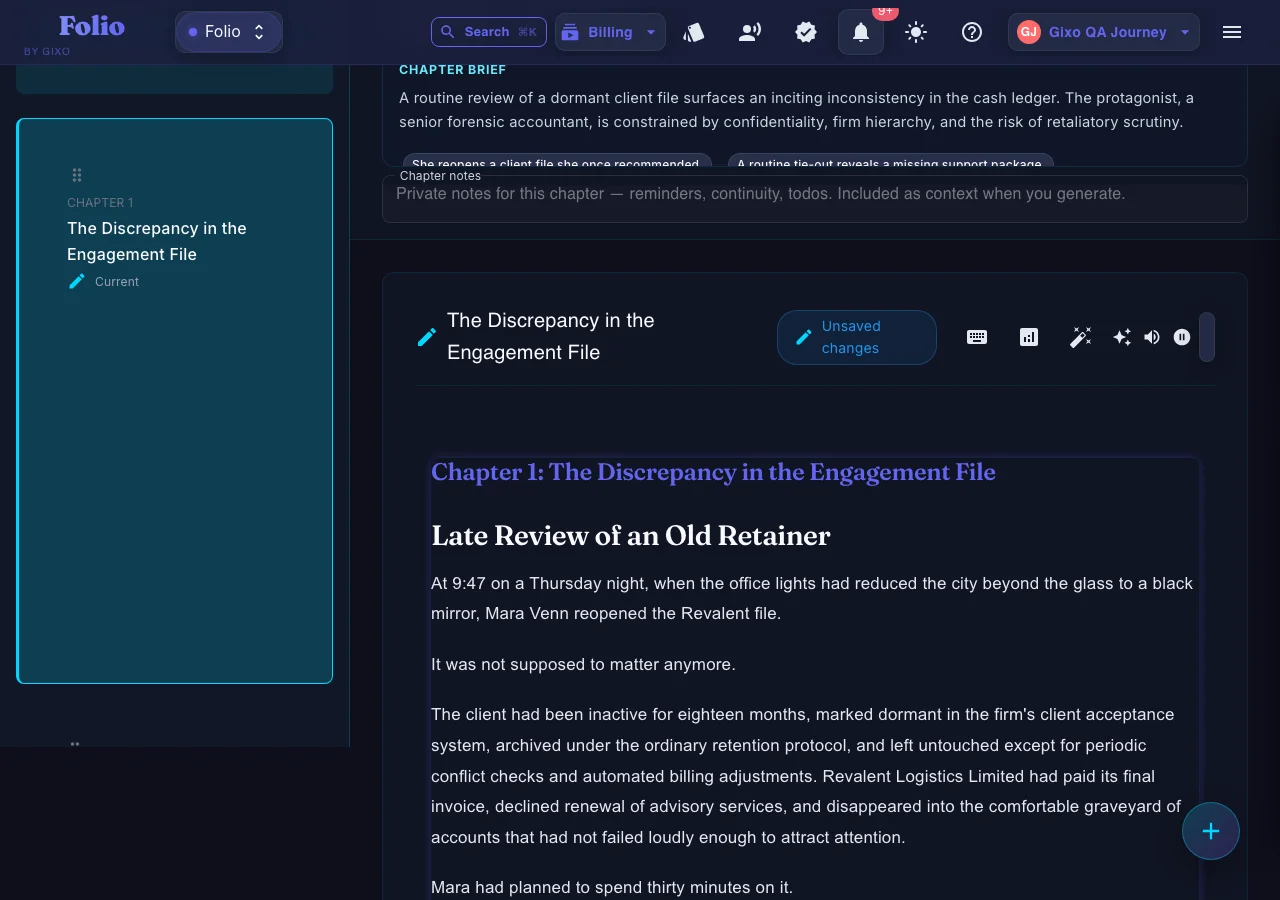
Gixo Folio — a real fiction chapter drafted inside Gixo Folio's editor
A real fiction chapter drafted inside Gixo Folio — the workspace supports long-form narrative prose, not just nonfiction guides. This novella and its names were generated from a brief written for this picture.
01Brief the book
02Shape the outline
03Draft chapters
04Review the manuscript
05Export the edition
Folio is a strong fit whenThe manuscript still needs structure, revision, and a finish line.

Use the persistent book workspace when the outcome is a real guide, authority book, training manual, client asset, or exportable edition.

Consider another tool whenYou only need one narrow part of the publishing job.

If your manuscript is already finished and you only need specialist formatting or a dedicated fiction system, a focused tool may be the simpler choice.

Why Gixo Folio is a better fit for getting your book done

Use Gixo Folio when the book needs to get finished and exported with less setup overhead.

Lower setup
Start with the manuscript, not the system
Brief the book, shape the chapters, and move into drafting without standing up a separate codex-heavy environment first.
Final output
Treat the export as part of the workflow
EPUB, editable DOCX, chapter PDF, HTML, Markdown, and SCORM sit inside the same book surface instead of being an afterthought.
Edition path
Keep the source manuscript ready for localization
Create international editions across 87 locale variants once the original book is finished.
Export clarity
Know when to trigger final export
Revise chapters in the workspace and confirm the manuscript is complete before choosing the export format.
Buying clarity
Use a monthly Folio plan
That purchase model is easier when the buyer wants AI drafting for a defined manuscript, not another open-ended monthly tool.
Nonfiction fit
Better for structured authority books and guides
Novelcrafter is more obviously fiction-first; Gixo Folio is stronger where the manuscript needs a business or educational outcome.

How to decide between Novelcrafter and Gixo Folio

Choose based on whether you need deeper story systems or the chapter, review and final-file controls you need.

1
Check whether codex depth is the actual requirement
If the project depends on worldbuilding depth and custom lore systems, Novelcrafter is aligned with that need.
2
Check the type of book
If the book is nonfiction, client-facing, or authority-driven, simpler structure and stronger export often matter more than codex richness.
3
Check how much setup you want
If you want to move quickly from brief to outline to chapter drafts, a lighter workflow wins.
4
Check how the project ends
If you need a polished final file and later editions, optimize for that finish line from the start.

Gixo Folio vs Novelcrafter

Both are serious writing tools; they optimize for different jobs.

Decision areaGixo FolioNovelcrafter
Primary fitStructured nonfiction and finished manuscript deliveryNovel writing built around its Codex, which it calls a story bible and world builder
Setup overheadBrief and chapter planAsk how much Codex setup your book needs before drafting
Pricing modelManuscript import and manual authoring without a subscription; paid AI chapter draftingRecurring tiered plans billed monthly or annually; 21-day trial, no free plan
Final exportFirst-class book export workflowDOCX and Markdown novel export, with Codex/chats/snippets options
Edition growthInternational editions across 87 localesCheck the current language and edition workflow
Best forConsultants, educators, authority books, focused projectsAuthors who want a Codex for their story world and their own AI connections
Comparison basis
Vendor documentation, not a hands-on score

Checked 6 November 2026 against Novelcrafter's features page, pricing page and novel export help, linked below. Those pages establish the Codex, tiered plans billed monthly or annually with a 21-day trial and no free plan, bring-your-own-key AI access, and Word or Markdown novel export. They describe supported workflows; no matched-output quality test is claimed here.

Choose Novelcrafter if
The codex is the product you want

Novelcrafter makes the most sense if your workflow centers on worldbuilding, ongoing story systems, and a more customizable fiction environment. In that case, the time you give the Codex is part of the value.

That is especially true for novelists building large fictional universes.

Choose Gixo Folio if
The book needs a reviewable production path

Gixo Folio is the better fit when the manuscript should move from planning into revision and export with less operational overhead. It is particularly strong when the book supports a business, training, or client education goal.

That makes it a credible Novelcrafter alternative for nonfiction buyers who do not want to set up a story system they will not use.

Frequently Asked Questions

Is Gixo Folio better than Novelcrafter for fiction?
Not across the board. Novelcrafter is more fiction-system-oriented. Gixo Folio is the better choice when you value simpler workflow, final export, and nonfiction book delivery.
How does Gixo Folio pricing compare?
Monthly Folio Author and Pro plans map to the months you need AI chapter drafting, and you can cancel when the book ships. Novelcrafter also bills monthly or annually, so compare the tier you would actually use.
Does Gixo Folio support export after the manuscript is ready?
Yes. Books supports direct and background export for EPUB, editable DOCX, chapter PDF, HTML, Markdown, and SCORM.
Can I localize a finished book?
Yes. Gixo Folio supports international editions across 87 locale variants once the source manuscript is final.
What export formats does Gixo Folio support?
Gixo Folio supports EPUB, editable DOCX, chapter PDF, HTML, Markdown, and SCORM export from the same workspace.
Want a book workflow without setting up a story system first?
Use the Books pricing page to evaluate the monthly plans, then read the guide to see how the workflow handles planning, revision, and export.

Updated