
Write a nonfiction book with AI that reads like you meant every word
To write a nonfiction book with AI, start from the book's brief and reader outcome, not just the topic: define the promise, build an explicit chapter plan around it, draft chapters quickly with AI while you revise for authority and proof, then review the full manuscript before export. Gixo Folio structures this as a four-step workflow — brief, chapter plan, draft-and-revise, review-export-localize — built for authority books, guides, training assets, and client education rather than loose AI-generated text. A finished manuscript can be exported and later expanded into international editions.
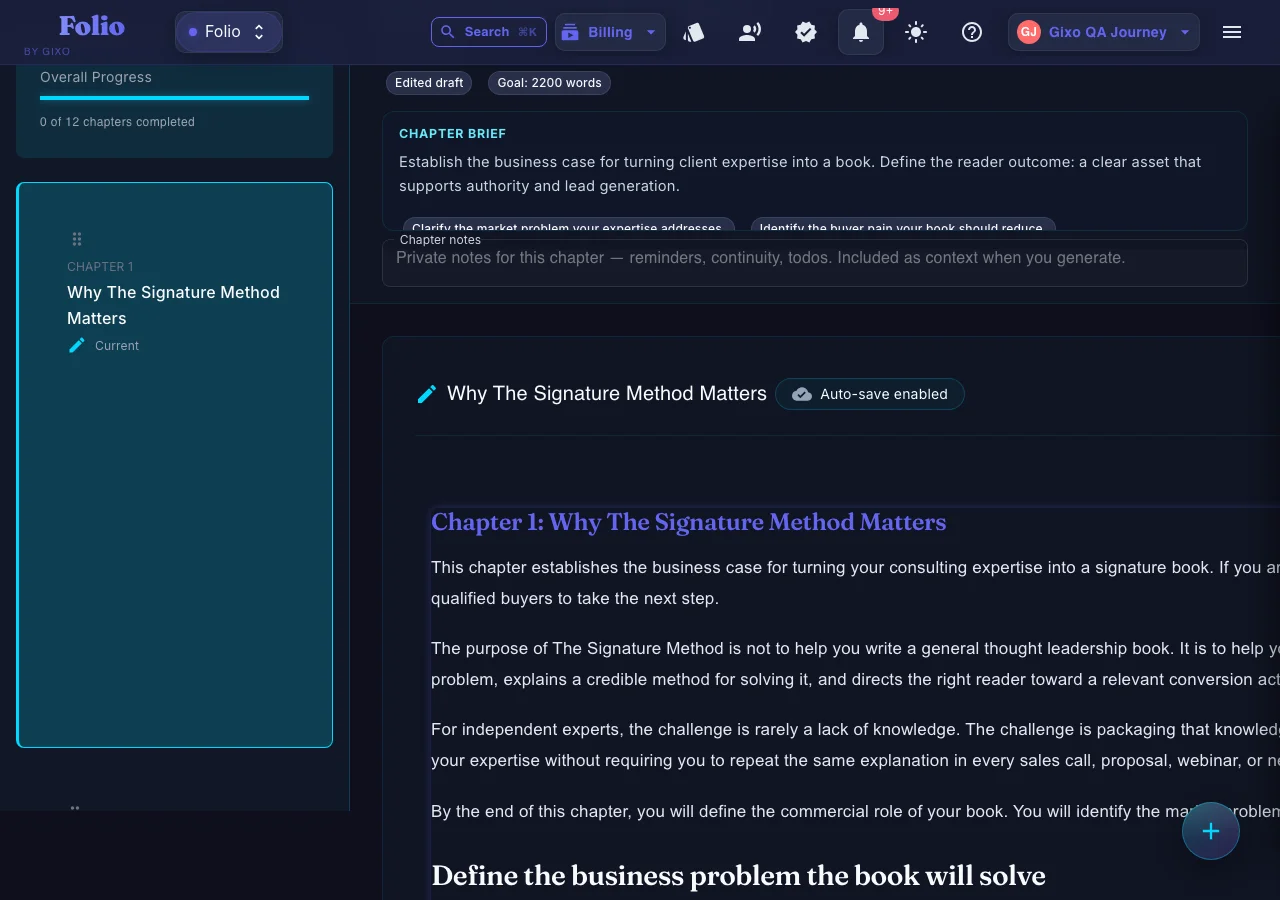
Use the persistent book workspace when the outcome is a real guide, authority book, training manual, client asset, or exportable edition.
If your manuscript is already finished and you only need specialist formatting or a dedicated fiction system, a focused tool may be the simpler choice.
What principles make an AI nonfiction workflow actually work?
Nonfiction books fail when they drift away from the reader outcome and lose structural discipline.
What is the workflow for writing a nonfiction book with AI?
This is the shortest path to a book that still feels intentional.
Why does a structured workflow beat generic AI for nonfiction books, and which types of nonfiction fit?
The difference is whether the manuscript has a real operating plan.
| Decision area | Gixo Folio | Generic AI writer |
|---|---|---|
| Starting point | Book brief and reader outcome | Prompt or topic |
| Chapter structure | Explicit chapter plan | Loose sections generated ad hoc |
| Revision | Manuscript-aware editing flow | Text generation without manuscript governance |
| Final export | Built into the workflow | Usually requires another tool |
| Best for | Authority books, guides, training, workbooks | Fast idea drafting |
| AI drafting allowance | Folio Author includes 10 AI chapters/month | N/A |
| Locale expansion | Available across 89 supported locale variants after the source manuscript is done | N/A |
AI is most useful in nonfiction when it helps you organize, expand, and draft faster while you still provide the judgment, examples, and clarity that make the book worth reading.
That means the workflow should support structure and revision instead of celebrating raw output volume.
Gixo Folio is built around a structured chapter workflow, export, and later editions. That is much closer to how authority books, client guides, and educational manuscripts actually get used in the real world.
It is a stronger fit than a generic chatbot for buyers who need the finished book to perform a job.
Frequently Asked Questions
Nonfiction-adjacent Books pages
These pages are the strongest next reads if you are building a serious nonfiction manuscript.
More Gixo Folio pages
Related book writing, publishing, and alternative pages.
Updated