
Generate chapters that stay true to the shape of your book
An AI chapter generator is a tool that drafts book chapter content from AI, but a standalone chapter draft is only useful if it still answers to the same book brief and outline it came from. Gixo Folio generates chapters inside one manuscript workspace — connected to the book's outline, revision pass, review, and export — rather than as an isolated block of text from a blank prompt. That keeps generation, revision, and export tied to the same project instead of requiring a copy-paste handoff to another tool.
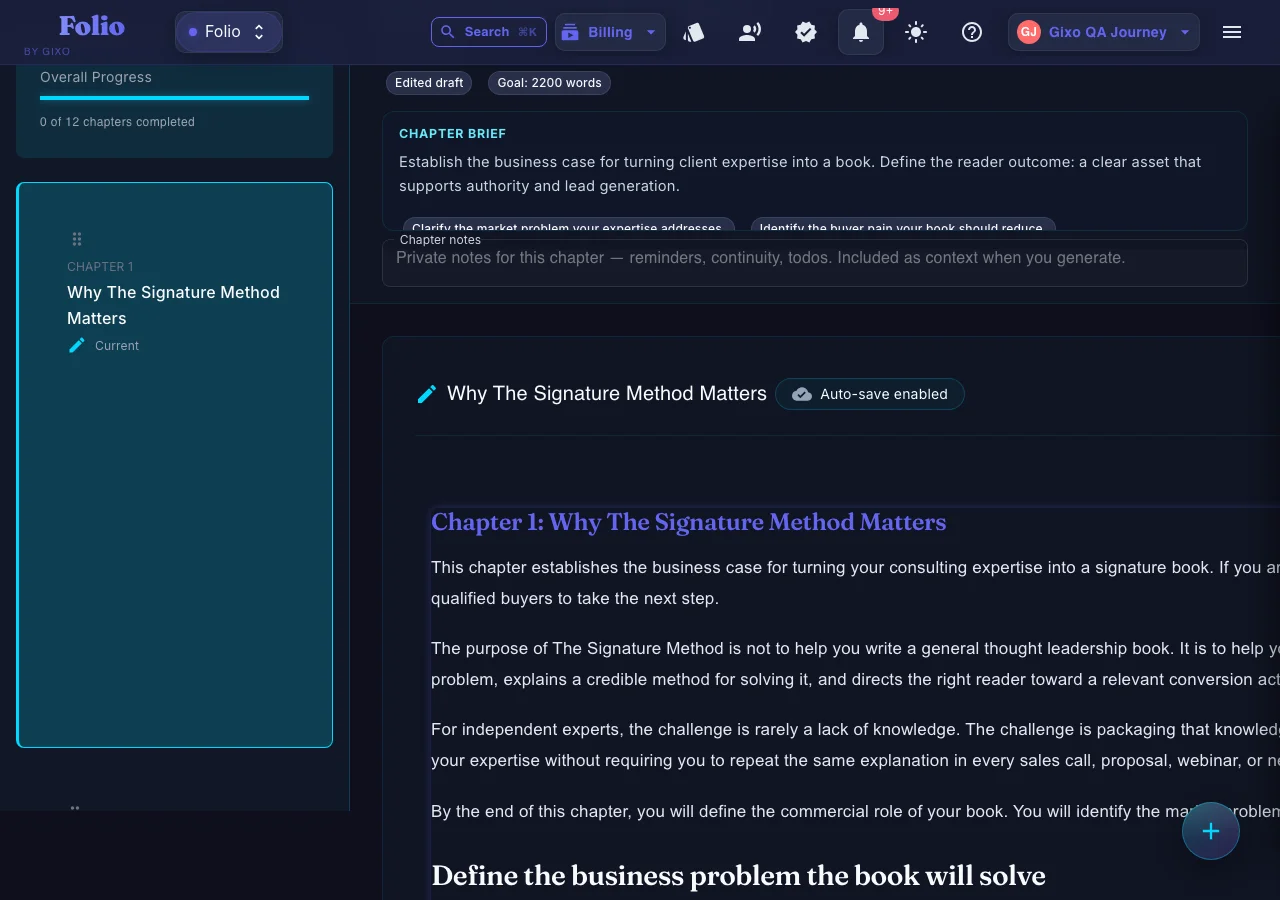
Use the persistent book workspace when the outcome is a real guide, authority book, training manual, client asset, or exportable edition.
If your manuscript is already finished and you only need specialist formatting or a dedicated fiction system, a focused tool may be the simpler choice.
What should you expect from an AI chapter generator that actually works?
The job is not just producing text. The job is producing the next useful part of the book.
How do you use AI chapter generation well inside an AI book generator?
The stronger the structure, the better the chapter output.
How do Gixo Folio chapters compare to generic AI chapter output?
The main difference is whether the chapter belongs to a book or just exists as a block of text.
| Decision area | Gixo Folio | Generic AI chapter tool |
|---|---|---|
| Chapter context | Connected to the book brief and outline | Prompt-specific only |
| Revision flow | Edit in the same manuscript workspace | Often copy and paste elsewhere |
| Final review | Review chapters in the workspace before export | Usually missing |
| Export | Feeds straight into the final book | Requires another product |
| Best for | Books that must actually get finished | Quick drafting experiments |
| AI drafting allowance | Folio Author includes 10 AI chapters/month; Pro includes 50 | Not applicable (per-generation tools) |
A generic chapter generator can help you move faster, but it often creates chapters that read like isolated content blocks. That leads to repetition, drift, and weak transitions once the full manuscript is assembled.
The issue is usually context, not output length.
Gixo Folio keeps the chapter inside one broader manuscript flow: outline, draft, revise, review, export, and editions. That makes each generated chapter more useful because it remains answerable to the book's actual structure and purpose.
For serious nonfiction projects, that is the difference between drafting and finishing.
Frequently Asked Questions
Related drafting and planning pages
These pages cover the next most common questions after chapter generation.
More Gixo Folio pages
Related book writing, publishing, and alternative pages.
Updated