
Skip to content
Sign In Try Free
Workflow-specific products Content, decks, briefs, proposals, legal, and sales each have a clearer buying path.
Review before delivery Draft, edit, collaborate, approve, and export in the same workspace.
Security + procurement path Security policy, support, and Azure Marketplace buying are public.
Books fiction use case

Novel writing software for chapter-based fiction inside one manuscript workflow

An AI novel writer is a tool that helps you outline, draft, revise, review, and export a novel from one workspace instead of stitching scenes together across separate tools. Gixo Folio works this way: it drafts fiction chapter by chapter inside a single manuscript workflow, then lets you revise for continuity and pacing, review the whole book, and export the finished file. It is built for novelists who want the outline-to-export workflow to stay coherent, not for fiction-first brainstorming or scene-idea generation.
Chapter-first The novel is drafted and revised chapter by chapter in one workspace.
Review-led Review the whole manuscript in the workspace before export.
6 exports The final novel can be exported from the same workflow once it is ready.
Alternative fit Useful for fiction writers who want one manuscript system more than a brainstorming-only tool.
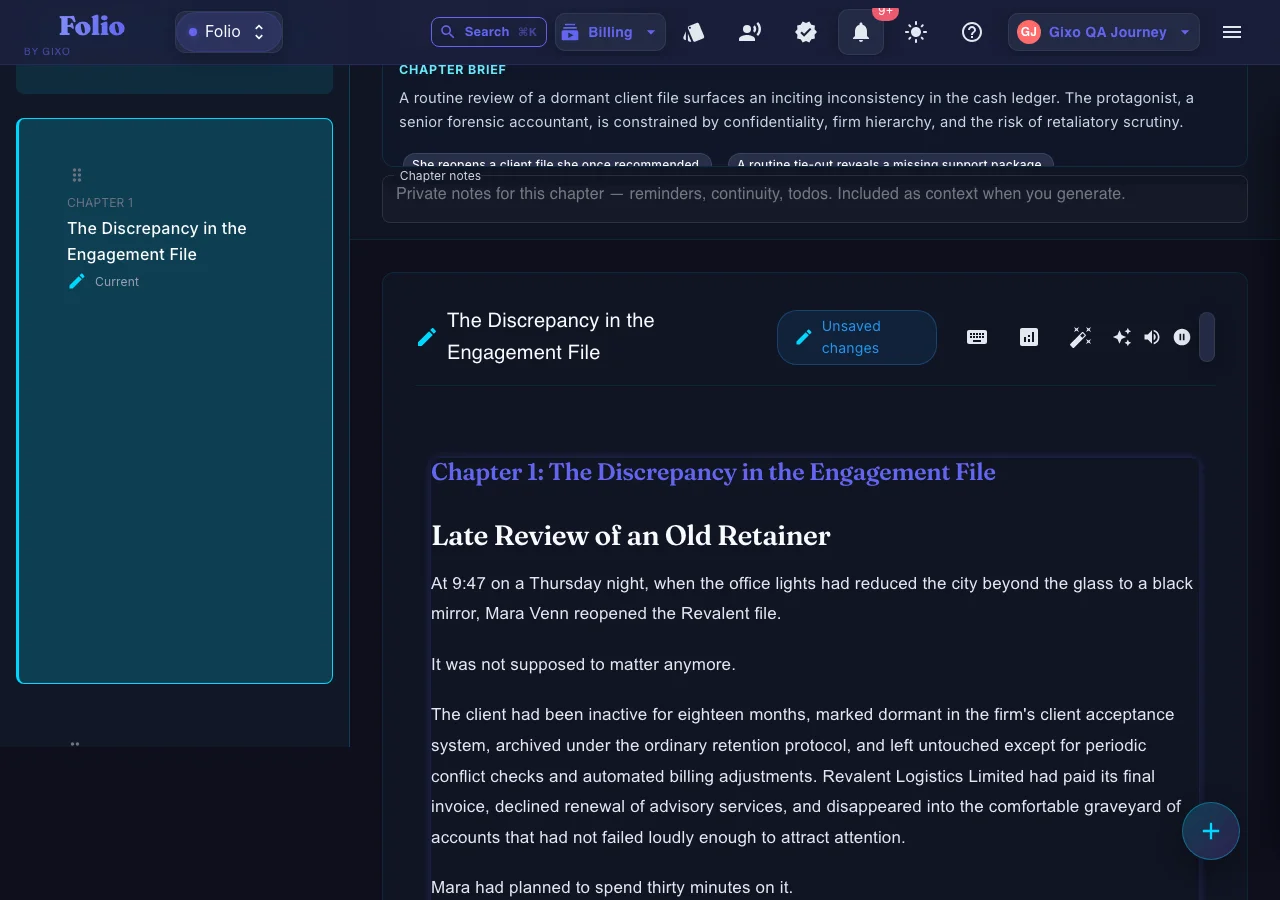
Gixo Folio — a real fiction chapter drafted inside Gixo Folio's editor
A real fiction chapter drafted inside Gixo Folio — the workspace supports long-form narrative prose, not just nonfiction guides.
01Brief the book
02Shape the outline
03Draft chapters
04Review the manuscript
05Export the edition
Folio is a strong fit whenThe manuscript still needs structure, revision, and a finish line.

Use the persistent book workspace when the outcome is a real guide, authority book, training manual, client asset, or exportable edition.

Consider another tool whenYou only need one narrow part of the publishing job.

If your manuscript is already finished and you only need specialist formatting or a dedicated fiction system, a focused tool may be the simpler choice.

What does Gixo Folio do well for novel projects?

This is a chapter-based fiction workflow, not a pure scene-suggestion engine.

Outline
Start from the shape of the story
A chapter plan helps keep the novel coherent before the draft expands.
Drafting
Generate chapters inside the same manuscript
Keep the novel together instead of scattering scenes across multiple tools.
Revision
Refine the manuscript in context
Use the editor to strengthen chapters once the first draft exists.
Manuscript review
Review the novel as a whole
Review pacing and continuity in the workspace before export instead of assuming chapter generation solved it.
Final file
Export the novel directly
Use the built-in export path when the manuscript is ready.
Alternative angle
Best when you want workflow over brainstorming depth
That is the key distinction between Gixo Folio and fiction-first tools.

How do you use Gixo Folio as an AI novel writer?

The product is most helpful when you want the manuscript workflow to stay coherent.

1
Shape the story spine
Outline the sequence of chapters or story beats before heavy drafting begins.
2
Draft chapter by chapter
Generate each chapter inside the same manuscript workspace.
3
Revise for continuity and pacing
Use revision to make the novel read as one whole book, not a set of disconnected scenes.
4
Review and export
Review the complete manuscript in the workspace before exporting the final novel.

Is Gixo Folio better than a fiction-first AI novel writer?

Choose based on whether you want brainstorming depth or a simpler manuscript workflow.

Decision areaGixo FolioFiction-first tool
Primary strengthOne manuscript workflow from outline to exportIdea generation, scene expansion, fiction-specific brainstorming
Chapter workflowCentral to the productVaries by tool
Review and exportReview and export from the same workspaceOften less central
Continuity across chaptersStory Bible entries track characters, settings, timelines, and plot threadsUsually a core feature of fiction-first tools
Free tierNone — Folio is monthly, paid-plan onlySome tools offer a limited free tier or trial
Best forNovelists who want workflow coherence and final deliveryNovelists who want more fiction ideation depth
How to choosePick Gixo if the finish line matters mostPick the fiction-first tool if brainstorming depth matters most
Where Gixo Folio is a good fit for fiction
When the novel needs a coherent workspace

If your biggest problem is keeping the manuscript together from outline to final export, Gixo Folio can be a good fit. The chapter workflow, revision tools, and export path all support that goal.

That makes it a credible AI novel writer for structured fiction workflows.

Where specialist fiction tools still lead
When brainstorming depth is the main requirement

If the purchase is primarily about creative ideation, scene expansion, and fiction-specific prompting depth, fiction-first tools remain more obviously positioned for that use case. Gixo Folio is stronger when the novel still needs a clean draft-to-delivery workflow.

That is the honest distinction.

Novel writing software
What novel writing software is actually for

Novel writing software is a category defined by five jobs: holding a book-length manuscript without it becoming unmanageable, giving the story a structure you can rearrange, tracking continuity so chapter 30 still agrees with chapter 3, supporting revision at the chapter level, and producing a file you can hand to an editor or a store. A general word processor does the first badly and the rest not at all.

Gixo Folio covers four of those five. The manuscript stays in one workspace, the chapter plan is the structure, Story Bible entries carry characters, settings, timelines, and plot threads across the whole book, and revision and export are part of the same flow. The fifth — deep scene-level ideation and fiction-specific prompting — is where dedicated fiction tools are still ahead, and this page is not going to pretend otherwise.

The practical read: if the novel stalls because the draft is scattered and never reaches a finished file, that is the problem Folio solves. If it stalls because you do not know what happens next, a fiction-first brainstorming tool is the better spend.

Free vs paid
Is free novel writing software enough?

Free novel writing software exists and is genuinely usable. Word processors, open-source manuscript organizers, and the free tiers of commercial tools will all hold a novel, and for a first draft written straight through that is often the honest answer — no tool has ever been the reason a novel got finished.

What free tools tend not to cover is everything after the draft: structured revision, continuity that survives a rewrite, and an export the destination accepts without hand-formatting. Gixo Folio is monthly rather than free — Folio Author is $19/mo for 10 AI-drafted chapters a month, Folio Pro $99/mo for 50 — and it is built to be cancelled the month the manuscript ships, so a novel costs the months it is actively in production rather than a standing subscription.

Frequently Asked Questions

Can Gixo Folio be used to write a novel?
Yes. It can support chapter-based fiction drafting, revision, final review, and export inside one manuscript workflow.
Is it better than fiction-first tools for brainstorming?
Not necessarily. Fiction-first tools still have stronger public positioning for brainstorming depth. Gixo Folio is stronger when the workflow from outline to export matters most.
Can I export the finished novel?
Yes. Gixo Folio supports final export once the novel has been reviewed.
Should novelists still revise heavily?
Yes. AI can speed the draft, but revision is still what gives the novel continuity, pacing, and a distinctive voice.
What is an AI novel writer?
An AI novel writer is a tool that supports chapter-based fiction drafting, revision, review, and export inside one manuscript workflow, rather than only generating isolated scenes or ideas. Gixo Folio is built around that full outline-to-export workflow.
Does Gixo Folio work like a fiction-first brainstorming tool?
Not primarily. Gixo Folio's strength is keeping the whole manuscript together across outline, chapter drafting, revision, review, and export. Fiction-first tools remain more specialized for pure scene-suggestion and brainstorming depth.
How does Gixo Folio keep a novel consistent across chapters?
Through Story Bible entries. Folio tracks characters, settings, timelines, and plot threads alongside the chapter plan, so continuity survives across a full manuscript rather than depending on prompting discipline in a chat window. The product is still built first for structured nonfiction, so treat fiction as a narrower fit.
What is novel writing software?
Novel writing software is a tool built to hold a book-length manuscript rather than a single document: it keeps chapters or scenes organized and reorderable, tracks continuity across the book, supports chapter-level revision, and exports a file an editor or a store will accept. Gixo Folio covers those jobs and adds AI chapter drafting on top of them.
Is there free novel writing software?
Yes. Word processors, open-source manuscript organizers, and the free tiers of commercial tools will all hold a novel, and for a straight-through first draft that is often enough. Gixo Folio is not free; it is a monthly plan, because what it adds — AI chapter drafting, structured revision, continuity tracking, and export — sits after the point where free tools usually stop.
What should I look for in novel writing software?
Start from where your novel actually stalls. If it is organization, look for chapter and scene structure you can rearrange. If it is continuity, look for a story bible. If it is momentum, look for drafting assistance. If it is finishing, look for revision and export in the same place. Buying for a feature that solves someone else's bottleneck is the most common mistake in this category.
Is Gixo Folio the best novel writing software?
Not for every novelist, and it would be dishonest to claim so. Folio is built first for structured nonfiction and fiction is a narrower fit, so dedicated fiction tools remain stronger for scene-level ideation and brainstorming depth. Folio is the better choice when the novel needs one workspace that carries it from outline through chapter drafting and revision to a finished, exported file.
Need an AI novel workflow that still ends in a finished file?
Use the Books pricing page if the novel is a real project, or review the guide to see how the chapter workflow supports drafting and review.

Updated