I want to write a book. Where should I start?
Start by naming the book's premise and its promise to the reader in one or two plain sentences — what the book is about and what a reader gets from it. Then turn that promise into a chapter outline before you draft. Beginning with structure rather than the first sentence is the single biggest thing that keeps a first book moving.
How do you write a book when you only have an idea?
Turn the idea into a specific promise for a particular reader, then list the chapters needed to deliver that promise. Give every chapter one job, gather the source material or story beats it needs, and draft them one at a time. A complete working outline turns a broad idea into a series of manageable writing sessions.
What are the steps to write a book?
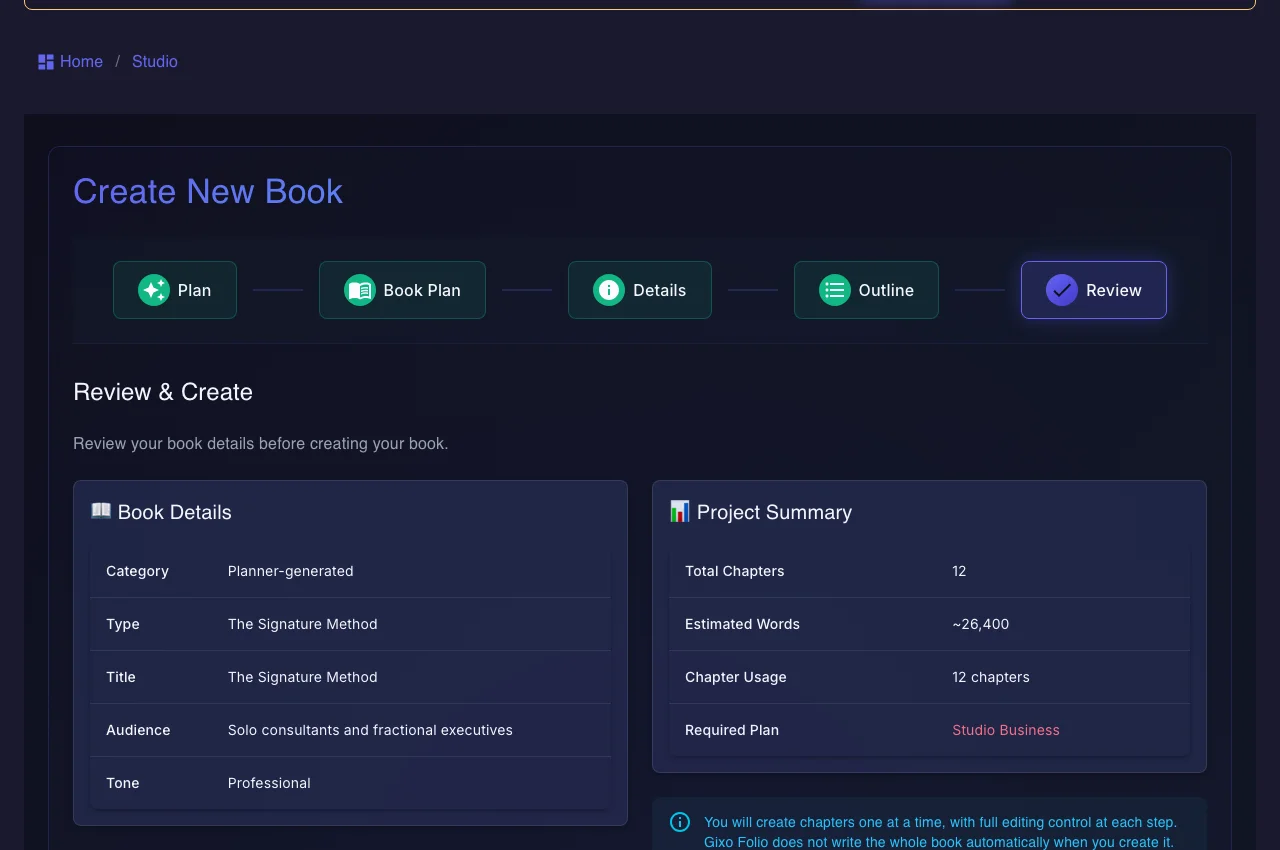
Six phases: find the idea and reader promise, outline the structure, build a sustainable drafting habit, draft the chapters one at a time, revise and edit in layers (structure, then chapters, then line edits), and prepare to publish or export. Gixo Folio maps this to a workflow of brief, chapter plan, draft, review, and export.
How long does it take to write a book?
It depends on length and how much time you protect each week. A focused nonfiction book of 30,000–60,000 words can take a few months of steady drafting; a full-length novel of 70,000–100,000 words usually takes longer, especially with revision. A consistent weekly word target finishes books far more reliably than occasional bursts.
How many words should a book be?
Let the book's job set the length. Short practical nonfiction and business books often run 25,000–50,000 words; standard novels commonly land around 80,000. These are orientation points, not rules — a book should be exactly as long as its promise requires.
Do I need an outline to write a book?
You are not required to, but for a first book an outline can give you a clear next chapter to work on. It can be as simple as a chapter list with one line describing each chapter's job, and you can change it as the draft teaches you more. Its purpose is to give you a clear next thing to write every session.
Can I write my first book with no experience?
Yes. First-time authors finish books all the time, and the ones who do are usually not the fastest writers — they are the ones who kept a structure in front of them and drafted to it, one chapter at a time. A clear promise, a working outline, and a steady habit matter more than experience.
Is it different to write nonfiction versus fiction?
The phases are the same, but the emphasis differs. Nonfiction is organized around a reader outcome, so each chapter should have a clear job and supporting proof. Fiction is organized around an emotional arc, so the outline maps beats and character change. Both benefit from an outline, a drafting habit, and layered revision.
Can AI write a book?
AI can produce book-length text, but that is not the same as authoring a reliable, coherent book. Tools like Gixo Folio accelerate planning and drafting and keep the manuscript organized, while you supply and verify the ideas, facts, judgment, lived experience, and voice. The author still revises every chapter and owns the finished book.
How many words in a novel?
Most adult novels run 70,000 to 100,000 words, with commercial and literary fiction usually landing between 80,000 and 90,000. Middle grade sits around 30,000 to 50,000, young adult around 55,000 to 80,000, and a nonfiction business or authority book is often 40,000 to 60,000. These are publishing conventions rather than rules, but a manuscript far outside its category's range is the first thing an agent or editor will question. Gixo Folio plans the chapter structure against a target length so the draft lands in range instead of drifting.
How do you make a book, start to finish?
Six phases: settle the idea and the promise to the reader, outline the structure, build a drafting habit you can sustain, write the draft, revise it, then prepare it for publication. Most first-time authors stall between outline and draft, which is why the outline matters more than the word count on day one. Folio carries a manuscript through all six inside one workspace and exports the finished book when it is ready.