Gixo Quill · content guide
SEO Copywriting
SEO copywriting is writing that satisfies a search intent well enough to rank and persuades well enough to convert. The two goals conflict far less than people assume — the real tension is between writing for a search engine and writing for a person who has already decided.
What your plan includes. Writing, checks, exports, public share links and publishing to WordPress, Ghost and Medium are on every plan, from $10 per seat a month. Comments and Brand Voice need Professional; Brand Kit and bulk need Business.
Where the goals agree, and where they do not
- They agree on answering fast. Both a searcher and an engine reward the answer appearing early rather than after six paragraphs of preamble.
- They agree on structure. Clear headings help scanning readers and machine extraction equally.
- They agree on specificity. Concrete detail persuades people and differentiates a page from the twenty that hedge.
- They disagree on breadth. Ranking rewards covering the topic; converting rewards getting to the point. Resolve it by answering first and expanding below.
- They disagree on repetition. Repeating a phrase for the engine reads badly to a person. Write for the person; the engine has not needed the repetition for years.
Writing for the two readers
| Element | Serves the searcher | Serves conversion |
|---|---|---|
| First 40 words | The direct answer | Proof you understand their problem |
| Headings | Scannable structure | Navigation to the part they care about |
| Specifics and numbers | Differentiates from hedged pages | The thing that actually persuades |
| Comparison table | Matches commercial intent | Handles the objection directly |
| One clear next step | Signals the page has a purpose | The conversion itself |
Writing the page, in the order that works
How Gixo Quill handles this
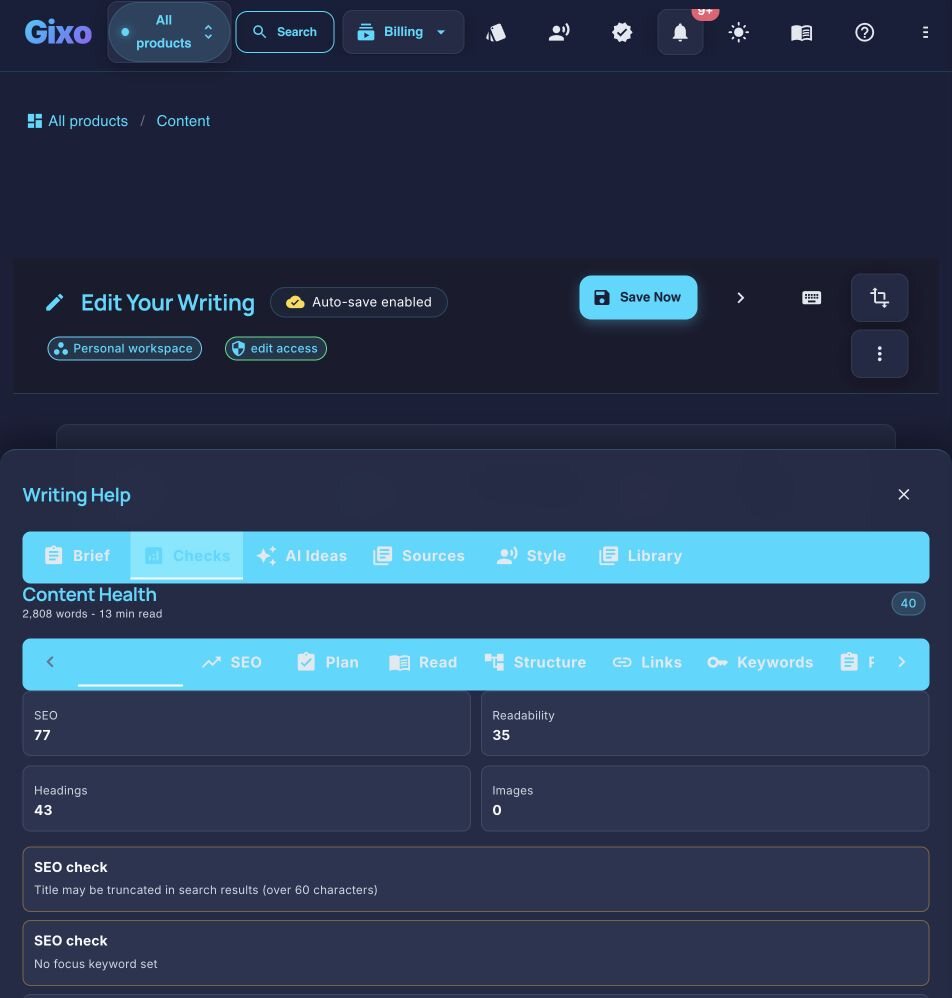
Quill's checks are aimed exactly at this overlap: answer extractability tests whether the page answers its question in the first lines, the style-guide linter finds disallowed wording that weakens both ranking and persuasion, and the content health check covers structure and readability together.
Frequently asked questions
What is SEO copywriting?
Writing that satisfies a search intent well enough to rank and persuades well enough to convert — usually by answering directly in the opening lines and expanding below.
Does writing for SEO hurt readability?
Only when it means repeating phrases for the engine. That has not been necessary for years, and it reads badly to the person you are trying to convert.
How many times should a keyword appear?
As often as natural writing requires and no more. Density targets are a legacy practice, and pages that hit them usually read worse than pages that do not.
Where should the answer go?
In the first 40 words. Both a scanning reader and an answer engine reward it, and burying it below context is the most common structural mistake.
Can one page rank and convert?
Yes, and most should. Answer the query first for the searcher who arrived, then give the specifics and the next step for the one who is ready.
How long should an SEO title be?
Under about 62 rendered characters. Length is measured in pixels rather than characters, so wide capitals cut sooner — the practical rule is to put the differentiating word early enough that it survives truncation.
Should the SEO title match the H1?
They can differ, and often should. The title competes in a result list against nine others and can carry the benefit; the H1 confirms to someone who has already clicked that they arrived in the right place.
How is SEO writing different from copywriting?
In practice, mostly in what it opens with. Copywriting can build to a point; SEO writing states it first because both the reader and the extraction are deciding within a few lines. The persuasion techniques below the opening are the same.
What is different about blog SEO specifically?
Blog posts fail on intent more than on optimisation — a topic gets chosen because it is interesting rather than because anyone searches it. Check the query exists before writing, and check what format currently ranks for it.
Does keyword placement in the title still matter?
Placement does, stuffing does not. Having the phrase in the title is worth doing because it confirms the match to a scanning reader; repeating it in the description and first paragraph is legacy practice that costs readability.
Related content guides
Answer first, then persuade
Quill writes the answer-first structure by default and checks it deterministically before you publish.
Inside Quill
Review concrete content and SEO signals before delivery