
A Smarter Way to Draft Proposals Than Qwilr
Qwilr builds interactive web-based proposals with embedded pricing, analytics, and e-signatures. Gixo drafts document-quality proposals from your uploaded source files using AI. Choose Gixo when document quality matters more than interactive web proposal chrome.
Gixo Arc is an AI proposal drafting tool that generates document-quality proposal content from your uploaded source files — up to 10 files per proposal, 500 MB each and 2 GB in total, across 11 accepted file extensions including PDF, DOCX, PPTX, TXT, CSV, XLSX, and scanned images read by OCR — then structures the draft using one of 21 proposal types and exports in 6 formats: PDF, DOCX, HTML, Markdown, JSON, and plain text. Arc costs $49 to $179 per seat per month with a 14-day no-card trial. Qwilr, by contrast, is a proposal delivery platform built around design-forward web templates, embedded pricing calculators, view analytics, and e-signatures, rather than AI drafting from source documents; its published pricing should be checked on its own site, as vendor tiers change. Choose Gixo when document quality and RFP-driven drafting matter most; choose Qwilr when interactive web delivery and tracking matter most.
See what Arc helps your team review
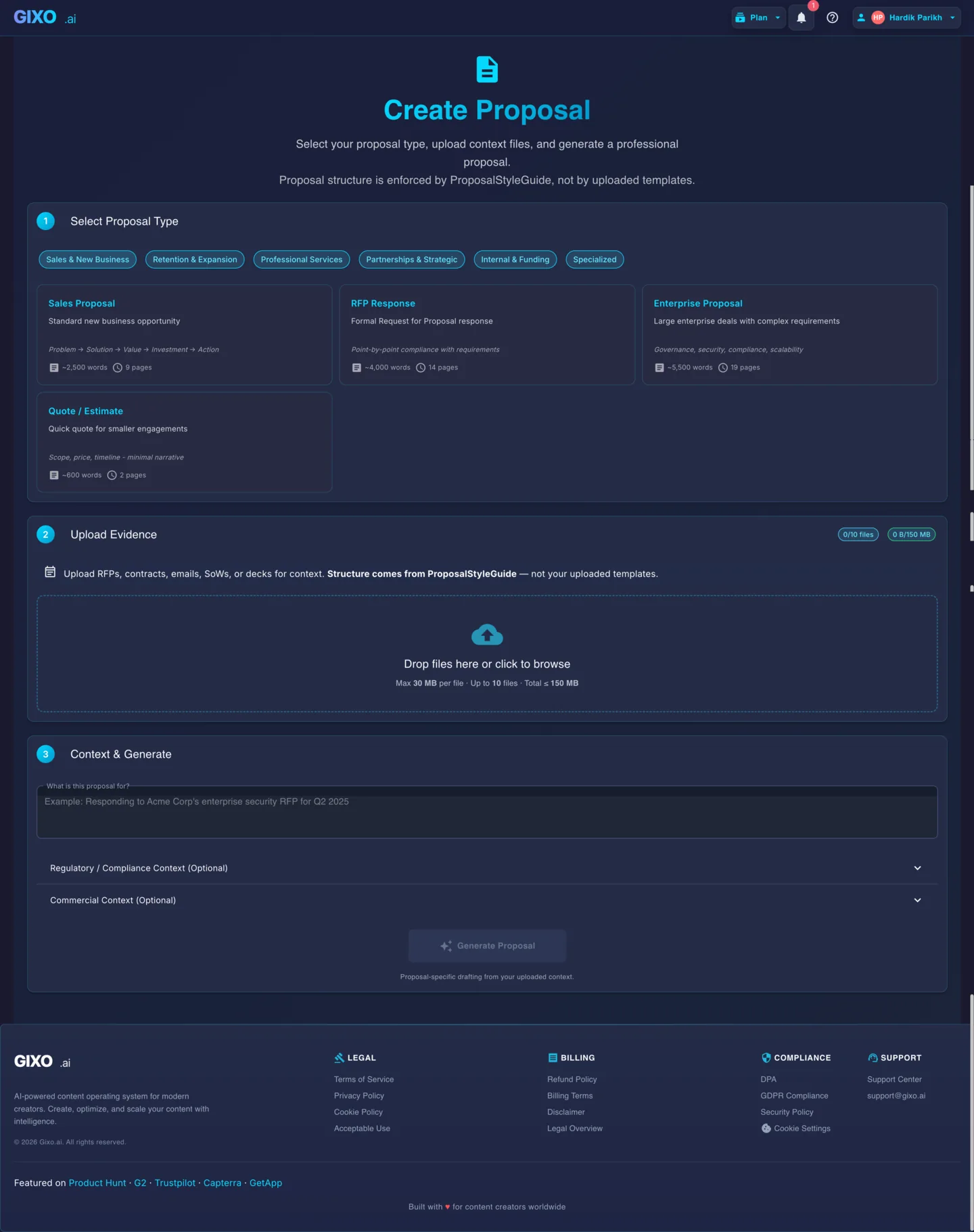
Choose the proposal type, add the RFP, brief, notes, or prior work, then review a structured first draft before it reaches a client.
- 1Add source materialRFPs, briefs, notes, decks, and prior work
- 2Draft to the proposal typeSections and structure follow the real opportunity
- 3Review before deliveryYour team checks facts, scope, pricing, and commitments
What's the difference between Gixo and Qwilr for proposal drafting?
Both platforms help you create proposals. The fundamental difference is in what each tool optimizes for — interactive delivery versus document-quality drafting.
Gixo generates proposal content from uploaded RFPs, client briefs, and source documents using AI. Qwilr provides design-forward templates that you fill in manually. Gixo front-loads the writing; Qwilr front-loads the presentation.
Gixo extracts requirements from your RFP documents and synthesizes them into structured proposal sections. Qwilr starts from visual blocks and content modules. If your proposals are driven by source documents, Gixo's intake model is purpose-built for that workflow.
Gixo exports in 6 formats — PDF, DOCX, HTML, Markdown, JSON, and plain text — with professional themes for offline delivery and formal submissions. Qwilr delivers proposals as interactive web pages with embedded pricing calculators and view analytics. Different delivery models for different client expectations.
How does Gixo compare to Qwilr feature by feature?
| Capability | Gixo Arc | Qwilr |
|---|---|---|
| Drafting approach | AI generation from source files | Manual content in visual templates |
| Source file upload | Up to 10 files per proposal, 500 MB each, 2 GB total (PDF, DOCX, TXT, CSV, XLSX, PNG, JPG, JPEG, EML, MSG) | Not a primary workflow |
| RFP requirement extraction | AI-powered extraction, including OCR for scanned PDFs | Confirm current product |
| Proposal structures | 21 proposal types | Visual template library |
| Proposal delivery | Document export in 6 formats | Interactive web pages |
| Embedded pricing | Not included | Interactive pricing tables |
| View analytics | Recipient-specific tracked links with view and download counts | Page-level analytics |
| E-signatures | Simple electronic signature, sealed PDF | Built-in acceptance |
| Rich text editor | Built-in with inline AI | Block-based editor |
| CRM integrations | No self-serve CRM sync | HubSpot, Salesforce |
| Export formats | PDF, DOCX, HTML, Markdown, JSON, plain text | Web-only delivery |
| Starting price | $49 per seat per month, 14-day no-card trial | Published on qwilr.com; check the vendor's current pricing page |
| Inline AI editing | Section-level refinement | AI builds branded templates from a website URL, not from your source files |
Gixo Arc rows describe the available workflow and limits. Qwilr rows describe its publicly positioned feature set as of mid-2026 and are not vendor quotes — confirm current features and pricing with Qwilr directly.
Gixo Arc proposal document exports, drafting limits and plans
The figures a buyer usually has to email support for, stated once.
| Specification | Current value |
|---|---|
| Source files per proposal | 10 |
| Maximum size per file | 500 MB |
| Maximum total upload | 2 GB per proposal |
| Accepted file extensions | 10: .pdf, .docx, .txt, .csv, .xlsx, .png, .jpg, .jpeg, .eml, .msg |
| Proposal types | 21, spanning sales, RFP response, enterprise, quote, renewal, expansion, win-back, consulting, project, retainer, staffing, partnership, joint venture, sponsorship, internal business case, grant, investment, government, research, creative, and technology implementation |
| Export formats | 6: PDF, DOCX, HTML, Markdown, JSON, and plain text |
| Plan pricing (per seat per month) | $49 Starter, $129 Professional, $149 Business, $179 Enterprise |
| Seat minimums | 1 / 2 / 5 / 10 seats respectively |
| Trial | 14-day no-card trial; there is no free tier |
When should you choose Gixo instead of Qwilr?
You respond to RFPs with dense source documents and need AI to synthesize them into structured first drafts. When document quality and formal PDF delivery matter more than interactive web pages. Best for consulting, professional services, and government proposals.
You need visually striking web-based proposals with embedded pricing calculators, e-signatures, and view tracking. When your sales process benefits from interactive delivery and you write proposal content yourself rather than responding to RFPs.
Your team drafts proposals from RFPs and source documents (Gixo for the writing) and also sends interactive sales proposals with pricing and tracking (Qwilr for the delivery). The tools serve different stages of the proposal lifecycle.
Comparison FAQ
Updated