
AI Legal Documents for In-House Counsel — Replace the Blank Page, Not Legal Judgment
In-house teams still spend time turning incomplete requests into reviewable drafts. Gixo helps capture the request, pull in reference files, and produce a structured first draft so counsel can spend time on review, negotiation, and risk.
Gixo is a drafting workspace for in-house legal teams that turns an incomplete request into a reviewable first draft, through structured intake, attached reference files and precedents, and inline review comments, across contracts, policies, and compliance-adjacent work. It is not a final-answer generator or a substitute for outside counsel: it gets counsel to a sharper review starting point faster, with qualified legal judgment still required for specialist and high-stakes work.
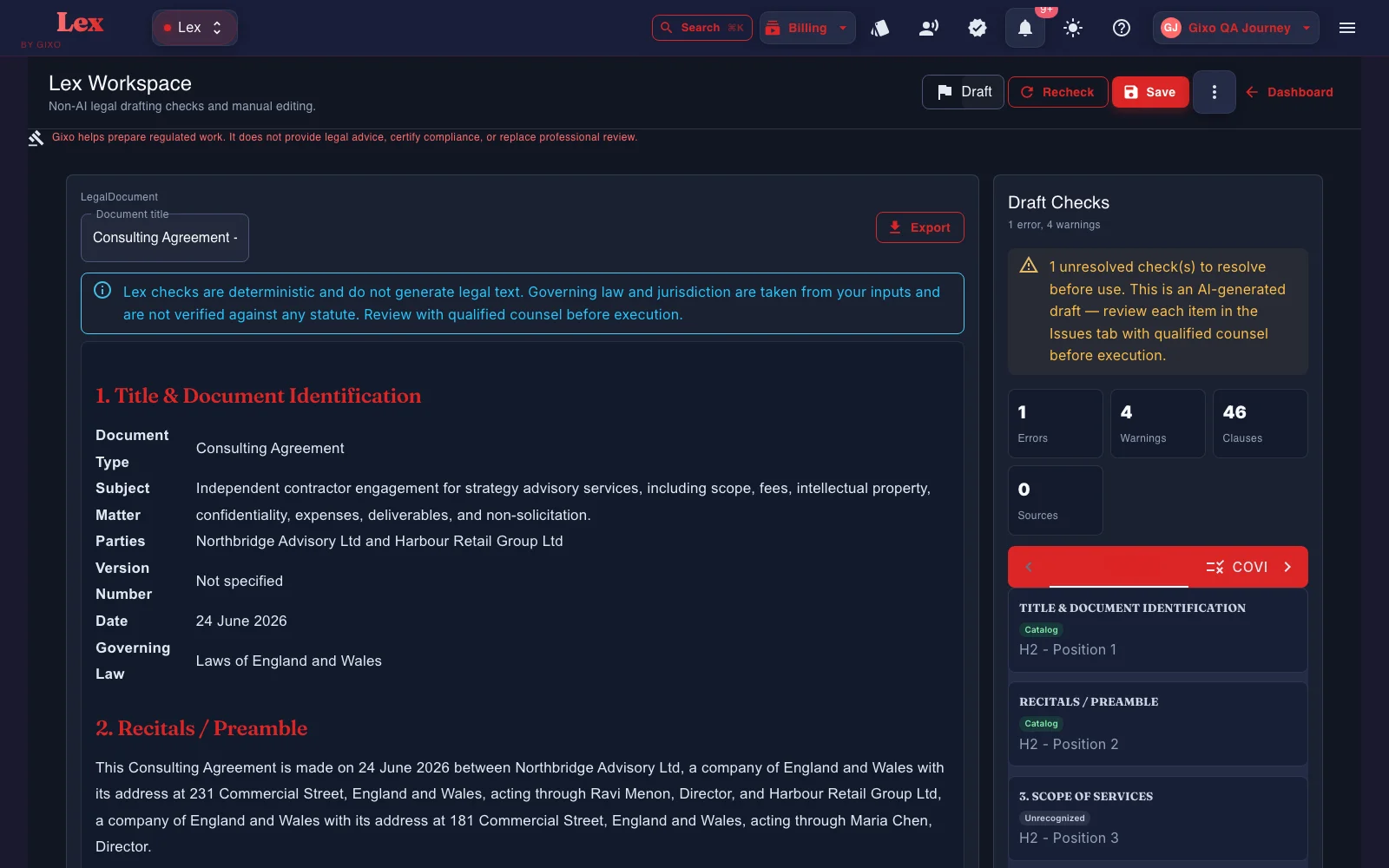
What does Gixo do as in-house legal software for drafting workflow?
Built for in-house legal, legal ops, finance, audit, and compliance teams that need reviewable work product rather than generic AI answers.
Replace vague email requests with a repeatable intake flow that captures parties, terms, jurisdiction, and business context before drafting starts.
Keep governing-law context and uploaded precedents close to the draft so reviewers can see what should carry forward and what needs to change.
After the first draft, Lex can run a deterministic contract review: clause coverage against a versioned playbook, clause-conflict detection, and defined-term and cross-reference checks. Findings, tracked-change DOCX redlines, comments, review state, assignees, due dates, and version history all stay attached to the same document. A contract imported from Word can go back as that same DOCX, with the Lex edits shown as Word tracked changes; where Lex cannot track an edit faithfully, such as inside a field, an existing revision, a header or a footer, it refuses the export instead of altering the document. Reviewers still verify every clause and conclusion.
Use the same drafting workspace across commercial contracts, internal policies, and compliance-adjacent work product instead of switching tools for every job.
Upload approved language, past drafts, or clause references so the new draft starts closer to internal standards.
The goal is not a final answer. The goal is to get counsel to a sharper review starting point faster.
How does Gixo generate a legal first draft?
Start with the type of work product you need to prepare, then capture the commercial and legal context that should shape the first draft.
Bring in prior templates, marked-up drafts, and reference documents so the draft reflects existing legal standards where appropriate.
Prepare the first draft, review clause by clause, and leave comments or open items attached to the same document.
Export the document when it is ready to circulate or move into the next stage of your legal process.
How should in-house teams evaluate an AI legal drafting workspace?
Evaluate the quality of the review starting point, the system boundary, and the legal judgment that remains with counsel.
Look for structured intake, reference-aware drafting, rich editing, comments, and exports that support the team's existing review process.
Confirm whether contract lifecycle management, matter management, approvals, signatures, and process orchestration remain separate.
Counsel still owns legal analysis, negotiation strategy, risk acceptance, and the decision to circulate or execute a document.
Gixo Lex vs. CLM systems, general AI assistants, and manual drafting
In-house teams usually choose between four categories, and they do different jobs. Gixo Lex is a drafting workspace: structured intake, reference files, a first draft, and inline review on one document, plus simple electronic signature and, once execution is recorded, obligation reminders for agreements run through an Agreement Pack. A CLM or contract-workflow system orchestrates approval, signature, and post-signature obligations, and it starts from templates rather than from a brief. A general AI assistant answers a prompt but keeps no intake, no attached precedent, and no review state. Manual drafting keeps full control and takes the most counsel time. Categories are described as of mid-2026; individual products vary, so confirm current capabilities with each vendor. The job is not to ask AI for a legal answer. The job is to prepare a draft or artifact that a qualified reviewer can actually work with.
| Capability | Gixo Lex | CLM / contract workflow systems | General AI assistant | Manual drafting |
|---|---|---|---|---|
| Main job | Drafting workspace | Process orchestration and storage | Open-ended prompt output | Manual authoring |
| Structured intake | Yes — parties, terms, governing law, business context | Workflow-led | Prompt-led | Email or meeting |
| Reference-file drafting | Yes — upload precedent and approved language | Template-based | Paste-only context | Manual |
| Inline review and comments | Yes — comments, review state, versions on the same document | Usually yes | Outside the tool | External tools |
| Signature routing and post-signature obligations | Simple electronic signature; obligation reminders once execution is recorded | Yes | No | External process |
| Best fit | Reviewable first drafts | Process orchestration | Ad-hoc questions | Full manual control |
Frequently Asked Questions
Draft legal work product with review built in
After the first draft, Lex can run a deterministic contract review: clause coverage against a versioned playbook, clause-conflict detection, and defined-term and cross-reference checks. Findings, tracked-change DOCX redlines, comments, review state, assignees, due dates, and version history all stay attached to the same document. A contract imported from Word can go back as that same DOCX, with the Lex edits shown as Word tracked changes; where Lex cannot track an edit faithfully, such as inside a field, an existing revision, a header or a footer, it refuses the export instead of altering the document. Reviewers still verify every clause and conclusion.
Updated