
Gixo Lex · User guide
Everything you need to draft and review legal work in Lex
Structured first drafts, rule-based checks, agreement packs and compliance drafts, with a link to each screen.
Start here
What Lex is
Lex is a workspace for legal drafting and compliance work. You give it the facts — the document type, the parties, the jurisdiction, the terms that matter and any reference material — and it prepares a structured first draft. Every draft then runs through a set of rule-based checks that use no AI: which clauses are present or missing, whether defined terms and cross-references hold together, and what still stands between the draft and signature.
Around each document, Lex keeps the rest of the work in one place. Agreement packs turn an agreement and its family into a matrix of terms, a register of parties and signatories, and a list of obligations with owners and dates. Review playbooks hold your preferred positions and fallbacks. The matter office gathers sources, findings and work products for a client question. And compliance drafts cover checklists, evidence trackers, working papers and registers.
What Lex is not
Lex shows this line on every legal and compliance document: “Gixo helps prepare regulated work. It does not provide legal advice, certify compliance, or replace professional review.” Jurisdiction and governing law steer how a draft is written, but they are taken from what you type and aren't checked against any statute. Plan on a qualified reviewer reading every draft before anyone relies on it.
Your Lex dashboard
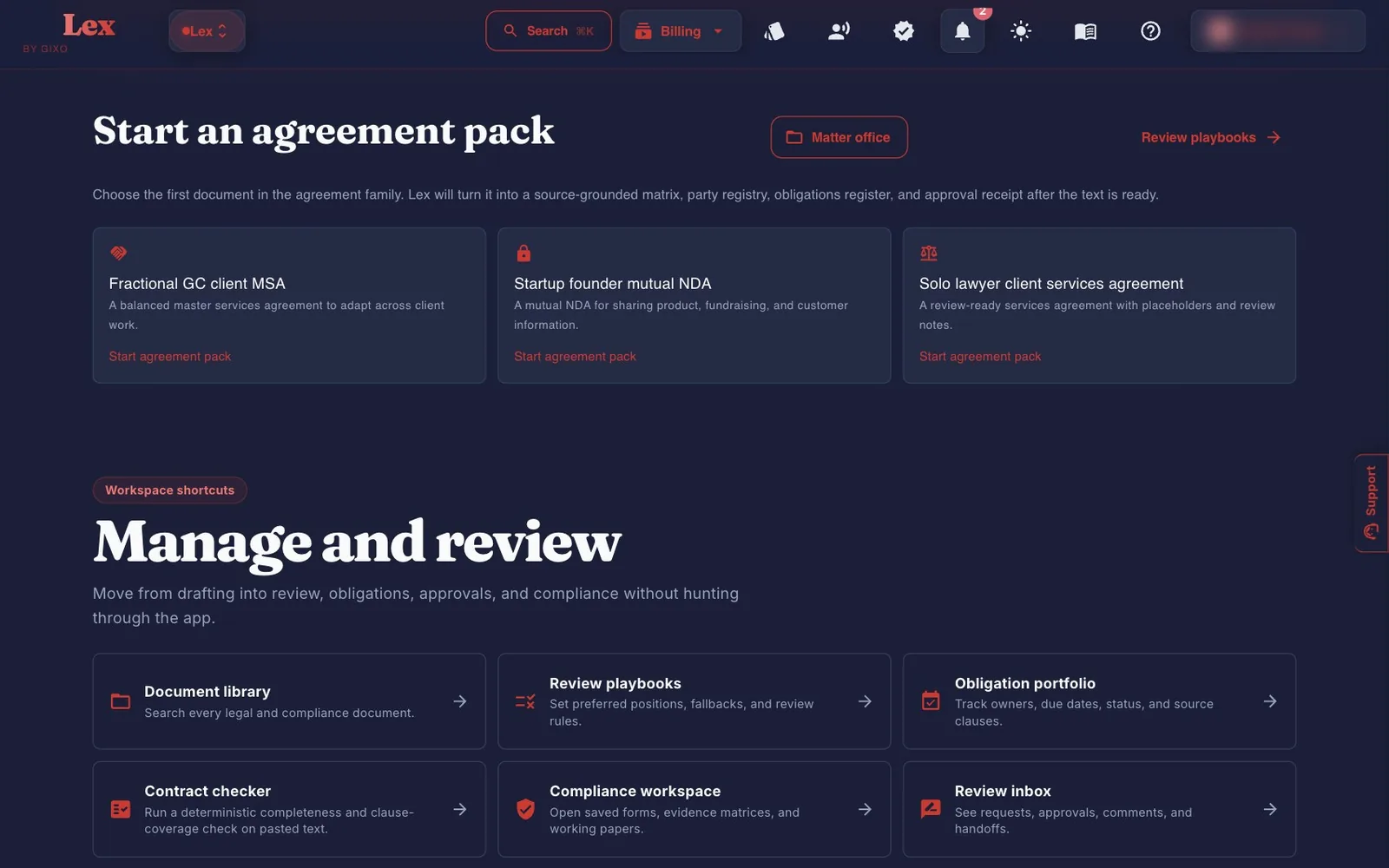
The dashboard is where every Lex job starts. The New agreement pack button at the top opens five starting points, and the page below it is organised into three parts.
| Part of the page | What it gives you |
|---|---|
| New agreement pack | Legal: Create an Agreement Pack, Import an Agreement Pack, Review Playbooks. Compliance: Make a Compliance Draft, Open Saved Compliance Work. |
| Start an agreement pack | Three presets — Fractional GC client MSA, Startup founder mutual NDA and Solo lawyer client services agreement. Each fills in the document type, title and drafting instructions with an example for you to correct. Nothing is drafted until you submit the form. |
| Manage and review | Shortcuts to the document library, review playbooks, your obligation portfolio, the contract checker, compliance work and your review inbox. |
| Continue working | Your library of legal and compliance documents, with search and filters for product, contract kind, lifecycle stage, open findings and date. A card opens the document in the Lex Workspace. |
Drafting a document
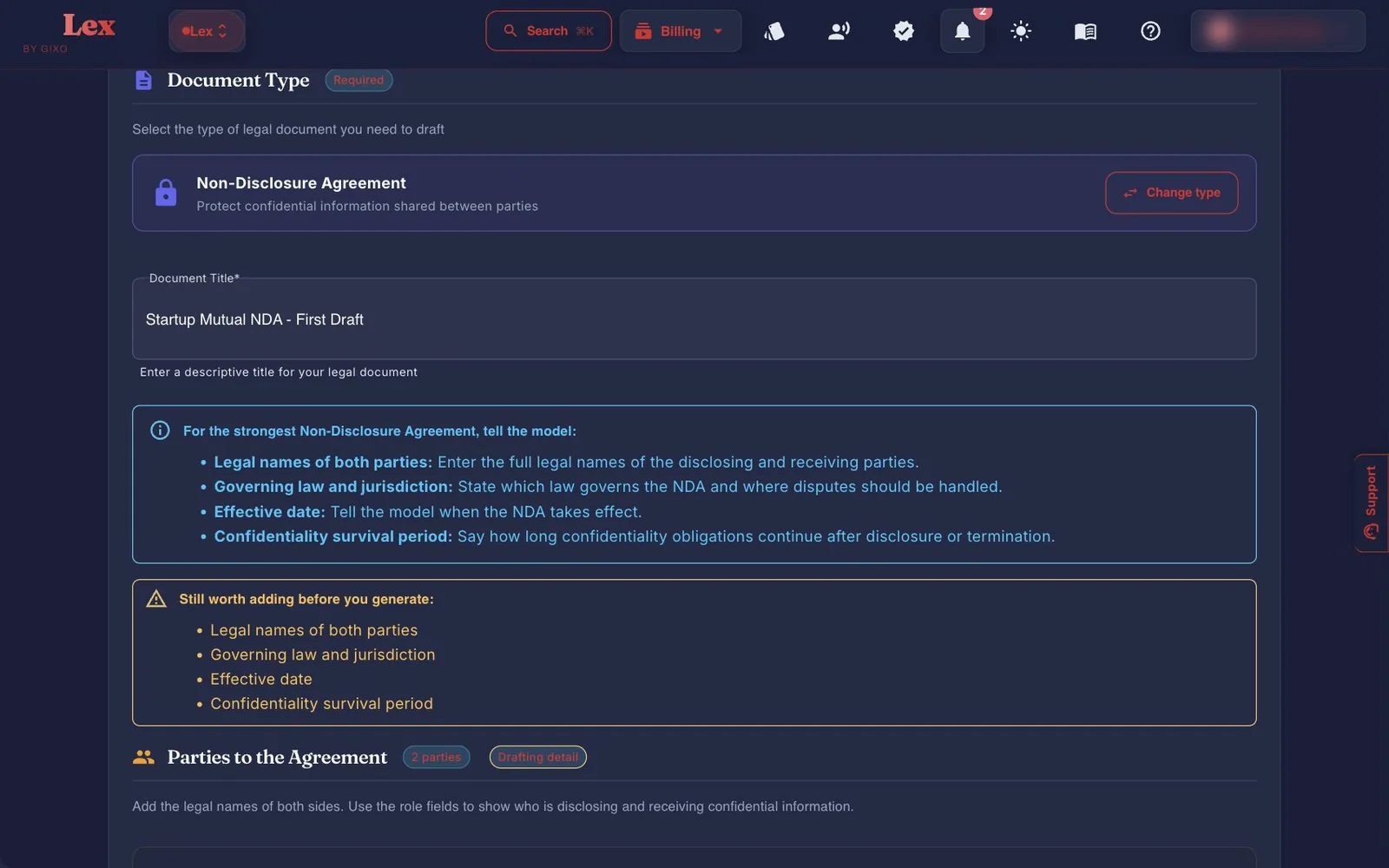
One form drafts either a single document or the first document of an agreement pack. It needs a document type, a title and at least one drafting detail. Everything else you add makes the draft better.
- Start from a common Lex opening (optional)Pick one of the three presets. It fills in the type, title and instructions, and it never overwrites anything you've already typed.
- Document TypeThere are 23 cards in seven categories: 22 named document types plus Custom Legal Document. If you're unsure, describe the transaction and click Suggest instrument for up to three matches. The matches come from keyword routing rather than AI, so confirm the instrument yourself.
- Document TitleRequired.
- Parties to the AgreementName, role, entity type and address for each party, plus registration number and authorised representative for organisations. You can add up to 10 parties.
- Jurisdiction & DatesJurisdiction and governing law are free text. Then set the effective date, the term and — for the document types that use one — a confidentiality period. Drafting posture sets the balance: Standard, Explicitly mutual, Favor Party A, Favor Party B or Lightweight / plain-language.
- Clause factsLex asks for just the facts the chosen type's clauses use. If required facts are missing, you can still go ahead: tick Generate an incomplete first draft, mark these facts for review, and do not invent values.
- Important Terms & InstructionsFree-text instructions. This field shapes the draft more than any other.
- Reference Documents (optional)Up to five files (PDF, DOCX, DOC, TXT, MD or HTML) plus pasted excerpts. Lex uses them as style and precedent references, not as legal authority. Together they share a 40,000-word budget, and longer material is trimmed evenly.
- Create first pack documentThe button reads Generate Document outside pack mode. Drafting uses plan capacity.
Lex starts drafting in the background and opens the workspace, which shows Generating legal draft until the text arrives. You can leave the page while you wait; no time estimate is shown. In pack mode, Lex moves you to the agreement pack once the draft is ready.
Name every party that has a role
Choosing a document type fills in roles for the first two parties. Lex won't draft if a party row has a role but no legal name, and all you see is a generic Generation Failed message. Fill in both names, or remove the second row.
Reviewing a contract you already have
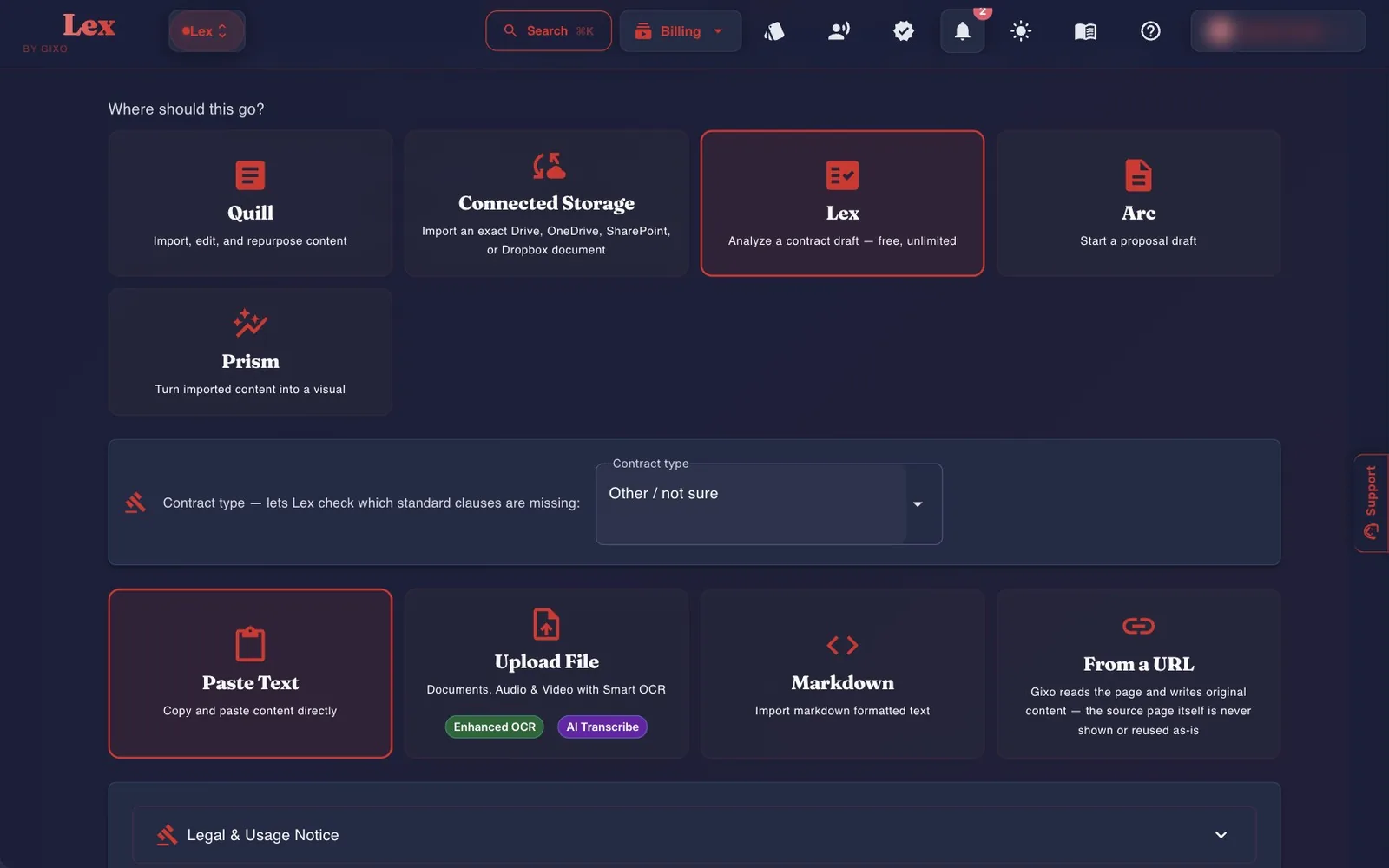
Bring in an existing agreement, keep its text as it is, and run the same checks as a Lex draft. Choose the contract type first so Lex knows which standard clauses to look for.
| Method | How it works |
|---|---|
| Paste Text | Plain text, HTML or Markdown. Smart formatting rebuilds headings and lists without using AI. |
| Upload File | One file at a time, including Word, PDF, spreadsheets, slides, text and images. Large documents keep processing in the background. Word and Excel files are read directly. The page notes that PDF, image, legacy DOC, audio and video files go through cloud processing, which needs an active Lex plan. When you import a DOCX, Lex keeps the original so you can later export in its formatting. |
| Markdown | Write or paste Markdown with a live preview. |
| Connected Storage | Import a document directly from Drive, OneDrive, SharePoint or Dropbox once you've connected the account. |
After the import finishes you land in the Lex Workspace with the checks already run. Importing and checking don't draft anything, so neither uses drafting capacity.
Two things to know
If you import in agreement-pack mode, you land in the workspace, not the pack: click Agreement Pack, then Create Agreement Pack. And a document with no contract type has no Clause Edit or Ask Lex until you confirm a type with Use this contract type, which leaves the text unchanged.
The Lex Workspace
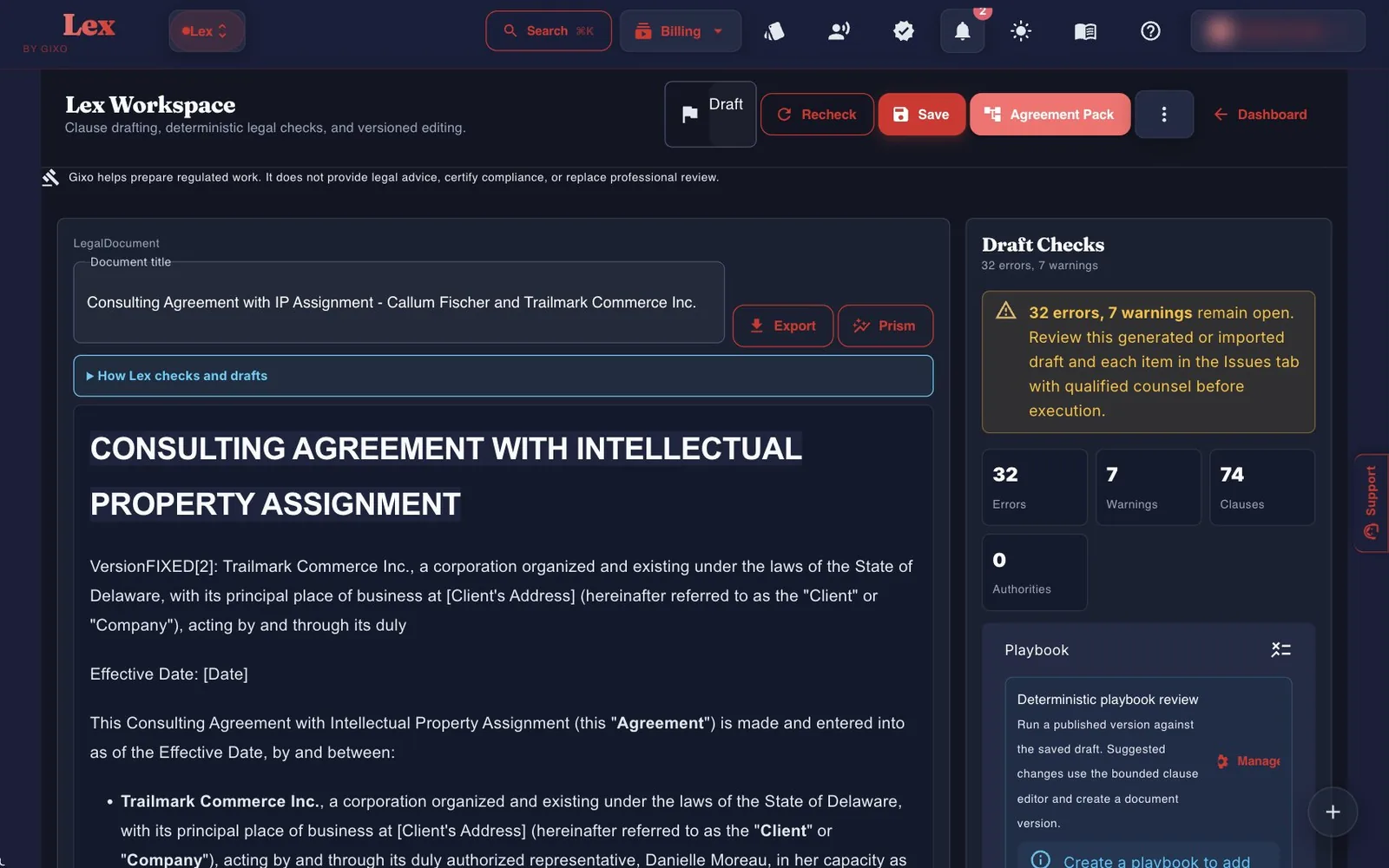
Every legal and compliance document opens here: the editor in the middle, Draft Checks on the right, and a header with the save state, lifecycle stage, Recheck, Save, Agreement Pack and a ⋮ menu. The editor toolbar covers formatting, tables, lists, comments and blocks. Click + or type / to insert a clause structure block.
Draft Checks
The checks run each time the document loads and after Save or Recheck. They use no AI and don't draw on plan capacity.
| Panel | What it tells you |
|---|---|
| Playbook | Runs one of your review playbooks against the draft. |
| Precedent | Compares which clauses are present with your own approved documents of the same contract type. |
| Clauses | Every clause heading Lex detected, each marked Catalog or Unrecognized. The mark says where a clause came from, not whether it's legally sound. |
| Coverage | The mandatory and recommended clauses for the contract type, each shown as present, present only in body text, or missing. A missing mandatory clause is an error; a missing recommended one is a warning. |
| Terms | Defined terms that are used inconsistently or never defined. |
| Cross-refs | References to a section or schedule that doesn't match a heading in the document. |
| Conflicts | Clause pairs that don't belong together, such as binding arbitration alongside exclusive court jurisdiction. Advisory only. |
| Authorities | Legal authorities attached to the draft, shown for relevance. Usually empty. |
| Comments | Review, assign, resolve and reply to comments on the document. |
| Negotiation | A ledger of positions and turns, each tied to a document version. |
| Obligations | Who has committed to what, and by when, found from operative wording such as “shall” and “must”. |
| Execution | Named parties, effective date, governing law, signature blocks and open placeholders such as TBD. |
| Issues | Every finding in one worklist, where you record decisions. |
Deciding on findings
In Issues, filter by severity, review state or category, then record a decision for each finding: Open, Accept risk, False positive or Resolved. Accept risk and False positive need a written rationale. After you edit, click Save or Recheck first, because decisions can't be saved while the analysis is out of date.
Editing clauses, and Ask Lex
Clause Edit is for legal documents with a contract type. Pick a clause and an operation — insert after, insert before, replace or remove — then write the text. Validate runs the rules check without changing anything; Apply makes the change.
Ask Lex writes proposed wording for a clause from your instruction, marking missing facts as [●] rather than inventing them. It never edits the document on its own. Stage the proposal, validate it, then apply it. Ask Lex needs a plan that includes drafting.
Saving, versions and approval
- Autosave runs about two seconds after you stop typing, and no later than about fifteen seconds after your first unsaved change. Ctrl/Cmd+S saves straight away, and the browser warns you before you leave with unsaved changes.
- Versions (in the ⋮ menu) lists earlier saved versions so you can restore one.
- The lifecycle stages Draft, In review and Superseded are labels only and don't lock anything. Choosing Approved records an approval receipt for that exact saved version. Before you can approve, every finding needs a decision and every finding's review thread must be resolved. Any later edit invalidates the receipt.
- The ⋮ menu also holds Tracked-change DOCX, Original-format DOCX (for documents imported from Word), Share, Copy link and Delete.
Agreement packs
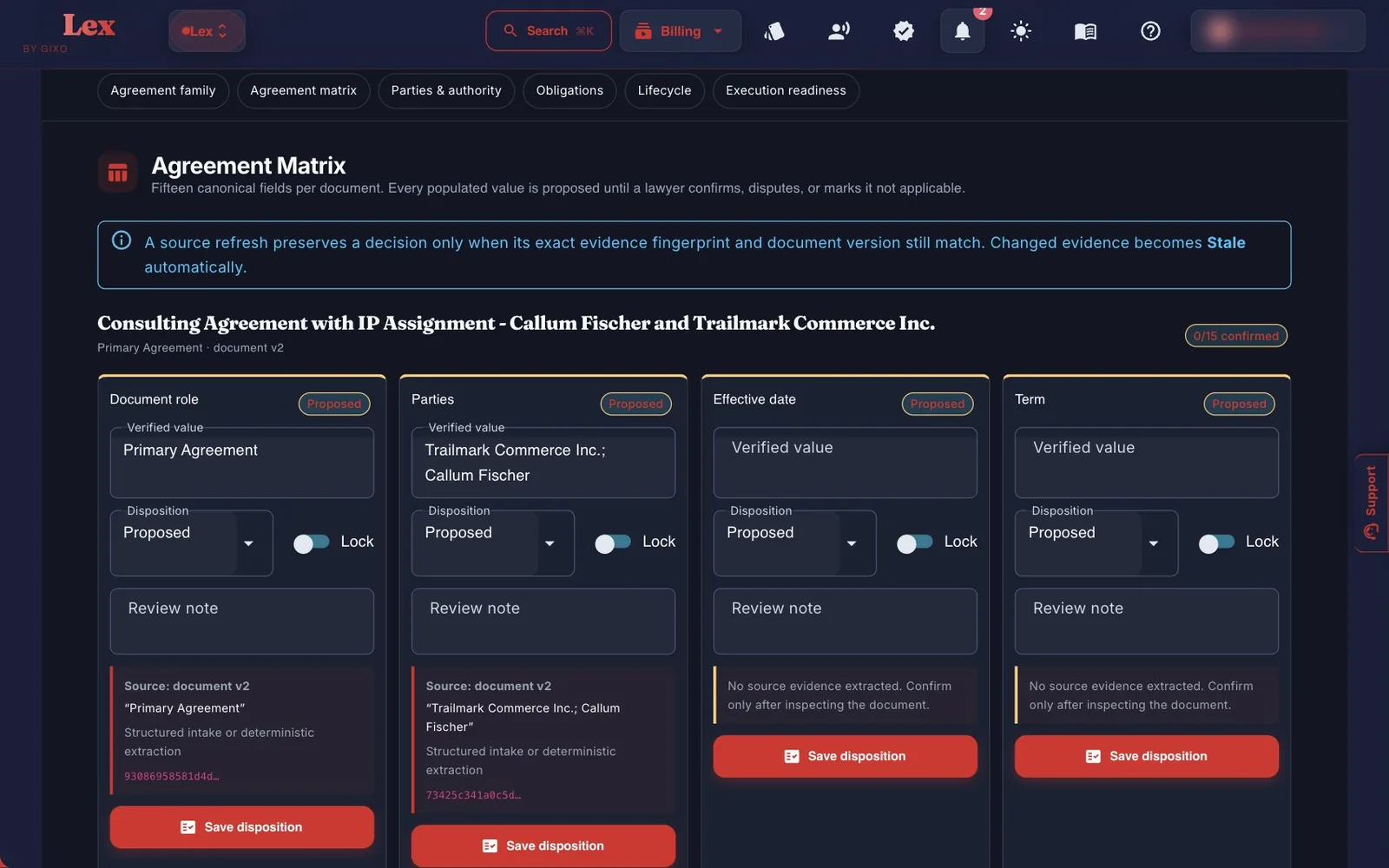
An agreement pack turns a document and the agreements around it into records you can work from. Open it from the workspace with Agreement Pack. If the document doesn't have a pack yet, Create Agreement Pack builds one. Every value Lex extracts starts as a proposal until someone confirms it.
| Section | What you do there |
|---|---|
| Agreement family | Link amendments, statements of work, data processing agreements, SLAs, schedules, purchase orders and side letters, each with a precedence order. |
| Agreement matrix | Fifteen fields per document, including parties, term, renewal, notice window, payment terms, liability cap, governing law and signature requirements. Mark each value confirmed, disputed or not applicable. |
| Parties & authority | Canonical legal names, registration details and authorised signatories. |
| Obligations | An extracted commitment becomes a tracked obligation once it has an owner, a trigger, due logic, a beneficiary and evidence. |
| Lifecycle | Dated events, a calendar download (.ics), and a record of where the signed copy lives, tied to the approved version. |
| Execution readiness | Approval blockers and warnings, then an approval receipt for the exact version that was reviewed. |
Reminders start at execution
Once you record execution on a pack, Lex reminds obligation owners of their due dates in the app and by email. Until then, dates are planning data.
Review playbooks
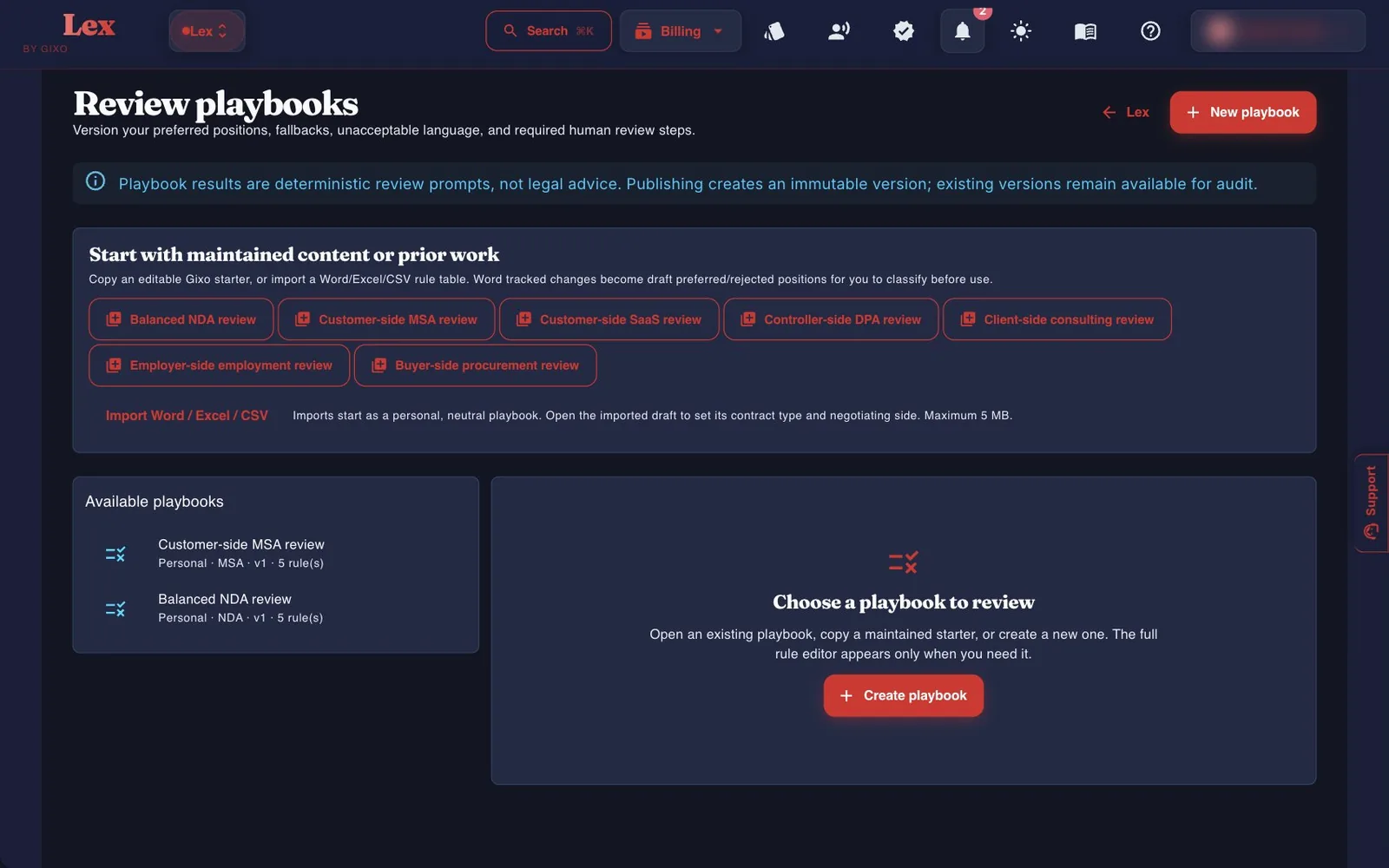
A playbook records how you negotiate a contract type: preferred positions, fallbacks, language you won't accept, and steps that need a human. Publishing creates a new version, and every earlier version stays available.
- Start from a maintained starter. There are seven: Balanced NDA review, Customer-side MSA review, Customer-side SaaS review, Controller-side DPA review, Client-side consulting review, Employer-side employment review and Buyer-side procurement review. Clicking one makes an editable copy for you. The starters are general commercial starting points, not jurisdiction-specific positions.
- Or import your own. Import Word / Excel / CSV takes files up to 5 MB. Tracked changes in a Word file become draft preferred and rejected positions for you to classify.
- Write the rules. Each rule is a required clause, a forbidden phrase, preferred language or a human review step, with a severity, fallback language and guidance for the reviewer.
- Use it. In the workspace, open Playbook in Draft Checks, choose the playbook and click Run. A finding can apply a bounded edit, which saves as a new document version. The list shows playbooks for the document's contract type, plus any set to Custom.
The matter office
A matter brings together the documents, facts, findings and work products for one client question. Matters are personal to you, and sources are checked against your current permissions each time you open them.
- Library — up to 200 documents per matter, including PDF, Word, spreadsheets, slides and images. Originals are kept intact, and you can arrange documents by issue, party and document family.
- Research — search across the matter's sources for a question or phrase.
- Evidence and Chronology — findings with their quotations and source versions, plus conflicts between dates.
- Facts, Tasks and Decisions — shared facts, workflow tasks, and decisions with their rationale.
- Work products — fifteen profiles, from engagement letters and advice notes to diligence reports and board minutes. Prepare draft uses plan capacity and needs findings saved against the current source versions. A reviewed delivery bundle packages up to ten lawyer-reviewed versions as a ZIP of Word files, printable HTML, source-linked text and an integrity manifest.
Obligations and your review inbox
- My obligation portfolio shows the obligations you track across documents as Tracked, Open, Overdue or Completed. To add one, open a document and go to Draft Checks → Obligations → Track / manage. gixo.ai/legal/obligations
- Lex Review Inbox collects comment threads assigned to you, your mentions, and anything due soon. It includes threads from all your Gixo products. Its Approve button sets a comment's review state; it doesn't approve the document. gixo.ai/legal/reviews
Compliance drafts
Compliance drafts open in the same workspace and get their own readiness checks. There are two ways to start one.
Where saved compliance work lives
Your saved compliance documents are in the dashboard library: set Product to Compliance. Open Saved Compliance Work on the dashboard starts a new draft from a template.
Getting your work out
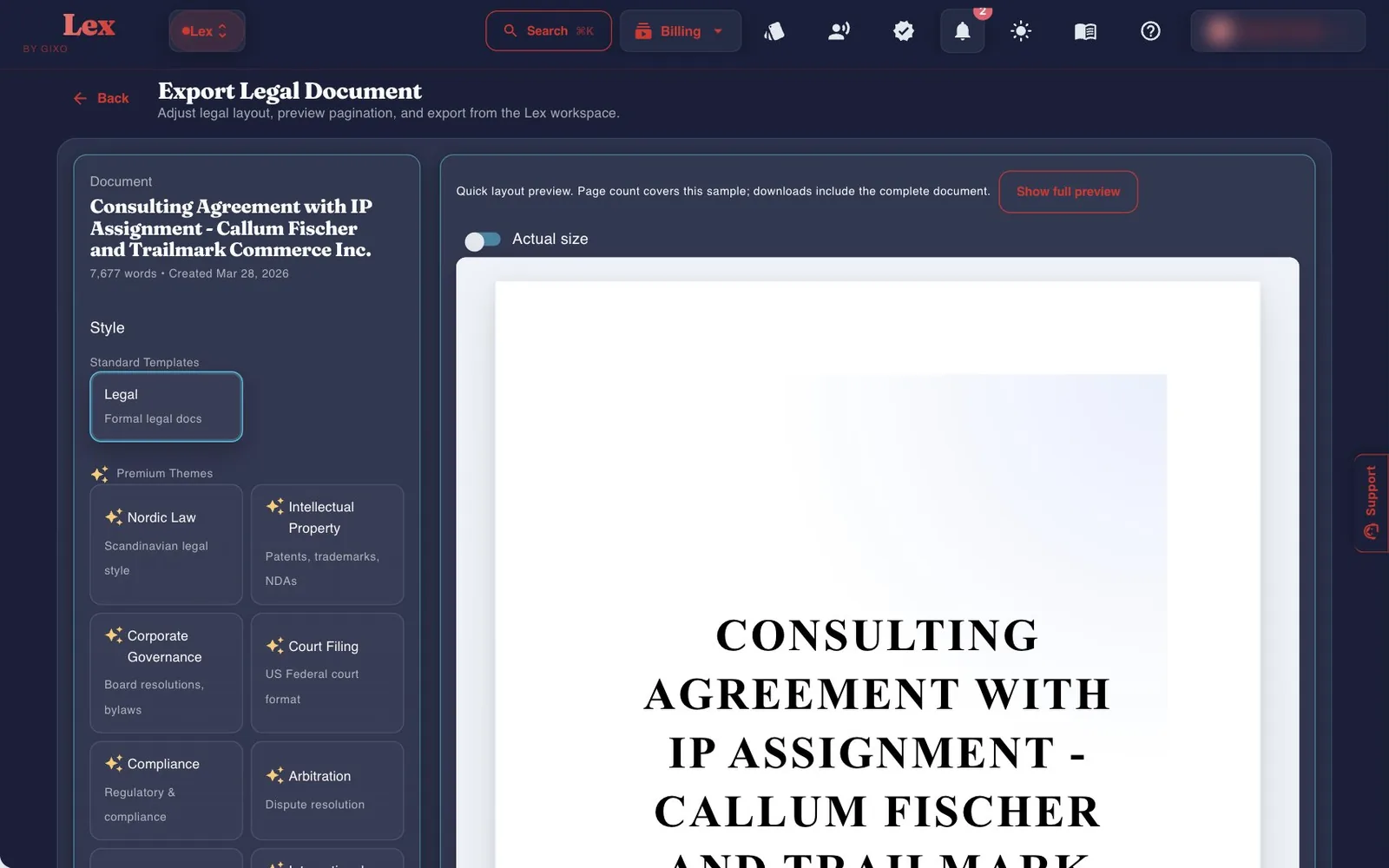
Export in the workspace toolbar opens the export workspace, where you can preview pagination before downloading.
| Option | What you get |
|---|---|
| Formats | PDF, DOCX, HTML, Markdown, JSON and plain text. The text formats can also be copied. |
| Look | The Legal template or one of eight legal themes: Nordic Law, Intellectual Property, International Treaty, Corporate Governance, Court Filing, Compliance, Arbitration and Real Estate. |
| Layout | Paper size (A4, Letter, A5, Legal, Tabloid), orientation, cover page, table of contents, header, footer and page-number position. |
| Tracked-change DOCX | A Word redline against an earlier saved version, from the ⋮ menu. It needs at least one earlier saved version to compare against. |
| Original-format DOCX | For contracts imported from Word: an export that keeps the formatting of the file you brought in. |
| Share | A public link to the document, or sharing with named people or a team. See Plans below for which plans include which. |
Good to know
Lex exports carry no watermark, and after a trial ends you can still export everything you made during it.
Plans and your trial
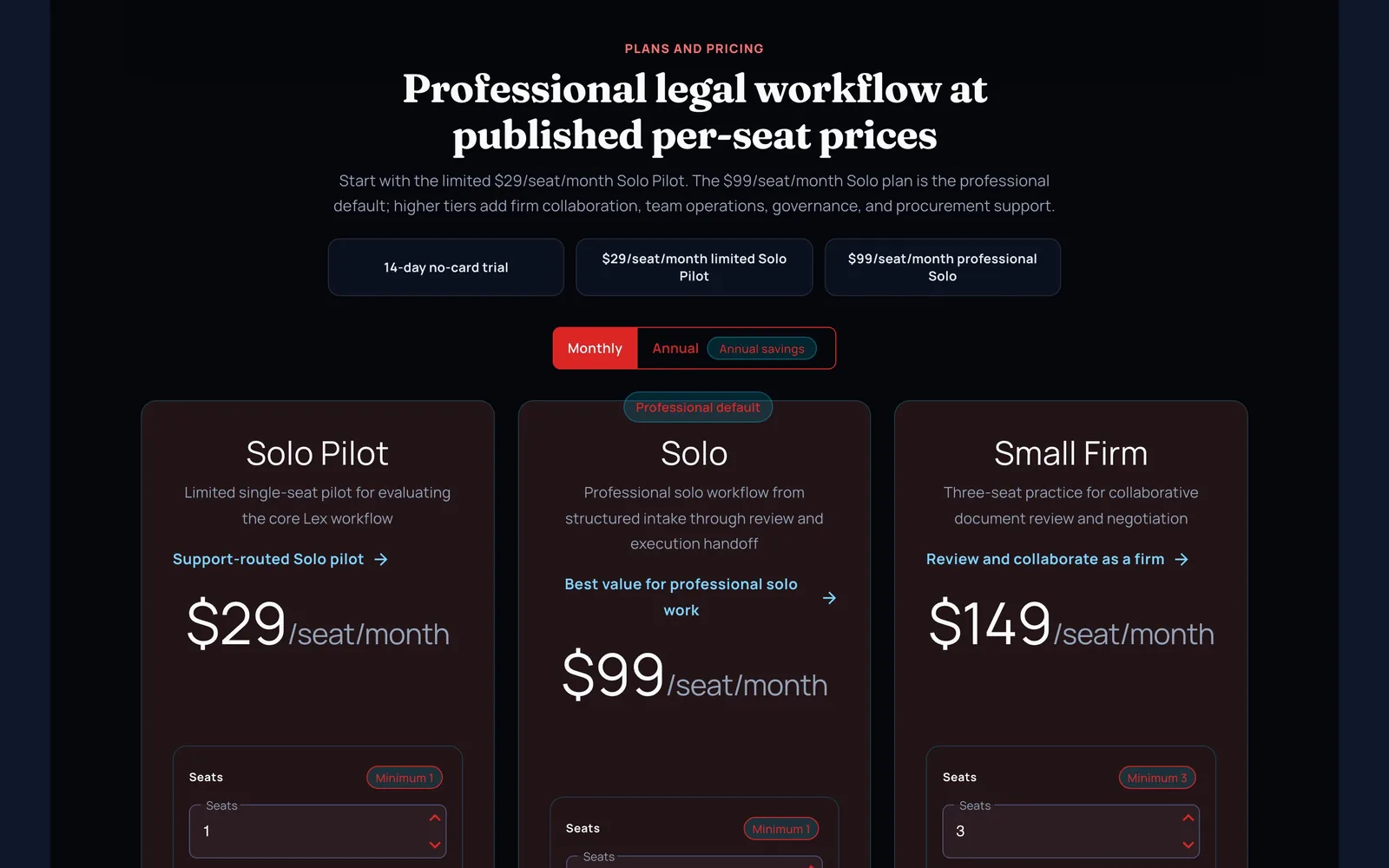
Lex is priced per seat, in US dollars. Every plan includes drafting capacity that resets each month; your subscriptions page shows a usage bar rather than counts.
| Plan | Per seat, monthly | Per seat, annual | Minimum seats |
|---|---|---|---|
| Solo Pilot | $29 | $261 | 1 |
| Solo | $99 | $999 | 1 |
| Small Firm | $149 | $1,499 | 3 |
| Growing Firm | $179 | $1,799 | 5 |
| Marketplace | $229 | $2,299 | 10, through Azure Marketplace or a private offer |
What changes between plans
- Every plan: drafting, Draft Checks, Ask Lex, review playbooks, agreement packs, the matter office, compliance drafts, exports and public share links.
- Small Firm and up: comments, and sharing with named people or a team.
- Growing Firm and up: creating teams and adding members.
- Marketplace: API access and provider governance.
Your 14-day trial
- No card is needed, and the 14 days start when you click Start my 14 days. Each email address gets one Lex trial.
- The trial works like Solo, so comments and sharing with named people aren't included.
- When the trial ends, you can still open, check and export everything. Drafting pauses until you choose a plan.
Free tools, no account needed
These tools run in the browser with no sign-in. They use no AI and store nothing you paste, which makes them a quick way to check a contract before it goes anywhere near a workspace.
| Tool | What it does |
|---|---|
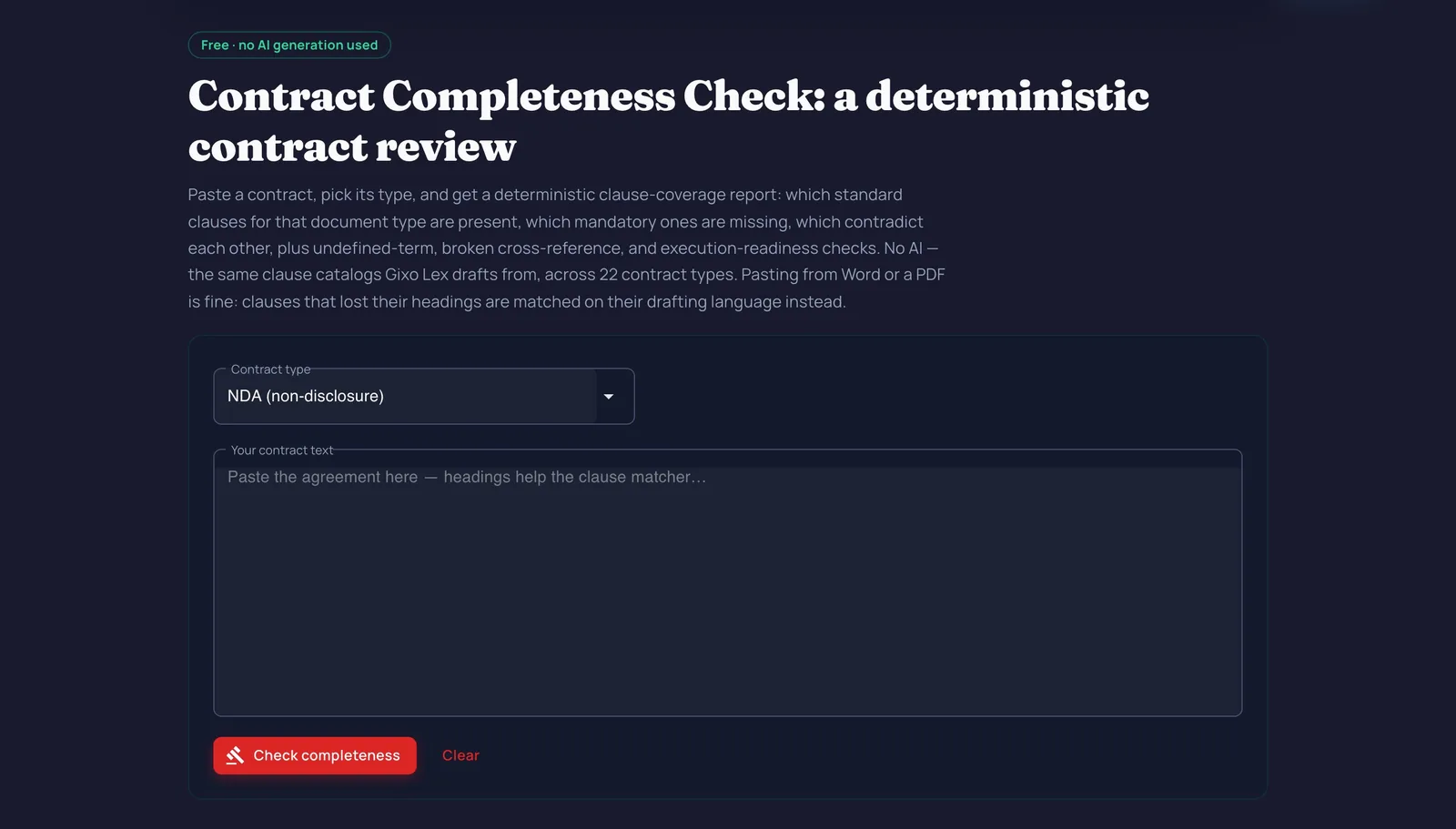
| Contract Completeness Check gixo.ai/lex/contract-check | Pick one of 22 contract types and paste the text. It reports clause coverage, contradicting clauses, execution readiness, defined terms and cross-references. |
| Contract Clause Checklist gixo.ai/tools/contract-clause-checklist | Checks whether a draft has the clause families expected for its agreement type. |
| Contract Compare gixo.ai/tools/contract-compare | Compares two versions of a contract section by section. |
| Key Terms Abstract Sheet gixo.ai/tools/contract-abstract | Pulls out parties, term, dates, governing law, payment, notice and liability language for review. |
| Obligations & Dates Extractor gixo.ai/tools/obligation-extractor | Lists explicit “shall”, “must”, deadline and notice statements, without judging them. |
| DPA Article 28 Check gixo.ai/tools/dpa-check | Checks a data processing agreement against the ten GDPR Article 28 topics. It gives no legal verdict. |
| Policy Set Gap Check gixo.ai/tools/policy-gap-check | Compares a list of your policies with a maintained baseline. |
| Compliance Readiness Scorer gixo.ai/tools/compliance-readiness-check | Scores evidence statements against a baseline of common programme controls. |
| Company Policy Template Builder gixo.ai/tools/policy-builder | Builds an internal policy with ownership, approval, review dates, exceptions and revision history. |
| RoPA Builder gixo.ai/tools/ropa-builder | Builds a GDPR Article 30 records-of-processing structure and flags missing transfer, safeguard and retention details. |
Tips from the checks
- Coverage looks for headings. A clause that only appears inside another section's text shows as a warning, so give it a heading of its own.
- An empty obligations list isn't proof there are none. Lex finds obligations from wording such as “shall” and “must”, so commitments phrased any other way won't appear. Read the draft.
- Precedent compares your own approved documents of the same contract type. Team documents aren't included.
- Compliance output modes are chosen for you from the type or format you pick.
- Before you record decisions or approve, save or recheck. Findings made against an older version are marked stale.
Quick links
| Lex dashboard | gixo.ai/dashboard/lex |
| Create an Agreement Pack | gixo.ai/legal/create?agreementPack=true |
| Draft a single document | gixo.ai/legal/create |
| Review a contract | gixo.ai/legal/import |
| Review playbooks | gixo.ai/legal/playbooks |
| Matter office | gixo.ai/legal/matters |
| My obligation portfolio | gixo.ai/legal/obligations |
| Lex Review Inbox | gixo.ai/legal/reviews |
| Make a Compliance Draft | gixo.ai/compliance/create |
| Start from an Existing Template | gixo.ai/compliance/workspace |
| Contract Completeness Check | gixo.ai/lex/contract-check |
| All free tools | gixo.ai/tools |
| Lex plans | gixo.ai/products/legal#plans |
| Help and support | gixo.ai/support |
Current as of 14 September 2026 and checked against the Lex code. If a screen doesn't match what you see, the product has moved on — tell us at gixo.ai/support and we'll update this guide.