
Legal first drafts built for counsel review
Start with the parties, terms, governing law, and reference files. Gixo builds a structured legal first draft that counsel can review clause by clause. The point is not to skip counsel. The point is to give counsel a structured first shot that arrives with context, references, and visible review hooks.
Reviewed 2026
An AI legal first draft for counsel is a structured, reviewable draft — built from captured intake (parties, terms, dates, governing law) and reference-file input — that hands counsel a working starting point with visible review hooks, not a finished, sign-ready document. It supports 22 named legal document types on the main create flow, plus custom drafting, with exports for counsel to review. The AI supplies structure and clause flow; counsel supplies the legal judgment, jurisdictional fit, and sign-off responsibility. Gixo Lex is sold per seat at $29–$229 per seat per month after a 14-day trial, with no free plan. Compare that subscription with the same matter's intake, review, negotiation, and approval effort; do not treat a seat price as a promise of unlimited drafts or a substitute for counsel.
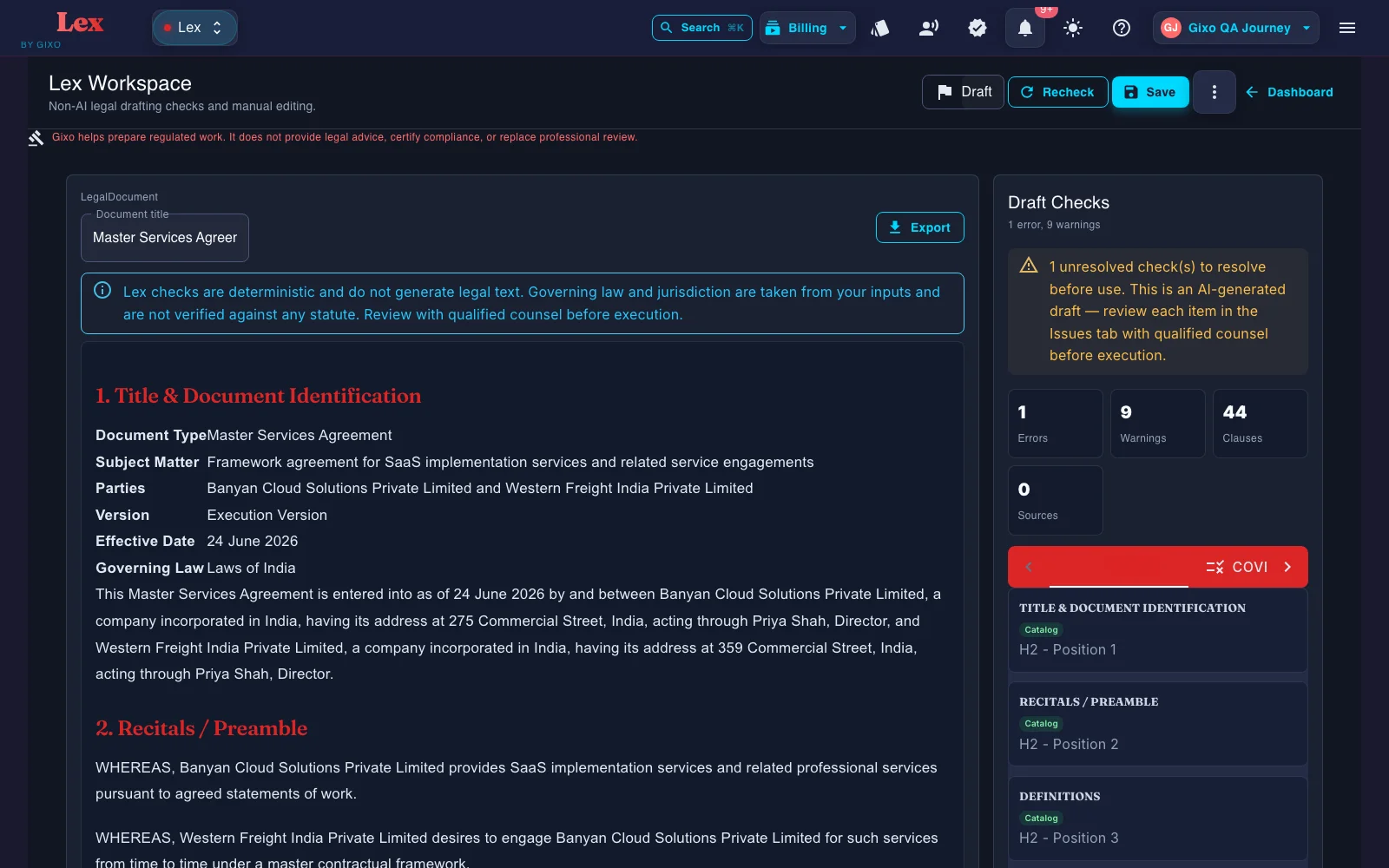
What makes an AI first draft usable for counsel?
The job is not to ask AI for a legal answer. The job is to prepare a draft or artifact that a qualified reviewer can actually work with.
Capture the parties, commercial terms, dates, and governing law before the draft is written so the reviewer does not start by fixing missing basics.
Use prior agreements, playbooks, or client forms to steer the first draft toward the language and structure counsel expects to see.
Reference files and governing context can shape the draft. Lex does not show clause-level source provenance, so reviewers should verify authority and supporting facts independently.
Refine the document inside the workspace instead of regenerating the entire draft every time counsel wants a targeted change.
After the first draft, Lex can run a deterministic contract review: clause coverage against a versioned playbook, clause-conflict detection, and defined-term and cross-reference checks. Findings, tracked-change DOCX redlines, comments, review state, assignees, due dates, and version history all stay attached to the same document. A contract imported from Word can go back as that same DOCX, with the Lex edits shown as Word tracked changes; where Lex cannot track an edit faithfully, such as inside a field, an existing revision, a header or a footer, it refuses the export instead of altering the document. Reviewers still verify every clause and conclusion.
Gixo helps prepare regulated work. It does not provide legal advice, certify compliance, or replace professional review.
How teams use Gixo's legal drafting AI for counsel-review drafts
Define the document type, parties, terms, dates, and governing law. Start with guided confidentiality/IP, services, corporate/equity, employment, real-estate, finance, and general legal documents, including custom drafting.
Use your team’s contract language, reference documents, or negotiated precedent to inform the first draft.
Gixo prepares the structure and clause flow so counsel can focus on legal judgment, negotiation posture, and missing facts.
Keep edits, comments, and export handoff in one place before the document moves to signature, negotiation, or external counsel workflows.
What does an AI legal first draft for counsel include?
On cost, the four routes separate sharply. As of mid-2026, having an attorney write a first draft from scratch typically runs about $300 to $2,000+ per document, and per-document template libraries typically charge about $10 to $50; Gixo and general AI assistants are subscription tools, so drafts are covered by the plan rather than billed per document. These are illustrative market ranges for the alternatives, not Gixo prices and not vendor quotes — confirm the real number with each provider.
| Capability | Gixo first draft | Template libraries | General AI | Manual drafting |
|---|---|---|---|---|
| Main job | Reviewable first draft | Prewritten forms | Prompt response | Attorney-written |
| Reference-file input | Yes | Rare | Paste only | Yes |
| Structured intake | Yes | Partial | No | Interview based |
| Jurisdiction-aware drafting | Yes | Template dependent | Unreliable | Yes |
| Review workflow | Yes | Outside tool | No | Outside tool |
| Multi-party support | Up to 10 parties | Usually 2 | Manual specification | Any number |
| Time to first draft | Minutes | Minutes | Minutes | Hours to days |
| Cost per draft (market ranges, mid-2026) | Subscription | $10–50 per document | Subscription | $300–2,000+ per draft |
The four pillars of reviewing an AI draft
A good review is not a linear read-through. It interrogates the draft from four angles — an error in any one can undermine the whole agreement.
AI has no knowledge of your actual deal — it uses placeholders or invents details. Confirm the draft reflects the real parties, dates, amounts, and business terms.
Does it include the clauses needed to be effective, and does it fit the governing-law jurisdiction? A globally-trained model can produce a generic contract that is invalid in a specific place. This is where counsel matters most.
A contract is a logical system. Are terms defined once and used consistently? Do cross-references point to the right sections? Do clauses contradict each other? AI drafts are notoriously prone to these errors.
A contract allocates risk between parties. The AI does not know your risk tolerance or negotiating position — does the draft protect you where you need it, or quietly give away too much?
The high-risk failure points to hunt for
These are where current AI drafts most often break. A reviewer should actively look for each one rather than assume the polished prose is correct.
AI builds from the most common patterns, so it can omit a clause your specific deal needs — a data-processing addendum, tailored IP assignment — or include one that does not belong.
It may define "Confidential Information," then later say "Proprietary Information" for the same thing — ambiguity that can render a key provision unenforceable.
"As defined in Section 3.1" when the definition is in 2.1 — or a section that does not exist. Models without a persistent map of the document fail to update these as numbering changes.
A "vanilla" draft blends legal systems; a non-compete that is standard in one state can be unenforceable in another. Check that the draft fits the governing law you have chosen.
AI can confidently cite statutes or cases that do not exist, or invent plausible-sounding clauses with no basis in law. Treat every citation with skepticism and verify it independently.
The hardest to catch is what is not there. The AI gives what was asked for, not what should have been asked for. Step back and ask what protection you would wish the contract had if things go wrong.
A structured review protocol
Check the fundamentals before the fine print. A logical order keeps reviewers from polishing prose in a draft whose foundation is broken.
Confirm all names, dates, amounts, and business terms against the deal sheet. Make sure the draft's scope matches the real transaction.
Before reading for substance, run a mechanical pass: verify definitions, hunt for defined-term drift, and validate every cross-reference.
Read section by section. For each clause ask: is it legally sound, is it clear, and does it achieve the outcome you want?
Check the document against the requirements of the governing-law jurisdiction. This step may need specialized counsel.
Read the corrected document end to end. Does it work as a coherent whole, and does the risk allocation match your position?
A last pass for typos, grammar, and formatting inconsistencies the AI may have introduced.
When should you start from an AI draft, and when shouldn't you?
Not every document carries the same risk. Match the approach to the stakes.
Simple NDAs, basic policies, internal resolutions. An AI draft is an efficient starting point — provided it still goes through the full review protocol.
Service agreements, employment contracts, commercial leases. Use with care: treat the draft as a collection of candidate clauses and expect significant redrafting.
M&A, patent licenses, shareholder agreements, litigation filings. These need strategic architecture from the first word — not a generative first draft.
Frequently Asked Questions
Updated