
Five-second clarity
Can a buyer tell who the product is for, what work it prepares, and where professional review remains required?
Neutral buyer evaluation
Legal AI products and packaging change quickly. Use current official vendor pages, real product access, contract terms, and security documentation. This hub gives you a repeatable evaluation rubric and shows the Lex evidence available on this site.
Gixo does not publish customer logos, ratings, certification badges, competitor pricing, or feature claims on this hub without evidence that supports them.
Seven-step rubric
Capture the date and source for each answer because public product pages, packaging, and policies can change.
Can a buyer tell who the product is for, what work it prepares, and where professional review remains required?
Is there a current workflow recording or full-size product capture, clearly separated from mockups and customer claims?
Can you move from overview to workflow, proof, trust, pricing, trial, and a realistic handoff without guessing the next step?
Can the responsible reviewer inspect inputs, issues, revisions, versions, and exports on the same work product?
Are security, AI-processing, retention, subprocessors, certifications, and legal limitations attributed to the organization that actually owns each claim?
Are trial mechanics, plan boundaries, support-routed pilots, and current contract terms understandable before a sales conversation?
Does the exported artifact remain legible, reviewable, and usable in the recipient's actual workflow?
What this site lets you verify
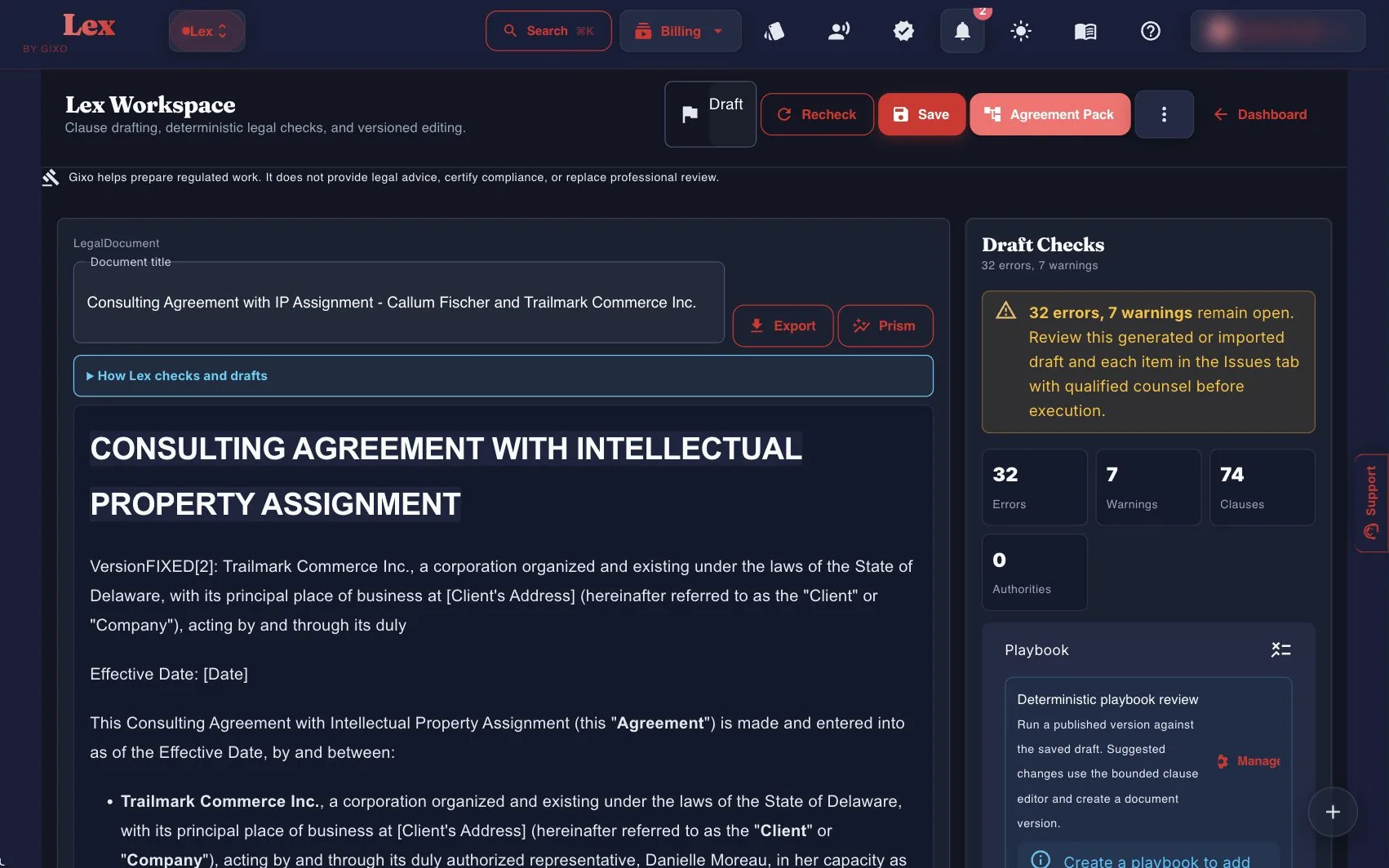
A workflow recording and product captures from July 2026 show structured intake, the working document, Draft Checks, and handoff surfaces, and the tour page lists the Lex capabilities added since that recording.
Reference files and governing context can shape the draft. Lex does not show clause-level source provenance, so reviewers should verify authority and supporting facts independently.
Review the current public plan cards, included usage, and no-card 14-day trial. Confirm the order terms that apply before purchase.
The workflow index distinguishes the named document types on the create flow from document-intent pages that begin through Custom intake.
The shortlist, by category
Most shortlists fail because they mix four different products into one comparison. Group candidates by the job first, then run the seven-step rubric inside the group. The products below are grouped by the category each vendor positions itself in on its own public pages. That is a map of the category, not a rating, a ranking, or a claim about what any of them does - confirm current capabilities, terms and security documentation with the vendor before you decide.
Finding authority, summarising it, and answering a question about a body of material. Positioned here: Harvey, Paxton.
The rubric bites hardest at criteria 02 and 05. Ask what the answer is grounded in, whether every proposition carries a citation you can open, and what happens when the source does not support the claim. A research tool that cannot show its working cannot be reviewed.
Turning an intake into a first draft, or turning a precedent into a reusable workflow. Positioned here: Gavel, Genie AI, and Gixo Lex.
Criteria 03 and 07 decide it. Follow one matter from intake to export and look at what arrives at the other end: whether the document is still structured, still editable in the recipient's tooling, and still legible once it leaves the product.
Reading an incoming agreement and marking what to change, usually inside the editor the reviewer already uses. Positioned here: Spellbook, and Gixo Lex for its contract review workflow.
In Lex, that review is deterministic: clause coverage against a versioned playbook, clause-conflict detection, and defined-term and cross-reference checks, with tracked-change DOCX redlines exported from the same document. See how Lex review works
Criterion 04 is the whole evaluation. The reviewer has to be able to see the input, the issue raised, the revision, the version history and the export against the same work product. A suggestion you cannot trace is not reviewable, whatever its quality.
Evidence collection, control monitoring and audit readiness. This category is mostly GRC platforms rather than legal drafting tools, and it is the most common shortlist error we see - a compliance platform and a drafting tool answer different questions and cannot be scored against each other.
If the requirement is compliance documents rather than a compliance programme, that is a drafting job and belongs in Job 02. Gixo runs it as a separate flow for the same reason.
Two questions buyers ask first
There is no defensible single answer, and any list that gives you one has picked a job for you without saying so. The category splits four ways - research and analysis, drafting and document automation, contract review and redlining, and compliance programme automation - and the leaders in one are not competitors in another. Name the job you are buying for, take the two or three products positioned in that job, and score them against the same rubric on the same matter. That comparison is defensible; a cross-category ranking is not.
Run one safe, fictional matter through every candidate, keeping the parties, requested document, source packet, reviewer checklist and export test constant, and score the seven criteria above as you go. Record the date and source for every answer, because packaging and policy pages change. Three things are worth more than any feature list: what the product does when it is not sure, whether a reviewer can inspect and revise on the same work product, and what the exported artifact looks like in the recipient's hands.
Keep the parties, governing context, requested document, source packet, reviewer checklist, and export test constant. Record where the product discloses uncertainty, how easy it is to revise the draft, and what survives the final handoff.
Official product information checked 10 October 2026 shows why the categories above are starting points, not exclusive boxes. Harvey describes agents, knowledge, document workspaces and contract intelligence alongside research. Clio Work combines cited research, document analysis and legal drafting, while Clio Draft has document assembly workflows.
Spellbook describes drafting, contract review and playbooks; its advertised contract-management product is marked early access. Gavel Exec is a separate Word drafting/review product from Gavel Workflows document automation. Genie AI and Paxton also span multiple document and analysis jobs. Confirm the current plan, access and commercial terms with each seller.
Operational platforms can also draft policies. Vanta, Drata and Secureframe describe document or policy assistance alongside their broader compliance operations. ISMS Copilot describes documentation and audit-preparation assistance without evidence collection or continuous monitoring. Compare the actual artifact, review controls and operational boundary with your own safe task.
These are dated vendor descriptions, not observed product scores. Lex's source-verified focus is structured first drafts, deterministic checks, reviewable bounded edits, version-bound approvals and defined Word handoffs, with professional review.
Structured first draft, accountable review
Start the 14-day, no-card Lex trial to evaluate structured intake, drafting, deterministic Draft Checks, review, and export. Gixo prepares work for review; it does not provide legal advice, certify compliance, or replace professional judgment.
Updated