
AI Legal Documents for Fractional General Counsel — One Drafting Workspace for Every Client
Fractional and outside counsel don't draft one NDA — they draft the same handful of commercial documents dozens of times, for dozens of clients, each with its own house terms. Gixo prepares a structured first draft from the parties, terms, and posture you set, so the billable hour goes to negotiation and judgment, not retyping a template.
Gixo's AI legal drafting tool for fractional general counsel is a drafting workspace built around the reality of a multi-client practice: repeatable commercial document types, a consistent clause structure across engagements, and a posture setting (balanced, or favoring one party) so the same NDA or MSA can be pulled toward a different client's house position without starting over. It does not replace your judgment on any engagement — every draft is a starting point for the review and negotiation you were already going to do, not a substitute for it.
What changes when you draft for five clients instead of one company?
The job is not to ask AI for a legal answer. The job is to prepare a draft or artifact that a qualified reviewer can actually work with.
Draft NDAs, MSAs, SOWs, and consulting agreements from a consistent structure each time, instead of hunting through old files for "the one I did for a client like this."
Set a balanced starting point, or lean the draft toward whichever party your client is this time — the same clause library, a different negotiating stance.
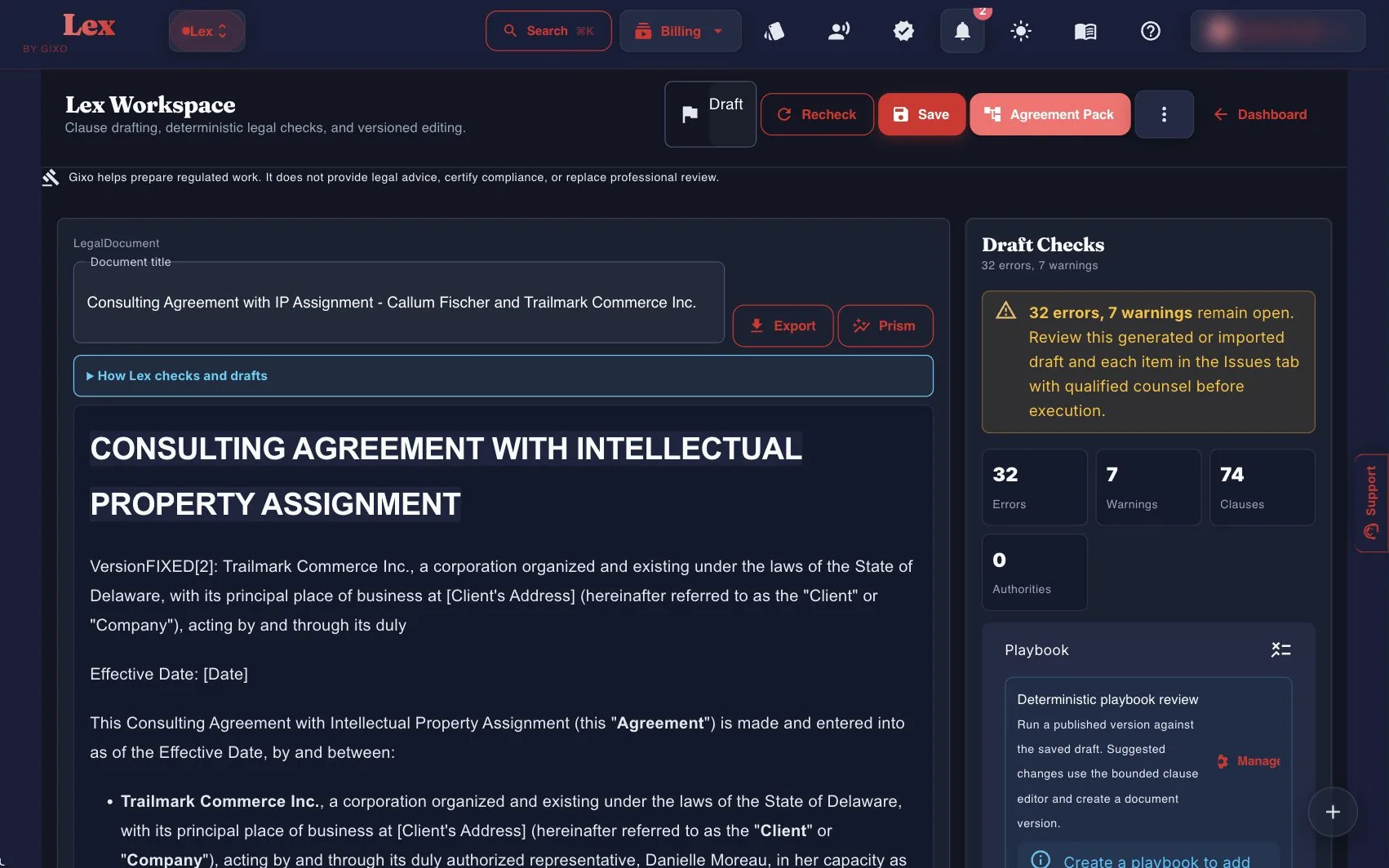
Before review, Gixo Lex runs a draft analysis pass: a clause inventory, missing-clause coverage, defined-term consistency, cross-reference validation, and execution-readiness checks. Those checks are rule-based rather than generated: they call no model, write no new legal text, and draw no plan capacity, so the same draft checked twice gives the same answer and reviewers start from a cleaner draft instead of hunting for gaps.
Upload a client's existing paper as reference so a new draft starts closer to the language they already use, instead of your firm's generic default.
After the first draft, Lex can run a deterministic contract review: clause coverage against a versioned playbook, clause-conflict detection, and defined-term and cross-reference checks. Findings, tracked-change DOCX redlines, comments, review state, assignees, due dates, and version history all stay attached to the same document. A contract imported from Word can go back as that same DOCX, with the Lex edits shown as Word tracked changes; where Lex cannot track an edit faithfully, such as inside a field, an existing revision, a header or a footer, it refuses the export instead of altering the document. Reviewers still verify every clause and conclusion.
Time saved on the first draft is time spent on negotiation, risk calls, and the parts of the engagement only you can do.
Legal workflow automation: how does a multi-client drafting workflow actually run?
Start with the document type — NDA, MSA, SOW, consulting agreement, or another supported kind — and whether this client needs a balanced draft or one favoring their side.
Capture the actual commercial terms for this engagement. Governing law and venue are free text, so the same workflow works regardless of which jurisdiction a given client sits in.
Anchor the new draft to a client's existing house terms instead of a one-size-fits-all default.
Resolve anything the draft-analysis pass flagged, apply your own judgment, and export when it's ready for this client's signature process.
What does Gixo's fractional-counsel drafting workspace include?
| Capability | Gixo |
|---|---|
| Main job | Drafting workspace, one login across every client engagement |
| Structured first drafts | Yes |
| Posture options per draft | Balanced, or favoring one party |
| Jurisdiction handling | Free-text governing law and venue — no fixed country list |
| Reference-file use (per-client house terms) | Yes |
| Client matters | Matter office with an optional client on each matter and a client filter; each matter keeps its own sources, work products, and tasks, including task due dates |
| Missing-clause and structural checks | Before review, Gixo Lex runs a draft analysis pass: a clause inventory, missing-clause coverage, defined-term consistency, cross-reference validation, and execution-readiness checks. Those checks are rule-based rather than generated: they call no model, write no new legal text, and draw no plan capacity, so the same draft checked twice gives the same answer and reviewers start from a cleaner draft instead of hunting for gaps. |
| Seats for a small practice | Multi-seat plans available if you bring on support |
| Export | PDF, DOCX, HTML, and TXT |
| Replaces your judgment on an engagement? | No — prepares the first draft, you still own the advice |
What legal matter management software does fractional counsel need for drafting?
For one client question, a useful matter workspace keeps the documents and the review trail together. Lex's personal matter office lets you record the client, organize supplied source documents, retain quoted findings with their source versions, build a chronology, record facts and decisions, and manage tasks with explicit operational due dates.
Use the matter's reviewed findings to prepare the relevant work product, then review the saved output before marking the work complete or preparing a reviewed delivery bundle. Refresh changed source dependencies first. The reviewer remains responsible for the facts, legal interpretation and any court or statutory deadline; the software does not provide a licensed research or citator service.
Lex covers this personal, source-based drafting job. Matters belong to their owner even on team plans; sharing a legal document does not turn its matter into a team workspace. If you need legal matter management software for firm-wide billing, trust accounting, docketing or multi-person case administration, evaluate a practice-management system alongside Lex.
Frequently Asked Questions
Updated