
Make the intake specific
Supply the parties, document kind, jurisdiction, obligations, dates and reference material. Review imported content and retain its source identity before using it in a new matter.
Use Gixo when an independent contractor or consulting engagement needs an agreement first draft shaped by deliverables, fees, IP ownership, confidentiality, and termination — with independent-contractor classification assumptions left for qualified counsel to confirm.
An AI consulting agreement generator drafts independent contractor and consulting engagement agreements, covering deliverables and acceptance criteria, fee structure such as time-and-materials, fixed-fee, milestone, or retainer, IP and work-product ownership, with the client owning deliverables by default and choices like work-for-hire, full assignment, or license-back set through your drafting instructions, confidentiality scope, and termination terms, while keeping the independent-contractor classification defaults on the contractor side of the line. Gixo produces this as a first reviewable draft in minutes, structured for handoff to commercial counsel, rather than a free-text template edited for hours. It does not provide legal advice or certify compliance.
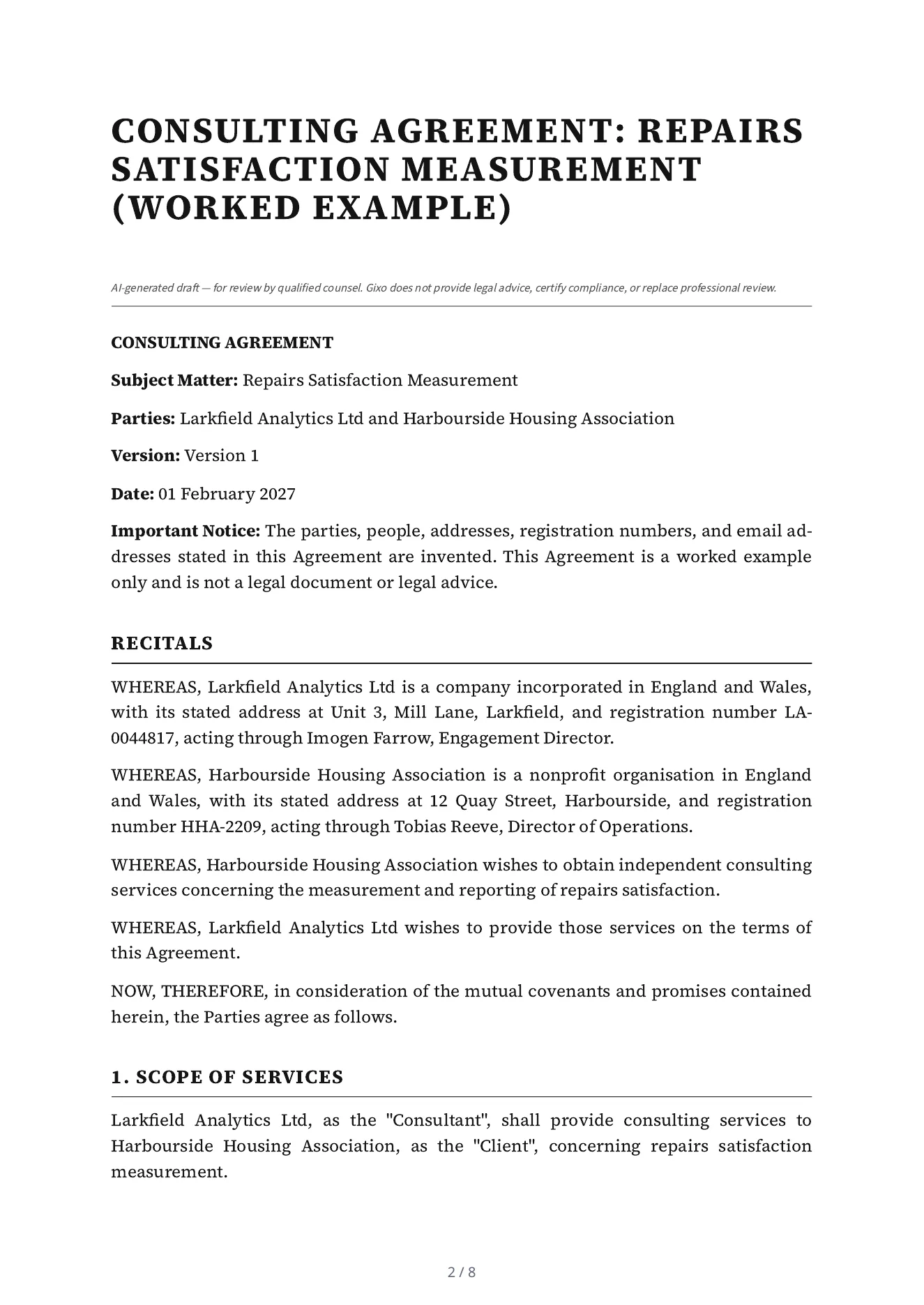
This is a real Lex export for invented parties. Inspect the input and clauses as a worked example, with professional review kept separate from automated drafting and checks.
A consulting agreement of 26 numbered clauses between two invented parties: scope, services, deliverables, exclusions, fees and expenses, intellectual property, confidentiality, liability, termination, notices, governing law and signature blocks. Its first page says the parties, people and addresses are invented and that it is a worked example, not a legal document.
Draft a Consulting Agreement: repairs satisfaction measurement between Larkfield Analytics Ltd (Consultant) and Harbourside Housing Association (Client). Governing law: England and Wales. Effective date: 2027-02-01. Term: Ten weeks from the effective date. Confidentiality: Three years after the engagement ends. The Consultant will review the Client's current repairs satisfaction survey and the data behind it, recommend a method for measuring repairs satisfaction by contractor, and leave the Client with a reporting approach that the repairs team and the board can use. Excluded: building or buying software, and running surveys. Dependencies: the Client provides the survey data within five working days of the effective date and two days a week of its operations manager's time. State on the first page that the parties, people and addresses in this agreement are invented and that it is a worked example, not a legal document. Keep the agreement short and plain. The notice email address of Larkfield Analytics Ltd is notices@larkfield-analytics.example and of Harbourside Housing Association is notices@harbourside-housing.example (both invented).
Read mechanically against the intake, not by a lawyer: all 12 facts the intake gave (names, registration numbers, addresses, representatives, the effective date and the governing law) are in the draft, nothing is left as a placeholder, and it states two terms the intake did not give, 30 days and 10 business days, which Lex chose.
Supply the parties, document kind, jurisdiction, obligations, dates and reference material. Review imported content and retain its source identity before using it in a new matter.
Use the legal workspace's permitted structural tools, Draft Checks and review paths. Compare proposed changes with the saved draft and original material; unsupported Word edits must be handled explicitly.
Have qualified counsel review enforceability, local requirements and the actual commercial intent. Check the current approval state and the downloaded document after a change.
Select the target clause and give Ask Lex a bounded instruction. Missing facts remain visible for review. Inspect the before-and-after proposal, required clause checks and any explicit outside-matrix or mandatory-clause override before versioned application. Use the legal workspace's structural allowlist rather than assuming every general content-editor block is available.
Inspect immutable playbook versions, anchored findings, provenance and precedent variants before staging a change. Matters retain original sources, quotation findings and source-version comparisons. Review extracted obligations for timing, ownership and source revision; negotiation turns and agreement-pack review cells have their own decisions and current-version requirements.
Original-format Word export, tracked changes against an original and saved-version redlines are separate paths. Unsupported edits must be surfaced rather than silently claimed as preserved. Inspect the layout, validator notes and downloaded file, then retain its delivery receipt. Counsel's review applies to the actual matter and version.
Every contract in Lex, drafted or imported, gets an AI contract review: each clause the document type expects marked present, weak or absent; up to 25 risks with a level, the party each falls on, why it matters and replacement wording; and provisions that cannot both be followed. Every quotation is checked against the contract text, findings are decided before approval, and there is no single risk score. The same review reads the key terms and obligations with the words they quote and proposes them into the Agreement Pack. Review every document puts up to 25 documents of an Agreement Pack, or up to 200 in a matter, into one table with your own questions as columns and an Excel export. Approvers can be named in order, and signing supports up to 10 signers with an optional signing order and automatic reminders; it is a simple electronic signature, not a qualified one. A qualified reviewer still decides what the contract says.
Lex does not provide legal advice or certify compliance. The public specimen is not a universally reusable legal template. Word fidelity depends on the supported original-document and saved-version path; unrestricted Power Edit and image insertion are not legal editing features.
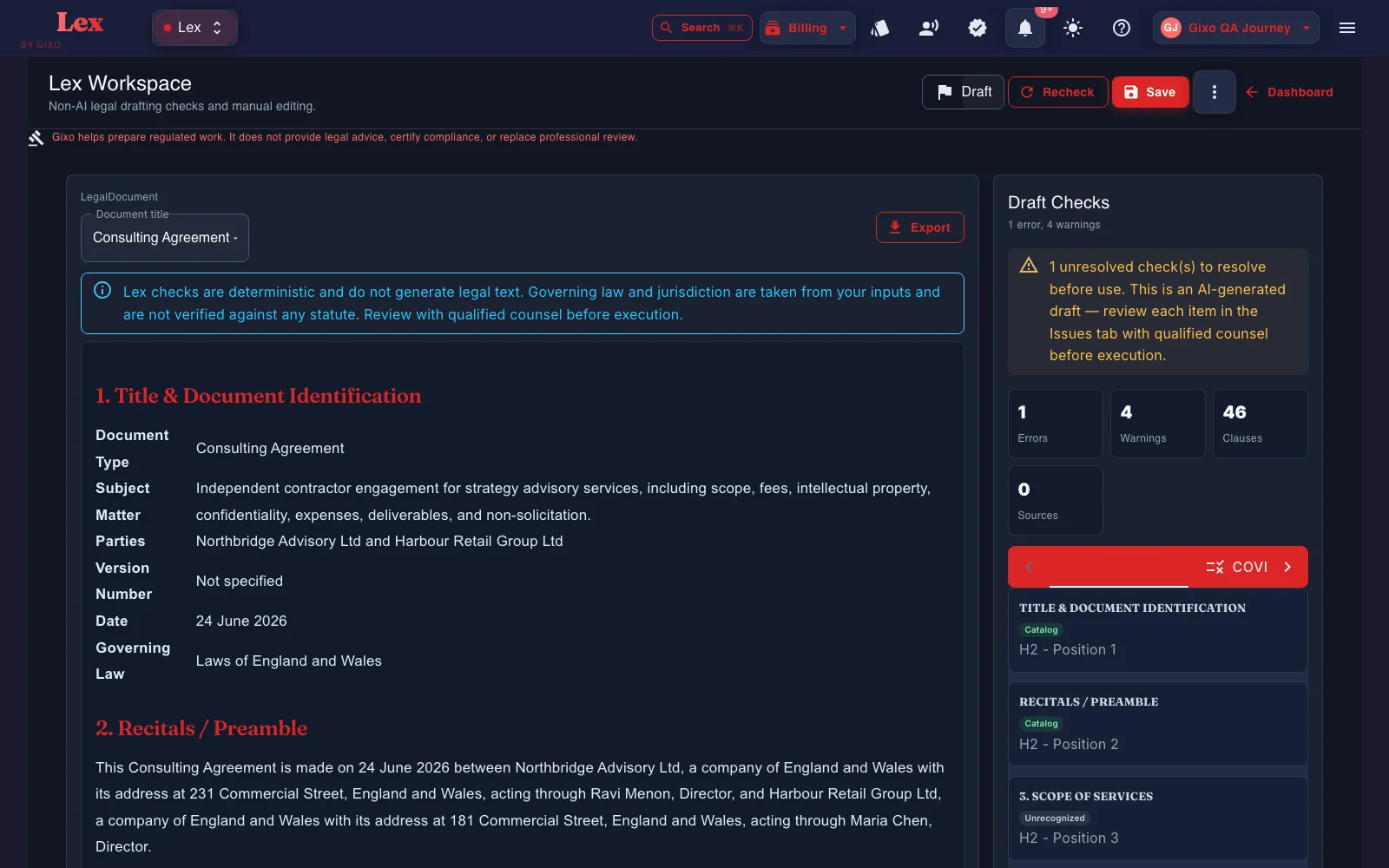
Drafted by Lex on 3 October 2026 from the intake shown and exported unedited as a PDF and a Word file. The parties are invented, and the first page says so. It is a specimen, not a legal document.
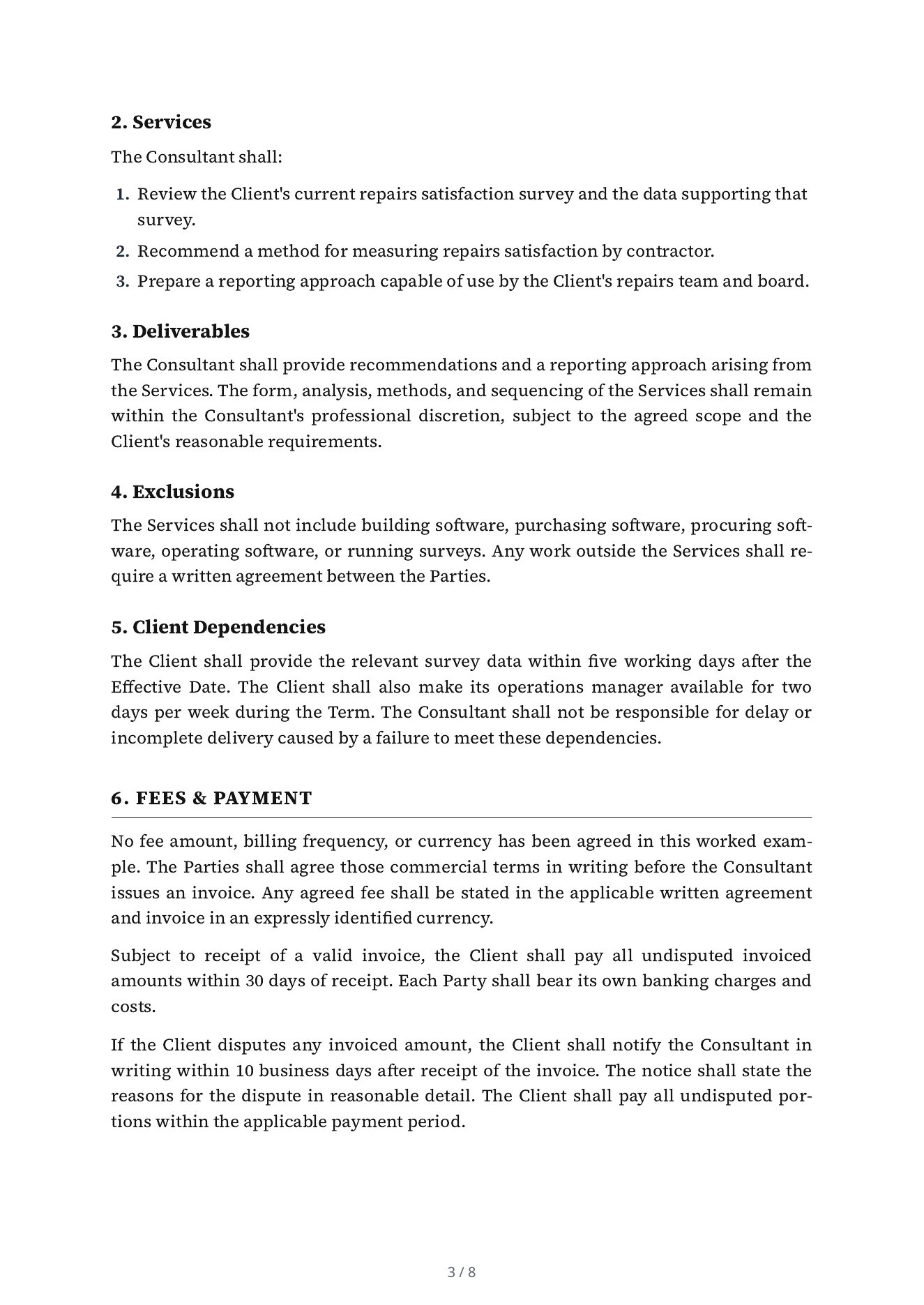
Consulting agreement · 8-page PDF · 1,860 words
A consulting agreement of 26 numbered clauses between two invented parties: scope, services, deliverables, exclusions, fees and expenses, intellectual property, confidentiality, liability, termination, notices, governing law and signature blocks. Its first page says the parties, people and addresses are invented and that it is a worked example, not a legal document.
Draft a Consulting Agreement: repairs satisfaction measurement between Larkfield Analytics Ltd (Consultant) and Harbourside Housing Association (Client). Governing law: England and Wales. Effective date: 2027-02-01. Term: Ten weeks from the effective date. Confidentiality: Three years after the engagement ends. The Consultant will review the Client's current repairs satisfaction survey and the data behind it, recommend a method for measuring repairs satisfaction by contractor, and leave the Client with a reporting approach that the repairs team and the board can use. Excluded: building or buying software, and running surveys. Dependencies: the Client provides the survey data within five working days of the effective date and two days a week of its operations manager's time. State on the first page that the parties, people and addresses in this agreement are invented and that it is a worked example, not a legal document. Keep the agreement short and plain. The notice email address of Larkfield Analytics Ltd is notices@larkfield-analytics.example and of Harbourside Housing Association is notices@harbourside-housing.example (both invented).
Read mechanically against the intake, not by a lawyer: all 12 facts the intake gave (names, registration numbers, addresses, representatives, the effective date and the governing law) are in the draft, nothing is left as a placeholder, and it states two terms the intake did not give, 30 days and 10 business days, which Lex chose.
The job is not to ask AI for a legal answer. The job is to prepare a draft or artifact that a qualified reviewer can actually work with.
Capture the independent-contractor assumptions for counsel to test against the actual working relationship — control, tools, scheduling, exclusivity, and benefit treatment.
Define what is delivered, the acceptance criteria, the milestone dates, and the dependencies so the engagement runs from a written scope.
Time-and-materials, fixed-fee, milestone, retainer — capture the right pricing model with rates, expense reimbursement, and invoicing cadence.
Start from the default of client-owned deliverables with the consultant keeping its own tools and methods, then ask for work-for-hire, full assignment, or license-back, pre-existing IP carve-outs, and any third-party-component obligations in your drafting instructions.
Set the confidentiality period, the return-of-information mechanic, and the residual-knowledge handling so post-engagement disputes are scoped up front.
Notice period, for-cause termination triggers, deliverable transfer on termination, and post-engagement cooperation captured before review.
Define the consultant, the client, the services, the term, and the renewal mechanic — and confirm the IC-status defaults apply.
Lock the deliverables and milestones, set the fee model and invoicing cadence, and pick the IP-ownership structure for the work product.
Add the confidentiality scope, the return-of-information mechanic, the termination triggers, and the post-engagement cooperation language.
Route to commercial counsel inside the workspace for review of IC classification and IP terms, then export in PDF, DOCX, HTML, and TXT.
| Capability | Gixo | Employment template | Generic AI | Outside counsel |
|---|---|---|---|---|
| IC-status defaults captured first-class | Yes | Test on the same inputs | Variable | Yes |
| Deliverables with acceptance criteria | Structured | Free text | Variable | Yes |
| IP options (WFH vs assignment vs license) | All three, set through your drafting instructions | Test on the same inputs | Variable | Yes |
| Pre-existing IP carve-out schedule | Yes | Test on the same inputs | Test on the same inputs | Yes |
| Time to first reviewable draft | Measure the same task | Measure the same task | Measure the same task | Measure the same task |
The other columns describe what each kind of tool is generally for, not a test of a named product, and products differ. Run the same brief and reference files through anything on your shortlist, then compare the draft, the review trail and the export.
Updated