
Make the intake specific
Supply the parties, document kind, jurisdiction, obligations, dates and reference material. Review imported content and retain its source identity before using it in a new matter.
Prepare a founder-friendly NDA draft from your parties, confidentiality scope, product context, fundraising context, and reference files. Lex keeps review boundaries visible so the draft can move to counsel or a qualified reviewer.
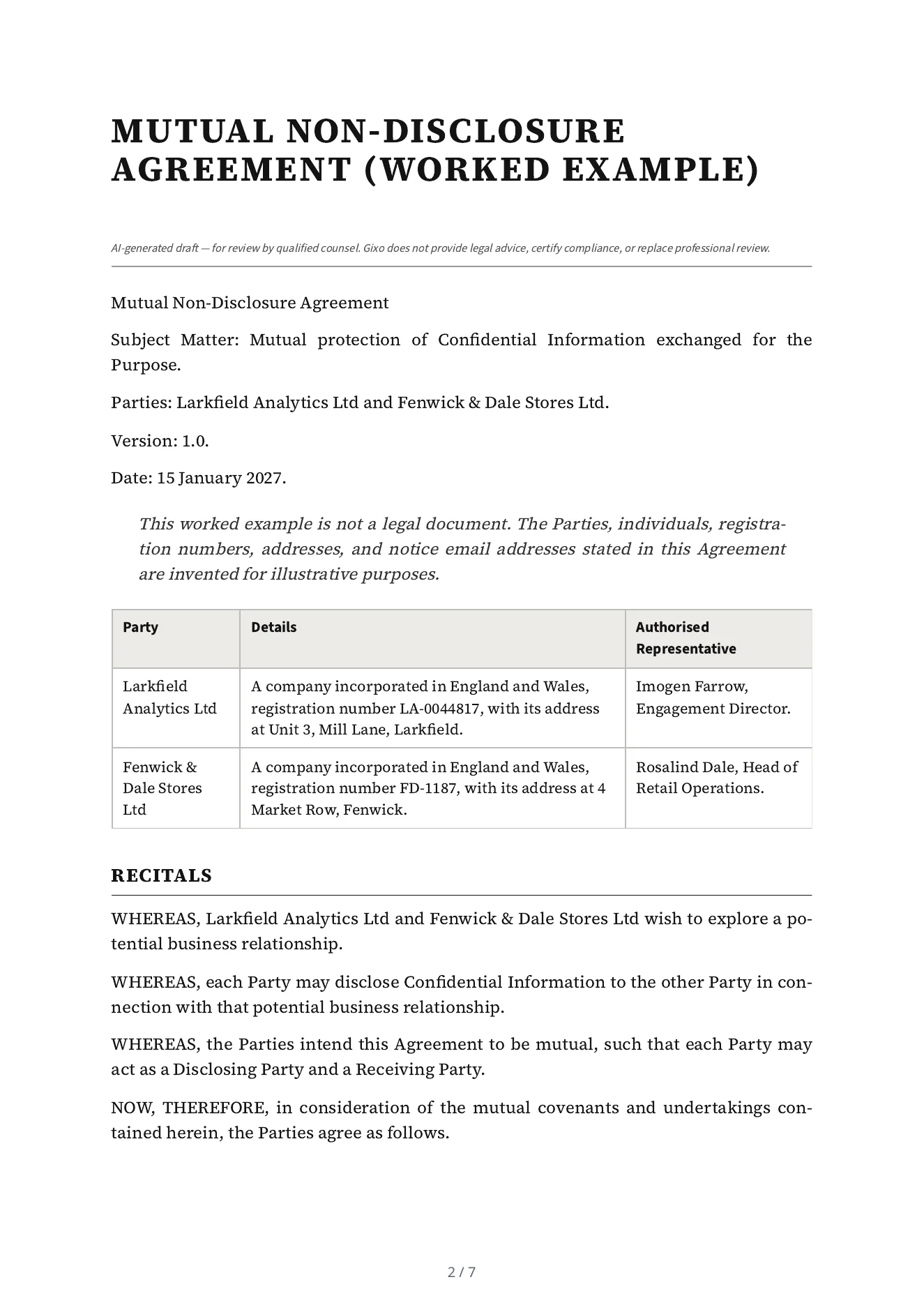
This is a real Lex export for invented parties. Inspect the input and clauses as a worked example, with professional review kept separate from automated drafting and checks.
A mutual non-disclosure agreement of 14 numbered clauses between two invented parties: definitions, confidential information, exclusions, obligations of the receiving party, permitted disclosures, return of materials, IP reservation, warranties, remedies, term and termination, survival, governing law, general provisions and signature blocks. Its first page says it is a worked example, not a legal document.
Draft a Mutual Non-Disclosure Agreement between Larkfield Analytics Ltd (Party A) and Fenwick & Dale Stores Ltd (Party B). Governing law: England and Wales. Effective date: 2027-01-15. Term: Two years from the effective date. Confidentiality: Three years after disclosure. A mutual agreement: each party may disclose and receive confidential information. State on the first page that the parties, people and addresses in this agreement are invented and that it is a worked example, not a legal document. The notice email address of Larkfield Analytics Ltd is notices@larkfield-analytics.example and of Fenwick & Dale Stores Ltd is notices@fenwick-dale.example (both invented). Use only these supplied facts and leave no placeholders or missing-fact markers: Document version is 1.0 (approved for this worked example). Place of execution: Fenwick, England (invented). Use 2027-01-15 as both the execution date and signature date, and treat each party representative's authority to execute as confirmed.
Read mechanically against the intake, not by a lawyer: 10 of 12 checked facts are in the draft (the two registration numbers are deferred to section 13 rather than printed verbatim), nothing is left as a placeholder, and 0 unstated terms appear outside the intake.
Supply the parties, document kind, jurisdiction, obligations, dates and reference material. Review imported content and retain its source identity before using it in a new matter.
Use the legal workspace's permitted structural tools, Draft Checks and review paths. Compare proposed changes with the saved draft and original material; unsupported Word edits must be handled explicitly.
Have qualified counsel review enforceability, local requirements and the actual commercial intent. Check the current approval state and the downloaded document after a change.
Select the target clause and give Ask Lex a bounded instruction. Missing facts remain visible for review. Inspect the before-and-after proposal, required clause checks and any explicit outside-matrix or mandatory-clause override before versioned application. Use the legal workspace's structural allowlist rather than assuming every general content-editor block is available.
Inspect immutable playbook versions, anchored findings, provenance and precedent variants before staging a change. Matters retain original sources, quotation findings and source-version comparisons. Review extracted obligations for timing, ownership and source revision; negotiation turns and agreement-pack review cells have their own decisions and current-version requirements.
Original-format Word export, tracked changes against an original and saved-version redlines are separate paths. Unsupported edits must be surfaced rather than silently claimed as preserved. Inspect the layout, validator notes and downloaded file, then retain its delivery receipt. Counsel's review applies to the actual matter and version.
Every contract in Lex, drafted or imported, gets an AI contract review: each clause the document type expects marked present, weak or absent; up to 25 risks with a level, the party each falls on, why it matters and replacement wording; and provisions that cannot both be followed. Every quotation is checked against the contract text, findings are decided before approval, and there is no single risk score. The same review reads the key terms and obligations with the words they quote and proposes them into the Agreement Pack. Review every document puts up to 25 documents of an Agreement Pack, or up to 200 in a matter, into one table with your own questions as columns and an Excel export. Approvers can be named in order, and signing supports up to 10 signers with an optional signing order and automatic reminders; it is a simple electronic signature, not a qualified one. A qualified reviewer still decides what the contract says.
Lex does not provide legal advice or certify compliance. The public specimen is not a universally reusable legal template. Word fidelity depends on the supported original-document and saved-version path; unrestricted Power Edit and image insertion are not legal editing features.
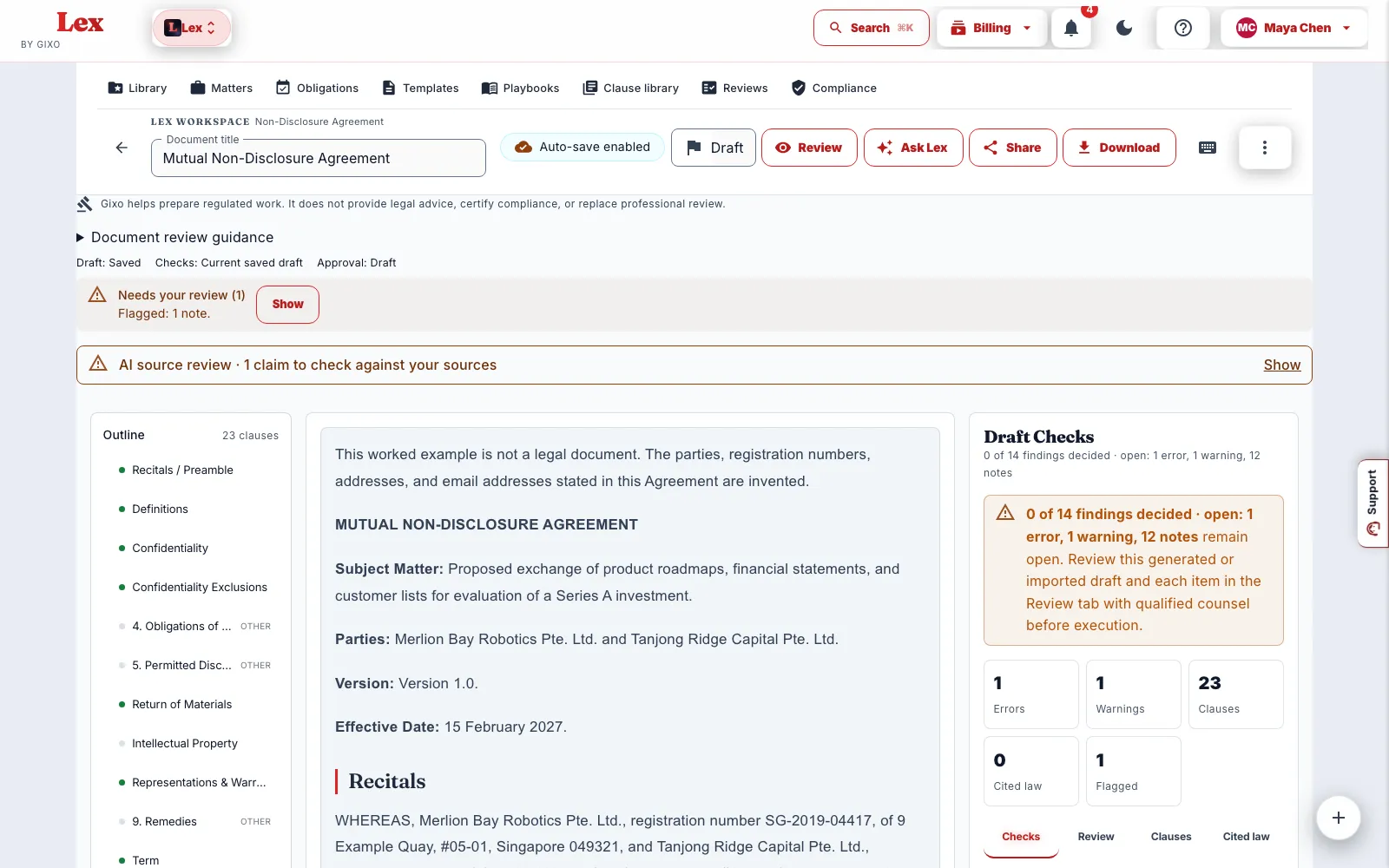
A startup NDA generator should help founders prepare a reviewable confidentiality draft, not bypass professional review. Lex starts with party roles, confidential information categories, permitted disclosures, exclusions, return or destruction terms, jurisdiction, and optional reference files, then prepares a draft with visible review notes. Gixo helps prepare regulated work. It does not provide legal advice, certify compliance, or replace professional review.
Start with the parties, terms, governing law, and reference files. Gixo builds a structured legal first draft that counsel can review clause by clause.
Set whether the NDA is mutual or one-way and identify who is disclosing, receiving, or both.
Describe product, technical, customer, financial, investor, or strategic information with enough specificity for review.
Capture advisors, employees, contractors, investors, auditors, or affiliates that may need access under restrictions.
Surface common exclusions and time limits so counsel can tune them to the transaction and jurisdiction.
Attach an existing company template or investor-favored NDA so the first draft can follow known structure where appropriate.
Before review, Gixo Lex runs a draft analysis pass: a clause inventory, missing-clause coverage, defined-term consistency, cross-reference validation, and execution-readiness checks.
Reusable mutual NDA template structure for two startups: Look at the 14-clause worked Mutual Non-Disclosure Agreement example above to see how a reusable structure works when two startups exchange product, technical, or customer information. Rather than pasting names into a static mutual NDA template, the editable workflow structures definitions, confidential information scope, standard exclusions, receiving-party obligations, permitted disclosures (for advisors, employees, or investors), return or destruction of materials, IP reservation, warranties, remedies, term and termination, confidentiality survival, governing law, general provisions, and signature blocks around your actual deal facts. Qualified counsel still reviews enforceability and local requirements before execution — open the editable startup NDA draft workflow to replace the example facts with your own.
Pick NDA as the document type. The startup preset fills in a mutual NDA starting point you can edit immediately.
Replace the placeholders. Add the company, counterparty, jurisdiction, governing law, and information categories.
Generate a first draft. Lex prepares a structured draft with review points instead of presenting it as legal advice.
Review before sending. Counsel or a qualified reviewer checks risk allocation, enforceability, term length, and open facts before circulation.
Start with the founder NDA preset, replace every example fact, and review the resulting draft before it is circulated or signed.
Updated