
Make the intake specific
Supply the parties, document kind, jurisdiction, obligations, dates and reference material. Review imported content and retain its source identity before using it in a new matter.
Startup teams often need founder, hiring, financing, and confidentiality documents quickly, but they still need a serious review pass. Gixo helps prepare structured first drafts from terms, parties, and reference files instead of forcing founders to start from blank templates.
Gixo's AI legal documents tool for startups is a drafting workspace that turns structured intake — parties, terms, and jurisdiction, plus any prior counsel documents you upload as reference — into reviewable first drafts across five core startup document types: founder agreements, IP assignment and confidentiality, SAFE and financing support, hiring and contractor documents, and NDA and disclosure packs. It does not replace startup counsel or provide legal advice; every draft is meant to be reviewed, negotiated, and finalized by a qualified reviewer before use. Editing, comments, and export stay attached to the same workspace so the draft, its references, and its review history live in one place. It is a per-seat subscription — published plans run $29 to $229 per seat per month with a 14-day no-card trial and no free plan, which is the relevant comparison against paying counsel hourly for a first draft.
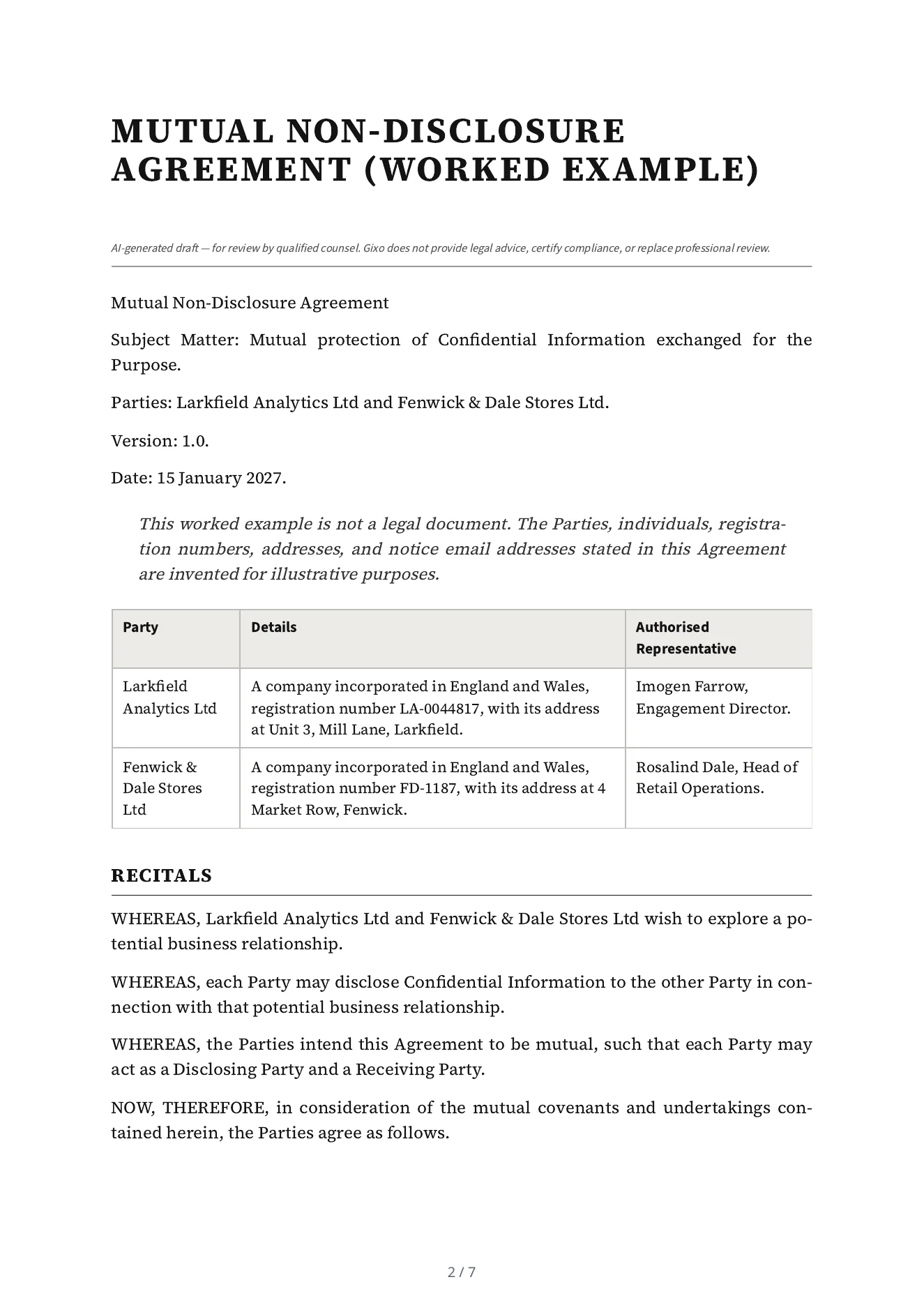
This is a real Lex export for invented parties. Inspect the input and clauses as a worked example, with professional review kept separate from automated drafting and checks.
A mutual non-disclosure agreement of 14 numbered clauses between two invented parties: definitions, what counts as confidential information, exclusions, the receiving party's obligations, permitted disclosures, return of materials, remedies, term, survival, governing law, notices and signature blocks. Its first page says it is a worked example, not a legal document.
Draft a Mutual Non-Disclosure Agreement between Larkfield Analytics Ltd (Party A) and Fenwick & Dale Stores Ltd (Party B). Governing law: England and Wales. Effective date: 2027-01-15. Term: Two years from the effective date. Confidentiality: Three years after disclosure. A mutual agreement: each party may disclose and receive confidential information. State on the first page that the parties, people and addresses in this agreement are invented and that it is a worked example, not a legal document. The notice email address of Larkfield Analytics Ltd is notices@larkfield-analytics.example and of Fenwick & Dale Stores Ltd is notices@fenwick-dale.example (both invented).
Read mechanically against the intake, not by a lawyer: all 12 facts the intake gave are in the draft, nothing is left as a placeholder, and it states no term the intake did not give.
Supply the parties, document kind, jurisdiction, obligations, dates and reference material. Review imported content and retain its source identity before using it in a new matter.
Use the legal workspace's permitted structural tools, Draft Checks and review paths. Compare proposed changes with the saved draft and original material; unsupported Word edits must be handled explicitly.
Have qualified counsel review enforceability, local requirements and the actual commercial intent. Check the current approval state and the downloaded document after a change.
Select the target clause and give Ask Lex a bounded instruction. Missing facts remain visible for review. Inspect the before-and-after proposal, required clause checks and any explicit outside-matrix or mandatory-clause override before versioned application. Use the legal workspace's structural allowlist rather than assuming every general content-editor block is available.
Inspect immutable playbook versions, anchored findings, provenance and precedent variants before staging a change. Matters retain original sources, quotation findings and source-version comparisons. Review extracted obligations for timing, ownership and source revision; negotiation turns and agreement-pack review cells have their own decisions and current-version requirements.
Original-format Word export, tracked changes against an original and saved-version redlines are separate paths. Unsupported edits must be surfaced rather than silently claimed as preserved. Inspect the layout, validator notes and downloaded file, then retain its delivery receipt. Counsel's review applies to the actual matter and version.
Every contract in Lex, drafted or imported, gets an AI contract review: each clause the document type expects marked present, weak or absent; up to 25 risks with a level, the party each falls on, why it matters and replacement wording; and provisions that cannot both be followed. Every quotation is checked against the contract text, findings are decided before approval, and there is no single risk score. The same review reads the key terms and obligations with the words they quote and proposes them into the Agreement Pack. Review every document puts up to 25 documents of an Agreement Pack, or up to 200 in a matter, into one table with your own questions as columns and an Excel export. Approvers can be named in order, and signing supports up to 10 signers with an optional signing order and automatic reminders; it is a simple electronic signature, not a qualified one. A qualified reviewer still decides what the contract says.
Lex does not provide legal advice or certify compliance. The public specimen is not a universally reusable legal template. Word fidelity depends on the supported original-document and saved-version path; unrestricted Power Edit and image insertion are not legal editing features.

Start with the parties, terms, governing law, and reference files. Gixo builds a structured legal first draft that counsel can review clause by clause.
Draft co-founder, equity, vesting, governance, and separation language from the actual commercial terms your team wants to review.
Prepare IP-assignment and confidentiality drafts for founders, employees, and contractors with room for counsel to adjust scope and exceptions.
Use structured intake and prior examples to prepare financing-related drafts and supporting documents that still need qualified legal review.
Prepare employment, contractor, and invention-assignment drafts from a consistent intake process instead of rewriting recurring legal basics.
Create repeatable NDA drafts and related confidentiality documents while keeping fallback language and reviewer edits attached to the same workspace.
After the first draft, Lex runs an AI contract review of the whole contract, with every quotation checked against the text, beside rule checks: clause coverage against a versioned playbook, clause-conflict detection, and defined-term and cross-reference checks. Findings, tracked-change DOCX redlines, comments, review state, assignees, due dates, and version history all stay attached to the same document. A contract imported from Word can go back as that same DOCX, with the Lex edits shown as Word tracked changes; where Lex cannot track an edit faithfully, such as inside a field, an existing revision, a header or a footer, it refuses the export instead of altering the document. Reviewers still verify every clause and conclusion.
Start with the actual job: founder agreement, IP assignment, NDA, hiring document, or financing-related draft.
Capture the actual participants, commercial terms, vesting logic, confidentiality scope, or financing mechanics through structured intake.
Use prior counsel drafts, term sheets, or company templates to keep the new draft anchored to your existing language where possible.
Counsel or a qualified reviewer edits the first draft, resolves open points, and exports the document when it is ready to circulate.
| Capability | Gixo |
|---|---|
| Main job | Drafting workspace |
| Structured first drafts | Yes |
| Reference-file use (prior counsel docs, term sheets, templates) | Yes |
| Rich editing and comments | Yes |
| Custom review and negotiation | Counsel layer |
| Document types covered | Founder agreements; IP assignment & confidentiality; SAFE & financing support; hiring & contractor documents; NDA & disclosure packs |
| Export | PDF, DOCX, HTML, and TXT |
| Replaces startup counsel? | No — prepares first drafts for counsel review, negotiation, and edge cases |
Evaluate whether the workspace produces a useful first draft, states what it does not manage, and keeps qualified counsel in the decision loop.
Look for structured intake, reference-file use, rich editing, comments, and exports that make counsel review more focused.
Formation services, filing, cap-table management, transaction coordination, and legal representation remain separate. Signing is built in as a simple electronic signature, not a qualified or certificate-based one.
Qualified counsel still owns negotiation, jurisdiction-specific advice, financing terms, edge cases, and final approval.
Run one representative founder, IP, hiring, or financing matter from intake through counsel handoff. Verify the supported document type, reference-file behavior, visible open items, editing and comments, version history, export quality, filing or signature boundaries, current commercial terms, and the point at which qualified counsel takes over.
Updated