
Make the intake specific
Supply the parties, document kind, jurisdiction, obligations, dates and reference material. Review imported content and retain its source identity before using it in a new matter.
Lex · worked guide
A software license agreement sets the permissions and conditions for using software. A useful template starts with the licensed software and the people, purposes and environments covered by the proposed grant. It then separates those permissions from ownership, service commitments and matters that require jurisdiction-specific legal review.
Choose License Agreement drafting →A worked workflow
A fictional supplier proposes a twelve-month internal-use licence for ten named users. The template should expose the permission granted, the limits on that permission and the commercial or operational terms still requiring agreement.
Choose the supported software-licence drafting type and supply the software, parties, users, territory, term and permitted use.
Inspect: An unspecified deployment, affiliate or external-customer right should remain a question; do not infer it from “business use”.
Read the proposed permission alongside user limits, transfer, copying, modification and other relevant restrictions.
Inspect: The licence grant and the restriction wording must agree. A broad statement in one section can undermine a narrow limit elsewhere.
Inspect fees, support, ownership, renewal, termination and post-termination obligations using the supplied deal terms.
Inspect: Do not let a generic template fill missing service commitments, data-processing terms or ownership arrangements with invented facts.
Review clause proposals at the permitted scope and inspect the final saved Word/PDF.
Inspect: After a change, compare cross-references, defined terms and the current review state rather than relying on an earlier approval.
Fictional intake and drafting walkthrough. It does not establish ownership, authority to license software, regulatory compliance or the suitability of any clause for a real transaction.
Lex · inspectable review specimen
A software license should separate the right to use software from ownership, support and data-processing arrangements. State the permitted users, period and restrictions before discussing remedies.
Authored fictional instructional sample. The downloadable Word file is rendered through Gixo’s real document exporter. This is separate from the captured product workflows on this page.
Licensor: Mariner Example Ltd. Licensee: Harbor Example Ltd. Proposed license: five named internal users for twelve months, beginning on a mutually confirmed start date. Supplied fee: EUR 2,400 for that period. No automatic renewal is assumed.
| Topic | Proposed position | Open review question |
|---|---|---|
| Use | Internal business use by five named users | How are user changes recorded? |
| Ownership | No ownership transfer is proposed | What applies to customer content and custom work? |
| Support | Scope remains to be agreed | Hours, response targets and exclusions? |
| Data | Separate processing terms may be needed | Roles, security, location and deletion? |
Resolve permitted deployment, audit rights, third-party components, confidentiality, warranties, liability, termination, exit assistance and applicable law. The EUR 2,400 fee is supplied for this example; it is not a product price or a market benchmark.
This is a discussion specimen with no signatures, acceptance or legal approval.
Authored fictional license specimen rendered as editable Word. It does not establish that Lex generated, approved or executed these terms.
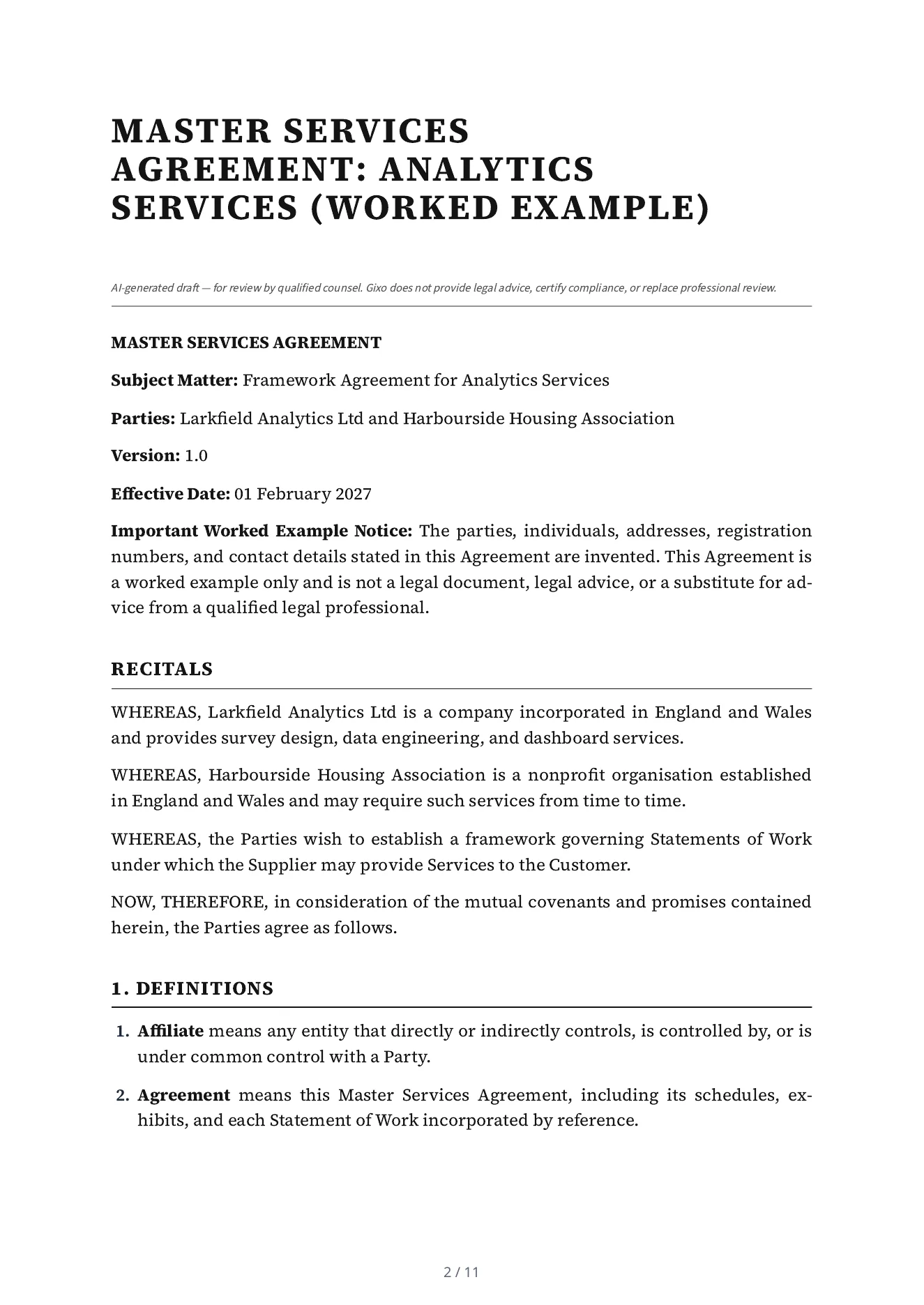
This is a real Lex export for invented parties. Inspect the input and clauses as a worked example, with professional review kept separate from automated drafting and checks.
A master services agreement of 17 numbered parts: definitions, scope of services, service levels and change orders, fees, intellectual property, confidentiality, data protection, warranties, indemnification, limitation of liability, force majeure, term and termination, transition assistance, governing law, general provisions and schedules. Its first page says it is a worked example, not a legal document.
Draft a Master Services Agreement: analytics services between Larkfield Analytics Ltd (Supplier) and Harbourside Housing Association (Customer). Governing law: England and Wales. Effective date: 2027-02-01. Term: Two years from the effective date, renewable by written agreement. Confidentiality: Five years after the agreement ends. The Supplier provides survey design, data engineering and dashboard services to the Customer under statements of work agreed in writing. Excluded: any service not set out in a signed statement of work. Dependencies: the Customer provides access to its systems and a named contact for each statement of work. State on the first page that the parties, people and addresses in this agreement are invented and that it is a worked example, not a legal document. The notice email address of Larkfield Analytics Ltd is notices@larkfield-analytics.example and of Harbourside Housing Association is notices@harbourside-housing.example (both invented).
Read mechanically against the intake, not by a lawyer: 10 of the 12 facts the intake gave are in the draft (the two registration numbers are not printed), nothing is left as a placeholder, and it states two terms the intake did not give, 30 days and 10 Business Days, which Lex chose.
Supply the parties, document kind, jurisdiction, obligations, dates and reference material. Review imported content and retain its source identity before using it in a new matter.
Use the legal workspace's permitted structural tools, Draft Checks and review paths. Compare proposed changes with the saved draft and original material; unsupported Word edits must be handled explicitly.
Have qualified counsel review enforceability, local requirements and the actual commercial intent. Check the current approval state and the downloaded document after a change.
Select the target clause and give Ask Lex a bounded instruction. Missing facts remain visible for review. Inspect the before-and-after proposal, required clause checks and any explicit outside-matrix or mandatory-clause override before versioned application. Use the legal workspace's structural allowlist rather than assuming every general content-editor block is available.
Inspect immutable playbook versions, anchored findings, provenance and precedent variants before staging a change. Matters retain original sources, quotation findings and source-version comparisons. Review extracted obligations for timing, ownership and source revision; negotiation turns and agreement-pack review cells have their own decisions and current-version requirements.
Original-format Word export, tracked changes against an original and saved-version redlines are separate paths. Unsupported edits must be surfaced rather than silently claimed as preserved. Inspect the layout, validator notes and downloaded file, then retain its delivery receipt. Counsel's review applies to the actual matter and version.
Every contract in Lex, drafted or imported, gets an AI contract review: each clause the document type expects marked present, weak or absent; up to 25 risks with a level, the party each falls on, why it matters and replacement wording; and provisions that cannot both be followed. Every quotation is checked against the contract text, findings are decided before approval, and there is no single risk score. The same review reads the key terms and obligations with the words they quote and proposes them into the Agreement Pack. Review every document puts up to 25 documents of an Agreement Pack, or up to 200 in a matter, into one table with your own questions as columns and an Excel export. Approvers can be named in order, and signing supports up to 10 signers with an optional signing order and automatic reminders; it is a simple electronic signature, not a qualified one. A qualified reviewer still decides what the contract says.
Lex does not provide legal advice or certify compliance. The public specimen is not a universally reusable legal template. Word fidelity depends on the supported original-document and saved-version path; unrestricted Power Edit and image insertion are not legal editing features.
This filled example is an editorial explanation of the structure. The related real product output above is separately identified.
| Part | Example and review point |
|---|---|
| Parties and software | Invented licensor Alder Software Ltd and licensee Birch Studio Ltd; the named software release and documentation must be identified. |
| Permitted use | Illustrative instruction: internal business use by the named team. Decide separately whether affiliates, contractors or additional environments are included. |
| Restrictions and ownership | Record the proposed copying, distribution, modification and transfer terms for counsel to assess; identify retained IP ownership. |
| Commercial and service terms | Supply the actual fees, term, support scope and any separately agreed service levels. |
| End of permission | Specify the proposed termination triggers and what should happen to access, copies and data afterwards. |
Hand-authored educational illustration. The parties and proposed transaction are invented. This is not a generated Lex result, a complete agreement or an actual obligation.
For this fictional planning example, Alder Software Ltd proposes to permit Birch Studio Ltd to use ExampleApp version 1 internally during the evaluation period from 15 January to 14 February 2027, solely through its named evaluation team. Ownership would remain with the licensor; the proposed permission would not include distribution or transfer of source code.
A license grant is not an assignment of ownership. Do not assume that a service agreement, privacy notice or open-source compliance policy answers the same question. Confirm the actual deployment model, third-party components, data handling and contracting entities before drafting. Lex includes a License Agreement type and can prepare a matter-specific first draft from supplied facts. Qualified counsel must review local enforceability, exclusions, remedies and the intended rights. This page does not perform a software-license compliance audit.
Reference: WIPO explanation of licensing agreements. Checked 20 October 2026.
Updated