Gixo Quill · content guide
SEO Checklist
Most SEO checklists are ordered by category, which puts trivial items next to fatal ones. This one is ordered by consequence: a page that is not indexable cannot be rescued by anything below it, and a page that misreads intent will not rank however well it is optimised.
What your plan includes. Writing, checks, exports, public share links and publishing to WordPress, Ghost and Medium are on every plan, from $10 per seat a month. Comments and Brand Voice need Professional; Brand Kit and bulk need Business.
In order of what actually costs you
- 1. Is it indexable? No stray noindex, no canonical pointing elsewhere, not blocked. A wrong canonical removes the page entirely — the highest-consequence failure and the easiest to miss.
- 2. Does it match intent? Open the results for your target query. If the ranking pages are a different format, yours will not rank.
- 3. Does it answer in the first 40 words? The strongest single content signal for both readers and answer engines.
- 4. Does the title fit and earn the click? Under roughly 62 rendered characters, and stating the benefit rather than the category.
- 5. Is there anything here that is not elsewhere? If not, the page has no reason to outrank what exists.
- 6. Do internal links point at it? A page nothing links to is found late or not at all.
- 7. Is the structured data valid? Increasingly what decides whether you get quoted rather than just ranked.
- 8. Then the details. Alt text, image weight, Core Web Vitals. Real, but tiebreakers rather than causes.
Before publishing anything
| Check | Fails when | Cost of missing it |
|---|---|---|
| Indexable | noindex or wrong canonical | Total — the page does not exist |
| Intent match | Format differs from what ranks | High — good page, no rankings |
| Answer up front | Buried below context | High — lost to a faster answer |
| No self-competition | Another of your pages targets it | Medium — you split your own signals |
| Internal links in | Nothing links to it | Medium — slow or no discovery |
| Valid schema | Invalid or missing JSON-LD | Low to medium — no rich result |
On-page, technical and off-page — in the order that pays
How Gixo Quill handles this
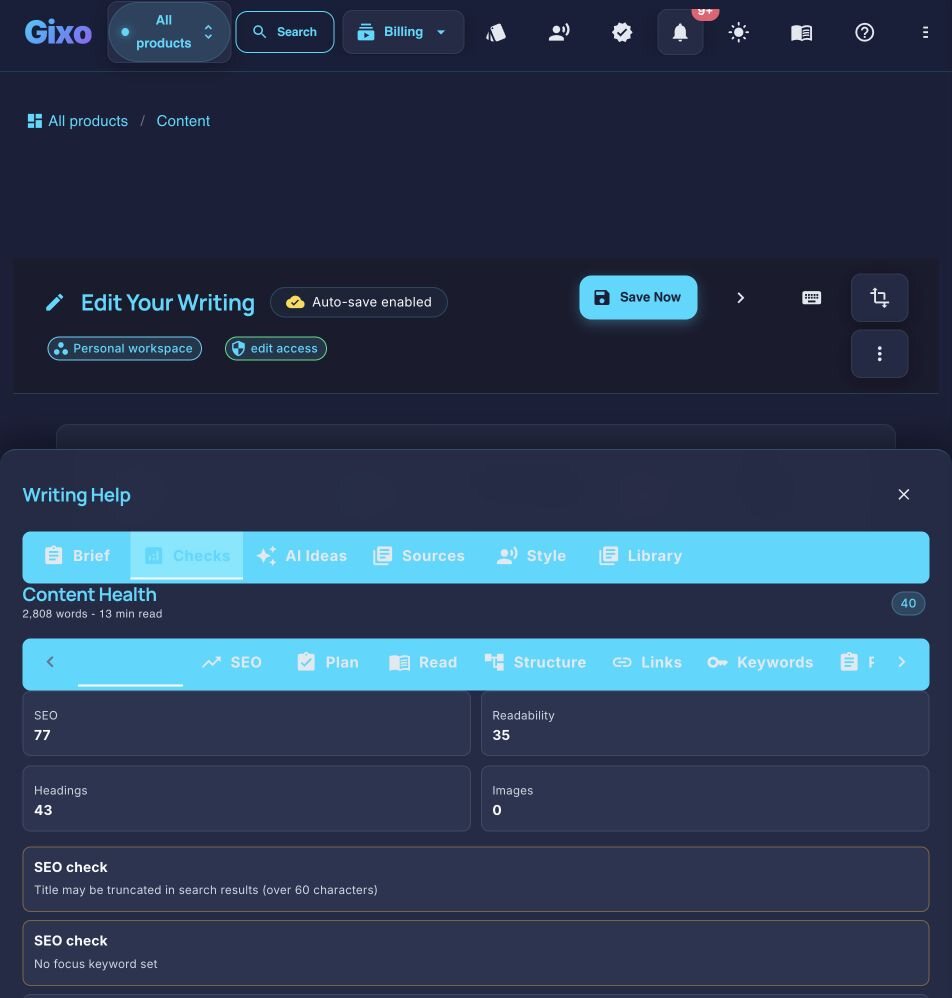
Several of these are deterministic and Quill checks them without a model: answer extractability tests whether the question is answered up front, the overlap checker catches self-competition, and the content health check covers structure and readability.
Frequently asked questions
What should an SEO checklist cover first?
Indexability. A stray noindex or a canonical pointing elsewhere removes the page from search entirely, which outweighs every other item on any checklist.
How do I check search intent?
Open the results for your target query and look at what ranks. If they are all comparisons and you wrote a guide, the format is wrong regardless of quality.
How long should a page title be?
Under about 62 rendered characters, or it gets cut in the search result — usually at the point where the differentiator sits.
Do Core Web Vitals belong on the checklist?
Yes, near the bottom. They are a genuine tiebreaker between comparable pages, but they will not rescue a page that is not indexed or misreads intent.
What is the most commonly missed item?
Internal links pointing at the new page. It is invisible in any on-page audit and it is why good pages sometimes take months to get found.
What belongs on an on-page SEO checklist?
Title, the answer in the first 40 words, heading structure, internal links pointing in, and valid schema. On-page is the part you fully control and the part that shows up fastest, which is why it is worth working through before anything off-page.
What is off-page SEO, and where does it belong?
Links and mentions earned from other sites. It is the slowest and least controllable lever, so it belongs last — pointing links at a page that is not indexable or misreads intent wastes them.
Are SEO best practices the same as a checklist?
No, and conflating them is why checklists get padded. Best practices are the habits worth keeping; a checklist is an ordered set of failures to rule out before publishing. Practices worth following that fix nothing on a given page do not belong on it.
Does passing more checklist items mean better rankings?
No. The items are not equal and the score is misleading — a page failing only indexability still earns nothing while scoring highly. Work the order, not the count.
Related content guides
Run the deterministic checks first
Quill checks structure, supplied JSON-LD, answer extractability and overlap before a page reaches a human reviewer.
Inside Quill
Review concrete content and SEO signals before delivery