
AI Proposal Automation for Agencies
Agencies pitch constantly, and every prospect expects a custom proposal turned around fast. Gixo Arc turns client briefs, RFPs, past proposals, case studies, scopes, pricing sheets, and brand-approved content into source-grounded first drafts your team can review, refine, and export.
AI proposal automation for agencies means turning client briefs, RFPs, past proposals, case studies, scopes, and pricing sheets into a source-grounded first draft, not a generic AI-written pitch. Built for agencies, consultants, and professional-services teams that need proposal drafts grounded in their own client context, not generic prompt output. Facts, claims, scope, pricing, and proof points should stay traceable to uploaded source material so reviewers can inspect the draft before it reaches a client. In the response workspace, a deterministic response-quality pass flags unsupported claims, unsupported high-risk claims, placeholder text, duplicate answers, and word- or character-limit breaches so the team can resolve them first. A human still owns the creative strategy, positioning, and final read before it goes to a client.
What should agencies look for in AI proposal automation solutions?
The strongest AI proposal automation solutions for agencies help account leads turn trusted agency material into a reviewable first draft without forcing the team to build a maintained RFP content library.
| Criterion | Why it matters for agencies | How Arc handles it |
|---|---|---|
| Source grounding | Agency proposals rely on real case studies, service scopes, pricing assumptions, and proof points. | Arc drafts from uploaded briefs, past proposals, case studies, scopes, and pricing notes. |
| No library migration | Small teams rarely have time to maintain a full RFP answer bank. | Each proposal starts from the current source pack, so stale answer libraries are not required. |
| Human review | Strategy, claims, pricing, and relationship context still need account-lead judgment. | Arc creates the first draft and leaves final positioning, commitments, and client fit to reviewers. |
| Proposal variety | Agencies pitch campaigns, retainers, projects, renewals, and RFP responses in different formats. | Arc uses proposal-type structures so every draft does not start from the same blank prompt. |
See what Arc helps your team review
Choose the proposal type, add the RFP, brief, notes, or prior work, then review a structured first draft before it reaches a client.
- 1Add source materialRFPs, briefs, notes, decks, and prior work
- 2Draft to the proposal typeSections and structure follow the real opportunity
- 3Review before deliveryYour team checks facts, scope, pricing, and commitments
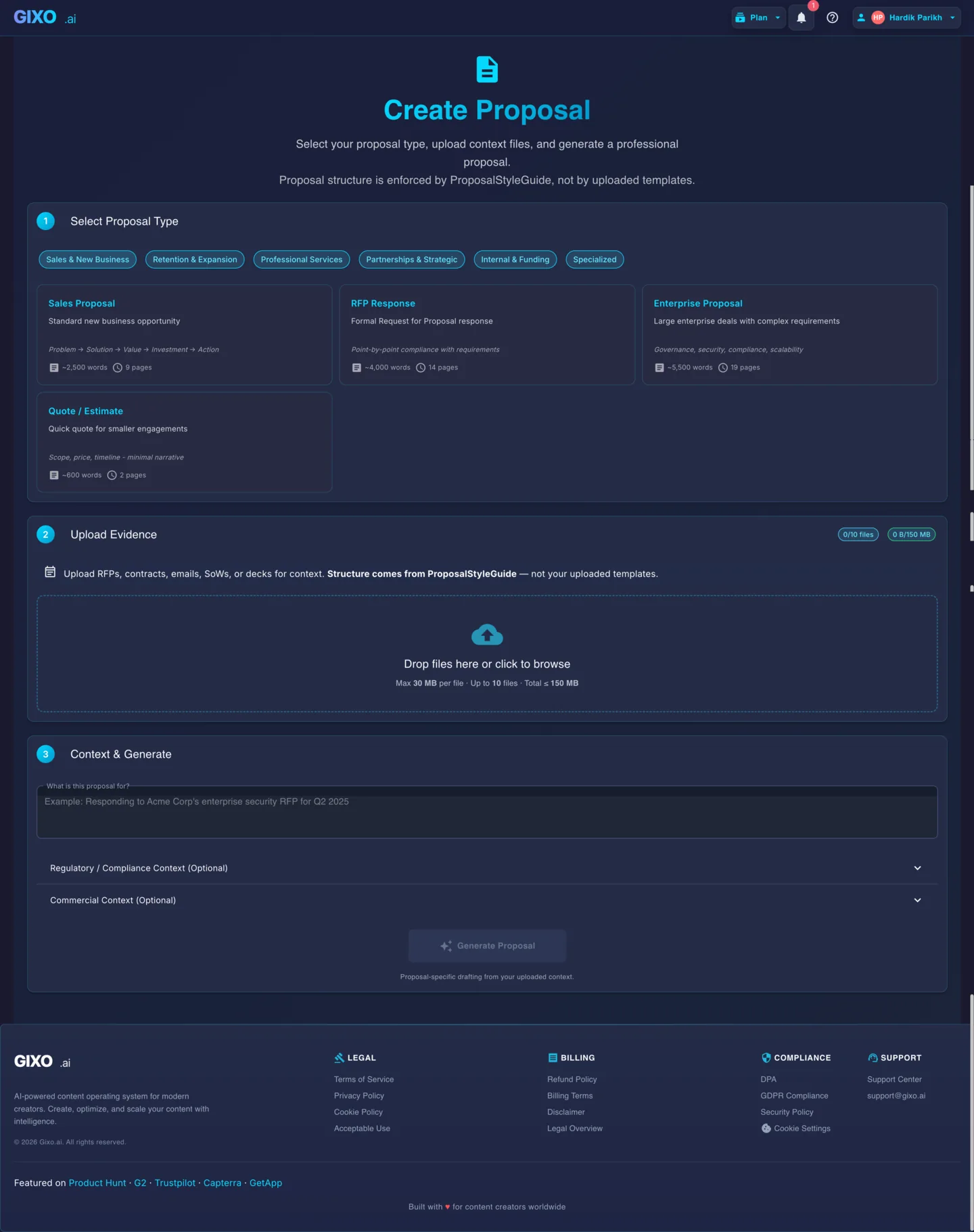
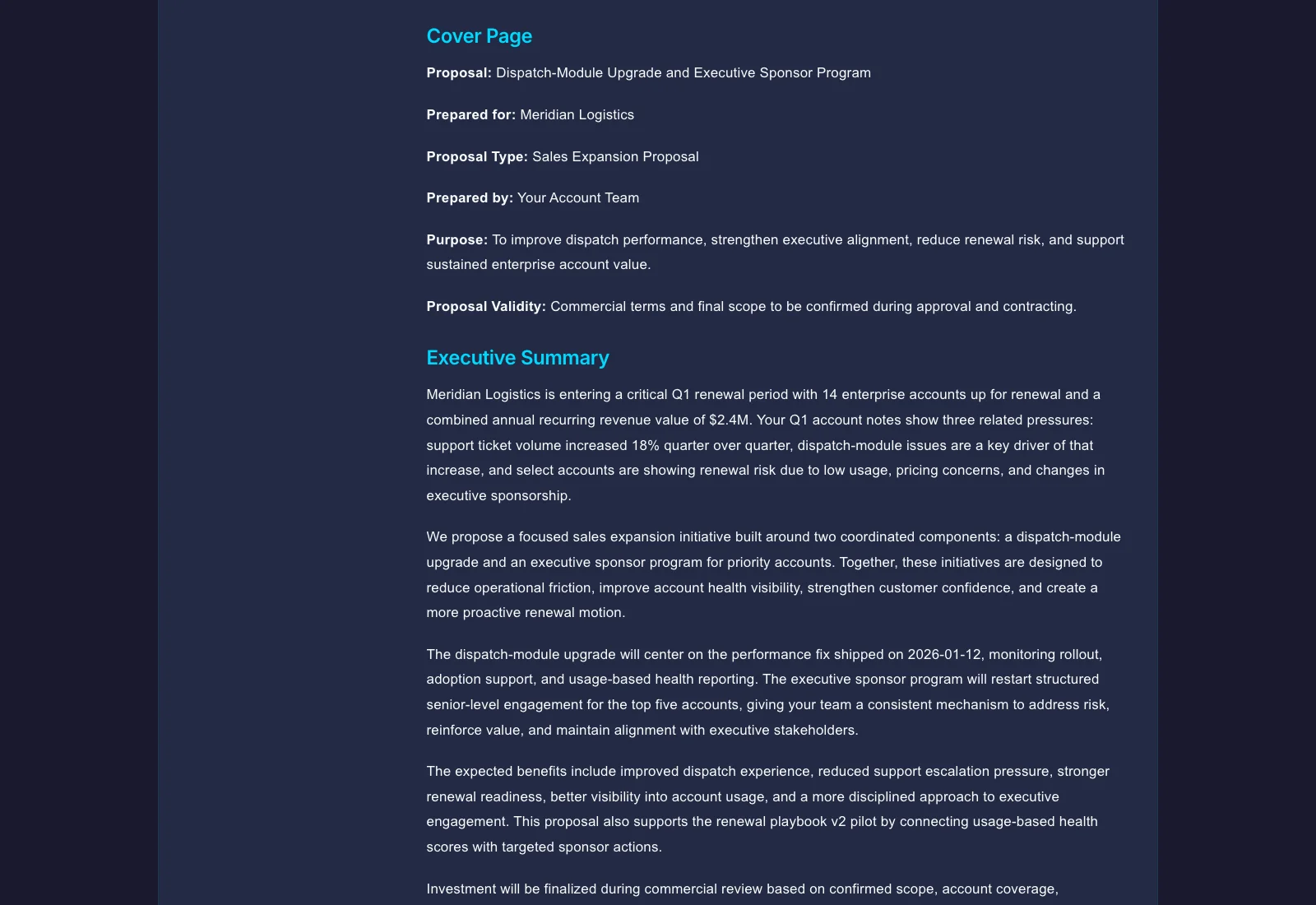
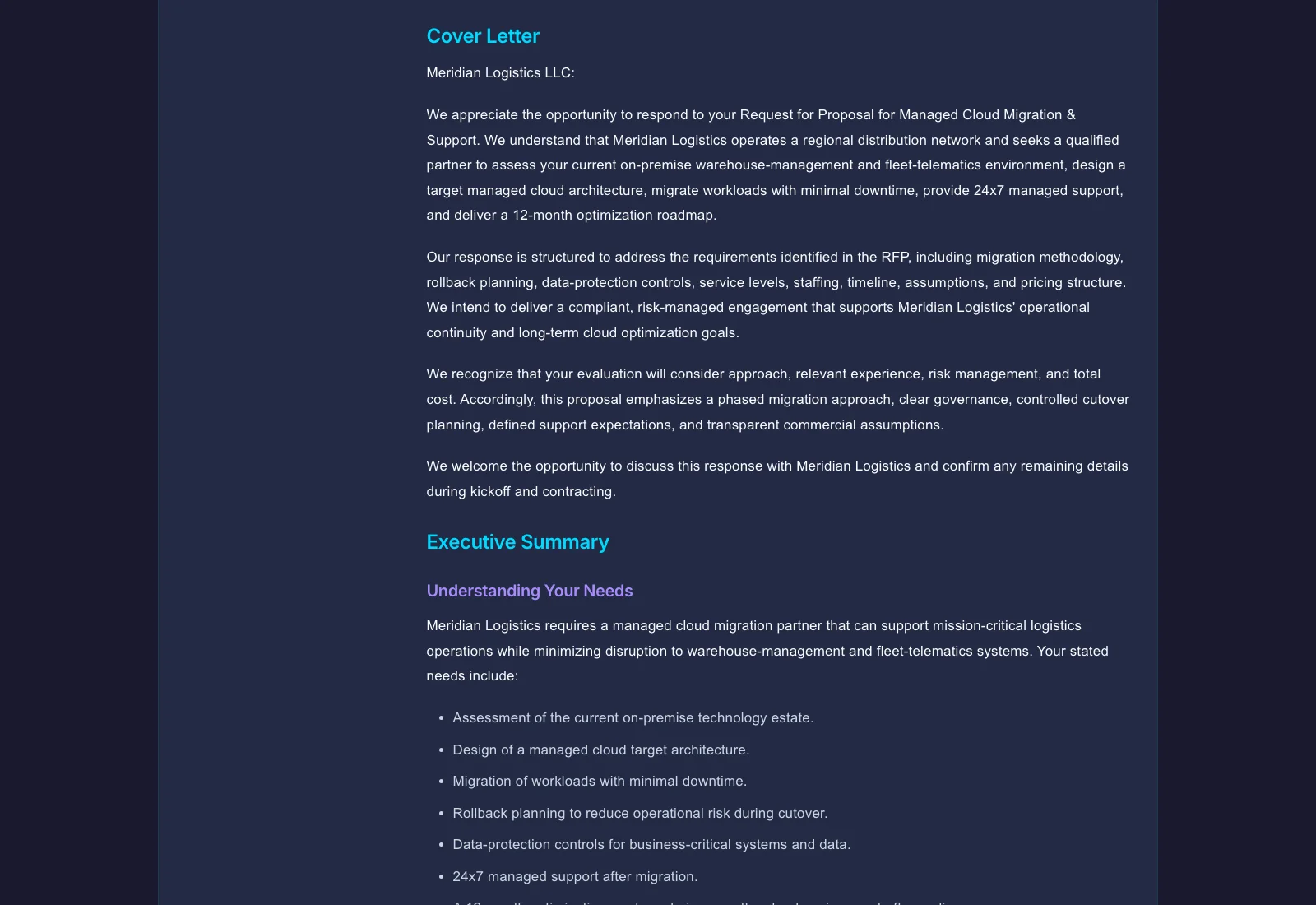
Illustrative example Output screens show document structure — not a promised or real customer result.
AI drafts the repeatable base. Your team adds what wins.
Every agency proposal is part boilerplate and part strategy. The boilerplate — scope structure, deliverables, timeline, capability sections, the shape of a retainer or a campaign pitch — is the same work over and over. The strategy — the creative idea, the positioning, the reason this client should choose you — is what actually wins the pitch.
Gixo drafts the repeatable base from your brief and past work, so your strategists and account leads spend more time on the parts that close — not formatting sections from scratch the night before a deadline. It is a co-pilot for the first draft, not an autopilot for the pitch. A human still owns the strategy, the final read, and the relationship.
That distinction matters because the agencies that get the most out of AI proposals are the ones that treat it as augmentation, not replacement: faster to a strong, on-brand draft, with people kept firmly in the loop on everything a client actually evaluates.
Why do agencies use AI for proposals?
Agencies pitch constantly. Every prospect expects a custom proposal, and you need to turn them around fast without sacrificing quality. Gixo handles the drafting so your team focuses on the creative strategy.
Agencies respond to multiple RFPs and pitch requests every week. Gixo creates structured first drafts from your uploaded brief, so your team spends time on strategy and creative concepts instead of formatting boilerplate sections.
Every client wants to feel like the proposal was written specifically for them. Upload the client's brief, brand guidelines, or competitive landscape and Gixo drafts content that speaks to their situation — not generic agency capabilities.
Agency proposals involve account leads, creatives, strategists, and media planners. Real-time collaborative editing lets everyone contribute simultaneously without version control headaches or sequential review bottlenecks.
Your best work is the input — not generic AI filler
The reason most AI proposals sound generic is that they are written from a model's general knowledge of the world. Gixo is source-first: you upload the client brief, your strongest past proposals, the case studies that match the prospect's industry, and your brand or voice guidelines — and Gixo drafts from your material.
Claims are drafted from, and checked against, the sources you provide. Your wins, your numbers, your language — woven into the draft, not drawn from a model's general knowledge. That is the part agencies cannot afford to get wrong: a fabricated result or a made-up statistic that surfaces in front of a client is the fastest way to lose trust in a pitch. Source-first drafting leaves far less to walk back: the model drafts from your own materials and is instructed not to invent figures, and in the response workspace a review pass maps each material claim to supported, needs verification, or unsupported against your evidence, so your team can check every number before the pitch goes out.
It also means the tool gets sharper the more good material you give it. An agency's curated library of winning proposals and proof points is the real asset — Gixo is the system that puts it to work on every new pitch.
The agency knowledge base is the real automation layer
AI proposal automation works best when Arc can draft from content your team already trusts.
Upload case studies, client wins, testimonials, past proposals, capability statements, and portfolio notes so the draft can use real proof instead of generic agency claims.
Bring in SOWs, rate cards, pricing notes, retainer packages, timeline assumptions, and delivery constraints before the proposal is generated.
Use brand guidelines, voice notes, service descriptions, team bios, and legal boilerplate as the source of truth for tone, claims, and standard sections.
Treat the library as a living system
- Tag source material by industry, service line, project type, buyer role, geography, and proof point.
- Remove outdated results, expired claims, old pricing, and case studies your team would not stand behind today.
- Give ownership to the people who know the material: marketing for case studies, operations for process, finance for pricing, and legal for approved terms.
Built for how different agencies pitch
Gixo structures the right sections for your agency model and grounds the content in the sources you upload.
SEO, PPC, paid social, and content agencies. Gixo structures channel strategy, audience targeting, KPIs, reporting cadence, and budget — grounded in the brief and your past performance work.
Brand strategy, identity, and web design shops. Gixo drafts the "our approach" narrative, a phased creative process, and outcome-led positioning instead of a flat list of deliverables.
Media planning/buying and PR & comms teams. Gixo structures audience and channel mix, campaign narrative, coverage targets, and measurement — drafted from your brief and prior campaigns.
What does AI proposal automation for agencies actually cover?
Gixo generates the right structure and sections for each type of agency proposal.
| Proposal Type | Key Sections | What you upload |
|---|---|---|
| Campaign Pitch | Creative concept, audience targeting, channel strategy, KPIs, budget | Brief + relevant case studies |
| Retainer Proposal | Scope of services, monthly deliverables, reporting cadence, team, pricing | Scope notes + past retainer wins |
| Project Scope | Objectives, deliverables, timeline, milestones, fixed price | Project brief + similar SOWs |
| Capability Presentation | Agency overview, case studies, methodology, team bios, next steps | Case studies + team bios |
| Renewal or Upsell | Delivered value, current scope, expansion rationale, revised terms, next quarter plan | Account notes + prior proposal + renewal terms |
| RFP Response | Requirement mapping, compliance answers, methodology, team, proof, pricing narrative | RFP + approved boilerplate + security or process docs |
How agencies should implement proposal automation
The strongest implementations start with one high-value workflow, not a company-wide content migration.
Track who touches a proposal, where time is lost, which sections are rewritten repeatedly, and which claims require the most review before the proposal can go out.
Start with a repeatable proposal type such as a campaign pitch, retainer renewal, project SOW, or RFP response. A focused pilot produces cleaner feedback than a broad rollout.
Build the source pack from approved case studies, service descriptions, scope examples, pricing notes, team bios, and brand voice rules. Remove stale or unsupported content before it reaches the model.
Assign review ownership for strategy, claims, pricing, legal terms, and final client fit. The AI creates a draft; the agency still owns the promise being made to the client.
Use sober metrics: cycle time, revision load, completeness, consistency, source coverage, and reviewer confidence. Treat win rate as a lagging business signal, not a guaranteed AI outcome.
How It Works
Drop in the RFP, client brief, or pitch request, plus the case studies and past proposals you want the AI to draw from. Gixo supports PDF, DOCX, and scanned documents via OCR. The stronger your sources, the sharper the draft.
Select campaign pitch, retainer, project scope, or capability presentation. Each type produces a different section structure optimized for that proposal format.
Edit the draft with your team in real time. Use inline AI tools to adjust tone for the client, expand strategic rationale, or tighten budget justifications. Quick AI handles rapid edits; Power Edit handles deeper rewrites.
Export to PDF or DOCX with professional formatting. Your proposal is structured, client-specific, and ready for the pitch meeting.
Agency buyer criteria for AI proposal automation software
When comparing tools, evaluate the proposal workflow rather than only the generation demo.
| Criterion | What to check | Why it matters for agencies |
|---|---|---|
| Source grounding | Can the tool use briefs, RFPs, past proposals, case studies, SOWs, and pricing files as input? | Agency proposals need specific proof and context, not fluent generic service copy. |
| Knowledge-base hygiene | Can teams curate, update, and govern approved content without relying on old local folders? | Outdated claims, stale pricing, and old case studies create client trust risk. |
| Workflow fit | Does the process match how account leads, strategists, creative leads, media teams, and operations already review proposals? | A feature-rich tool fails if the proposal team cannot adopt it during live pitch cycles. |
| Human review | Does the tool keep editing, collaboration, review, and export in the same workspace? | The last-mile review is where positioning, pricing, client nuance, and risk control happen. |
| Security and confidentiality | How does the tool handle sensitive RFPs, client briefs, pricing, and unpublished campaign strategy? | Agencies often upload confidential client and prospect material, so public-chatbot workflows are not enough. |
How is the compliance matrix built, and can you reproduce it?
Requirement tracking is where most agency RFP responses are actually lost — not on prose quality, but on a requirement nobody mapped. Arc's requirement extraction and coverage scoring run with no AI model in the path at all: no generation, no sampling temperature, no prompt. The same document produces the same matrix every time, and you can check it yourself for free at the proposal analyzer with no signup.
Requirements are found by obligation language, not by guesswork. The extractor scans for ten obligation cues — shall, must, required to, is required, are required, will provide, will deliver, will be, responsible for, and should — and lifts the sentence that carries each one. It reads up to 500 candidates internally and surfaces the 60 strongest per document by default.
Coverage is scored per requirement, on a fixed threshold. Each extracted requirement is matched against your draft by token overlap: 66% or above is Addressed, 34% to 65% is Partially Addressed, and anything below 34% is Not Addressed. Those three bands are the compliance matrix. Because the thresholds are fixed rather than model-judged, two people running the same pair of documents get the same statuses.
The same pass runs the hygiene checks that sink submissions. Acronyms used without ever being defined, measured against a 76-entry common-acronym allowlist so PDF and RFP do not generate noise. Cross-references that point nowhere, across eight pointer types — section, clause, article, appendix, exhibit, schedule, attachment, and annex. Unresolved placeholders such as TBD, TBA, lorem ipsum and bracketed [insert…] text. Missing pricing, validity or acceptance language. Term and cross-reference issues are each reported up to 12 per run so the list stays actionable.
What it does not do, stated plainly. It extracts obligation statements; it does not interpret them legally. Coverage is token overlap, so it tells you a requirement's vocabulary appears in your response — not that your answer is any good. The 60-requirement default is a display cap, so a very long solicitation needs the limit raised or the document split. And a green matrix is a completeness signal, not a win probability.
Why this matters when you evaluate vendors. Ask each AI RFP response tool whether its requirement extraction is deterministic or model-generated, and whether re-running the same document returns the same matrix. A matrix that moves between runs cannot serve as a submission gate, because you cannot separate a real coverage change from model variance. Ask for the coverage thresholds in writing.
What is AI proposal automation for agencies NOT?
It is not "the AI writes the whole thing." Gixo writes the first draft; your team brings the strategy and the final polish. The win is speed-to-a-strong-draft, not hands-off generation — the proposal a client actually evaluates still has a human behind it.
It is not a robotic, one-size-fits-all voice. Generic-sounding proposals come from generic inputs. Drafting source-first from your own winning proposals keeps your voice, and the inline editor lets you tune tone per client.
It is not a machine that invents impressive statistics. Gixo drafts from the sources you upload and its model is instructed not to fabricate results or case-study numbers, so a reviewer should still check each one against those sources — exactly the thing you cannot afford to put in front of a prospect.
It is not a replacement for senior judgment. Arc can reduce repetitive drafting work, but an agency still decides the creative strategy, commercial position, scope commitments, and relationship-specific nuance.
Frequently Asked Questions
Updated