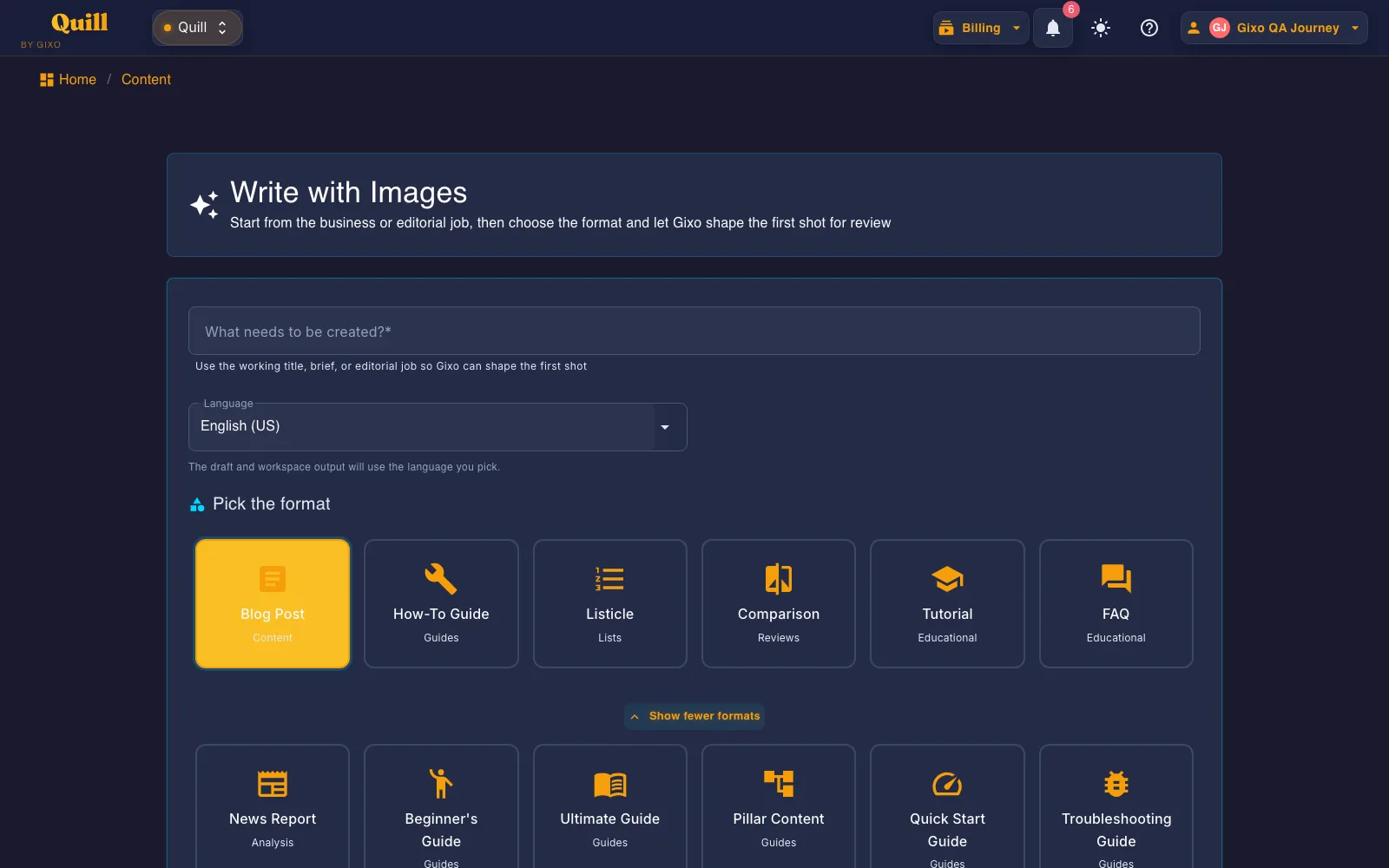
AI content tools charge in one of four ways: per seat, per credit or token, per word or output, and bundled suite subscriptions. Gixo Quill uses per-seat subscription pricing — 5 paid plans at $10 (Lite), $59 (Starter), $79 (Professional, 3-seat minimum), $99 (Business, 5-seat minimum), and $129 (Enterprise, 10-seat minimum) per seat per month, with a 14-day no-card trial and no free tier. All four models resell the same underlying unit, the token, which runs about 750 words per 1,000 tokens in English, so the model you pick changes your budget risk more than it changes the cost of generation. The number that decides real spend is cost per published asset, not price per word, because human review is usually the larger line item.
Evaluate pricing against the workflows and content formats a team can actually finish, not only word allowance.
AI content tool pricing generally falls into four models: per-seat by product, credit or token-based, per-word/per-output, and bundled suite subscriptions. Per-seat pricing (Gixo public model) is the most predictable and easiest to map to headcount, while credit- and per-output-based pricing get harder to forecast as usage scales. There is no single useful average-cost figure; the better comparison is cost per seat and cost per workflow, not a sticker price.
4
Common Billing Models
Per Seat
Or Usage Meter
Predictable
Or Variable Cost
1
Product or a Tool Stack
How do AI content platforms usually charge
These are the pricing models buyers run into most often.
Per-Seat by Product
Pay for the content product you need, per user. This is Gixo's public pricing model and it is easier to map to headcount and workflow ownership.
Credit / Token-Based
Purchase credits that are consumed per generation. Cost varies with usage volume, so forecasting gets harder as more people use the tool.
Per-Word / Per-Output
Pay based on the amount of content generated. This can look cheap at low volume but becomes difficult to budget once a team is publishing steadily.
ROI Considerations
Evaluate cost per article, time saved versus freelancer rates, and content quality. A tool that costs more but produces publish-ready content may save money overall.
Bundled vs Modular
Some tools charge for an entire suite while others let you subscribe per product. Modular pricing (like Gixo) means you only pay for capabilities you actually use.
Seat Growth
The useful question is how pricing behaves when you add users. Buyer-friendly models stay legible as seats, approvals, and shared workflows expand.
How do you tell if an AI content tool plan is worth it
The sticker price matters less than what the workflow costs once your team is using it every week.
1
Total Cost of Ownership
Factor in all tools needed: content writing, presentations, SEO optimization, and export. A platform like Gixo that handles multiple workflows can be cheaper than buying separate tools.
2
Output Quality vs Editing Time
A cheaper tool that requires heavy editing may cost more in labor hours. Evaluate how much post-generation work each platform requires before content is publish-ready.
3
Scalability & Predictability
Pricing gets harder to evaluate when usage rules are unclear or heavily metered. Look for plans that match your workflow, keep overage risk low, and stay predictable as your content needs grow.
4
Feature Breadth vs Depth
Some tools excel at one content type while others cover the full spectrum. Consider whether you need a specialist or a platform that handles content, presentations, and documents together.
5
Evaluation Quality
The best evaluation path lets you run real work without forcing you to decode obsolete plan names. Judge whether the workflow earns a paid seat.
Which AI content tool pricing model is right for you
The useful comparison is how each model charges, what it includes, and what extra tools you may still need.
Criteria
Gixo public model
Credit-based tool
Per-output tool
Suite subscription
Pricing Model
Per seat, per product
Credits or tokens
Words or outputs
Bundle subscription
Budget Predictability
High
Medium to low
Low at scale
Medium
Easy to Map to Headcount
✓
✗
✗
Usually partial
Good for Steady Weekly Publishing
✓
Only with close monitoring
Harder to predict
Only if you use the full bundle
Risk of Overage Surprise
Low
Medium to high
High
Low, but bundle waste is common
Best for One Workflow
✓ Buy only content
Sometimes
Sometimes
✗ Often overbought
Works Well for Occasional Use
Depends on whether the seat is worth it
✓
✓
Sometimes
Can Add Only the Products You Need
✓
✗
✗
✗
Common Questions About Content Tool Pricing
What is the average cost of an AI content tool in 2026?
Averages hide the model, so compare within one. For per-seat tools, Gixo Quill publishes 5 paid rungs at $10, $59, $79, $99, and $129 per seat per month; credit and per-word tools quote a rate per generation instead, and bundled suites charge for products you may not use. Convert whichever you are quoted into cost per seat and cost per published asset, then check whether it stays predictable once more people start publishing regularly.
Is per-seat or credit-based pricing better?
Per-seat pricing is easier to budget when content work is steady and tied to headcount. Credit-based pricing can work for occasional use, but it becomes harder to forecast at scale.
Should I pay for multiple AI tools or use an all-in-one platform?
It depends on whether your team needs one workflow or several. A broader platform can reduce tool sprawl, but only if you actually use the extra products.
How do I calculate ROI on an AI content tool?
Compare the software cost with the time and outside spend it replaces. The useful math usually includes editing time, freelancer spend, and whether the tool replaces other subscriptions.
Are free AI content tools worth using?
Only if the evaluation path shows you the real workflow. A short demo or obsolete plan page is less useful than a hands-on product path that shows what a paid seat actually feels like.
What should business buyers look for?
Business buyers usually care about support, security, admin controls, budget predictability, and whether pricing still makes sense as seats and approvals expand.
How often do AI content tools change their pricing?
Pricing changes as products and usage rules change. If a tool relies heavily on credits or usage limits, those details matter as much as the plan name.
What are the main types of AI content tool pricing models?
There are four common models: per-seat by product, credit or token-based, per-word or per-output, and bundled suite subscriptions. Per-seat pricing, like Gixo public model, is the easiest to map to headcount; credit- and per-output-based pricing get harder to predict as usage grows.
Why is there no single average price for AI content tools?
Because per-seat, credit-based, per-output, and bundled suites meter different things, one blended average would describe none of them. Compare inside a single model instead: for per-seat tools, Gixo Quill's published rungs are $10, $59, $79, $99, and $129 per seat per month (annual $90, $599, $799, $999, and $1,299), with a 14-day no-card trial and no $0 plan. Convert a credit or per-word quote into the same cost-per-seat and cost-per-published-asset terms, and check whether it stays predictable once a team is publishing steadily.
See pricing by workflow, not just by plan name
Compare the Gixo products against the work you actually need to do, then decide whether one platform or several tools makes more sense.
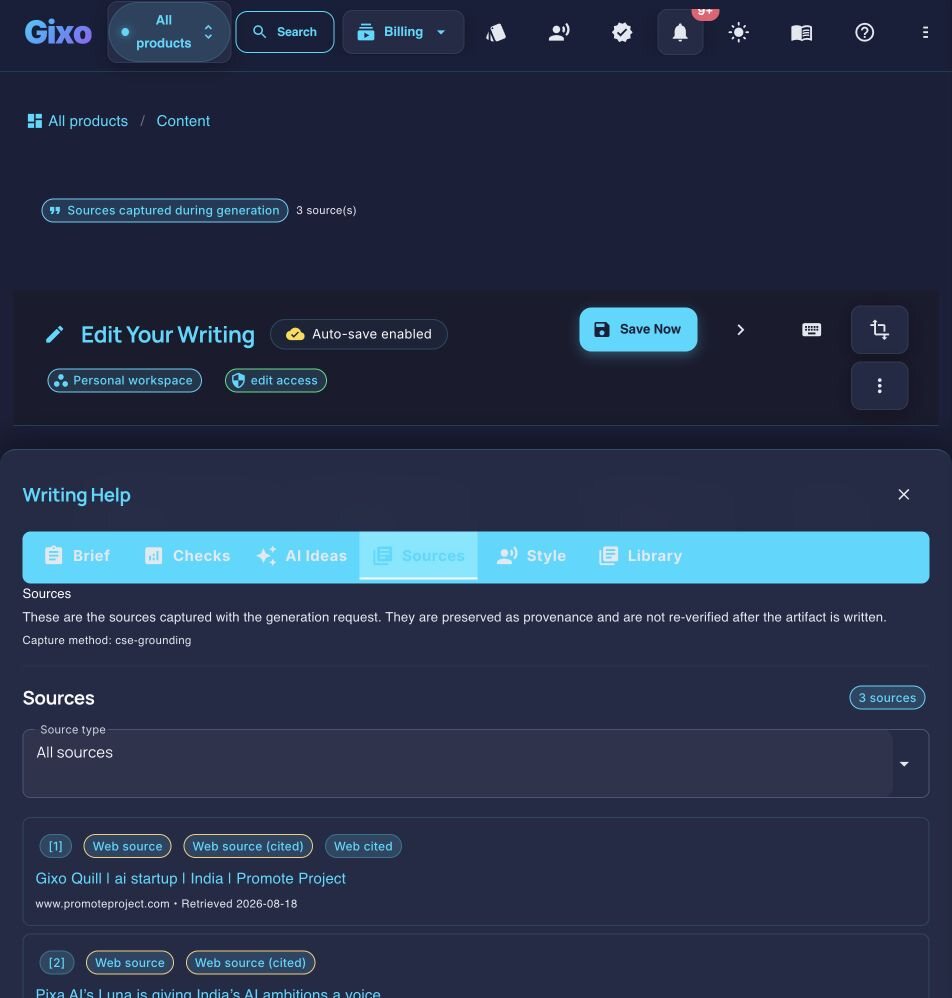
Current Quill Sources panel. Sources captured with the generation request remain attached as provenance, with source type and retrieval date. Quill grounds from that material; it does not re-verify the sources after the artifact is written.
Updated
More from Gixo
Keep exploring
Cookie
We value your privacy
We use cookies to improve the product, measure site usage, and keep settings in sync.
Choose which categories you want to allow.