
ROI of AI content tools: model your real unit economics
Whether AI content tools pay back depends on your cost per article, your review capacity and your publishing volume. See how the numbers compare against freelancers, agencies, and in-house writing teams.
A subscription can change the cost model compared with per-article buying, but only within the plan's capacity and your team's ability to review the output. As an illustration, a freelance article may cost about $150-500, agency content $500-2,000 per piece, and an in-house writer roughly $200-400 per article once salary and overhead are loaded in — while Gixo Quill starts at $10/mo. Those figures are illustrative market ranges, not vendor quotes or Gixo prices. Calculate your own result using equivalent deliverables, plan limits, review time, and the amount you actually publish; more pages do not guarantee more traffic or conversions.
Where Does the ROI of AI Content Tools Actually Come From?
AI content tools can change the economics of first-draft production. Measure the effect against the review time, plan limits, and quality standard your team actually carries.
Generation can shorten the first-draft stage, but source preparation, editing, approvals, and destination work still determine the time to publish. Measure the complete workflow.
Compare the subscription with an equivalent finished deliverable, including review and publishing work. Market rates vary, and a lower draft cost does not prove lower total cost or equal quality.
A subscription may let a team queue more drafts without a per-article fee, subject to plan capacity and review bandwidth. Track the number of approved pieces, not drafts generated.
Additional pages can create more opportunities to be found, but indexing, relevance, quality, and demand determine whether they earn traffic. Treat search impact as an outcome to measure, not an ROI guarantee.
Marketing teams spend less time briefing writers, reviewing drafts, and managing revisions. AI handles first drafts so humans focus on strategy and final polish.
A shared brief and voice profile can reduce variation in drafts. Editors still check tone, evidence, structure, and brand rules on each finished piece.
How Do You Calculate the ROI of AI Content Tools? A Content Marketing ROI Formula in Four Steps
Include writer fees, editor time, SEO optimization, formatting, and publishing. Most businesses underestimate true cost by 40-60% when they exclude internal labor.
Record how many pieces your team actually approves each month, how much review time each needs, and where the current bottleneck sits. Do not substitute a generic output benchmark.
Measure your own end-to-end time from brief to approved publication. Generation, review, fact checking, imagery, metadata, and CMS work can vary widely by article.
Track indexing, impressions, clicks, qualified visits, and conversions after publication. Additional pages may create opportunities, but relevance and usefulness determine whether those opportunities materialise.
Putting the four steps together
The steps above give you four numbers. This is how they combine — there is no industry multiple that substitutes for running it on your own figures.
Cost per article today = fully loaded cost from step 1 — writer fees, editor time, SEO, formatting, publishing, and internal labour.
Cost per article with a subscription = (monthly subscription ÷ articles you actually publish that month) + (review hours per article × your loaded hourly cost).
Monthly return = (cost per article today − cost per article with a subscription) × articles published.
Two things decide the answer, and neither is the tool. The subscription is fixed, so the more you publish the lower its share per article — which means the result is bounded by how much your team can actually review, not by how much can be generated. And if review hours per article do not fall, the second term does not move and the saving is smaller than the headline suggests.
What Does AI Content Actually Cost vs. Freelancers, In-House Teams, and Agencies?
As of mid-2026, a freelance article runs $150-500, an in-house writer about $200-400 per article fully loaded, and an agency $500-2,000 per piece, against a Gixo Quill subscription from $10/mo that stays flat whether you publish 4 pieces or 40. These are illustrative market ranges from buyer's guides, not vendor quotes — confirm the real number with each supplier.
| Metric | Gixo AI | Freelance Writer | In-House Team | Content Agency |
|---|---|---|---|---|
| Cost per article | No per-article fee — a fixed plan from $10/mo | $150-500 | $200-400 (loaded) | $500-2,000 |
| Time to produce | Varies by source, length, and review | Varies by brief | Varies by workload | Varies by process |
| Monthly approved output | Plan and review capacity | Writer capacity | Team capacity | Agency capacity |
| SEO optimization included | Built-in | Varies | Depends on skillset | Usually extra |
| Brand voice consistency | Profile can guide drafts; review required | Writer-dependent | Training required | Account-dependent |
| Revision rounds | Instant regeneration | 1-3 rounds | 1-2 rounds | 2-4 rounds |
| Scaling cost | Fixed subscription | Linear (per article) | Hiring required | Linear (per article) |
| Multi-language support | 71 languages across 89 locales | Separate writers | Separate hires | Separate contracts |
A worked example with a real Gixo Quill price
Gixo Quill's paid plan starts at $10/mo with included monthly generation capacity. Put that against the alternatives below and the per-article economics separate quickly.
10 articles/month at a midpoint $325 freelance rate is $3,250/month — and every additional article adds the same cost again, because the price scales linearly per piece.
The same 10 drafts come out of one $10/mo plan — but the subscription is only the first term of the formula above, and on its own it is not the comparison. Add the review: at, say, 1.5 hours an article and a loaded $60 an hour, that is $90 an article, or $900 across the ten. Total $910 against $3,250 — a saving of roughly $2,340 a month, and it moves the moment either of those two numbers is different for your team. Substitute your own review time and hourly cost before treating any of this as your answer; the freelance rate is an illustrative market range, not a quote. The subscription is fixed whether you publish ten or forty, which is where the saving comes from — bounded by how much your team can actually review.
The saving is not that the finishing work disappears. The example above keeps 1.5 hours of review on every article, and a freelance draft needs reviewing too — column A understates its own route by leaving that out. What changes is that one term stops scaling: the subscription costs the same for ten articles or forty, while a per-article fee does not. That is also the limit of the claim. The saving is bounded by how many articles your team can actually review in a month, so if review is your bottleneck rather than drafting, the gap narrows sharply.
Frequently Asked Questions
Inside Quill
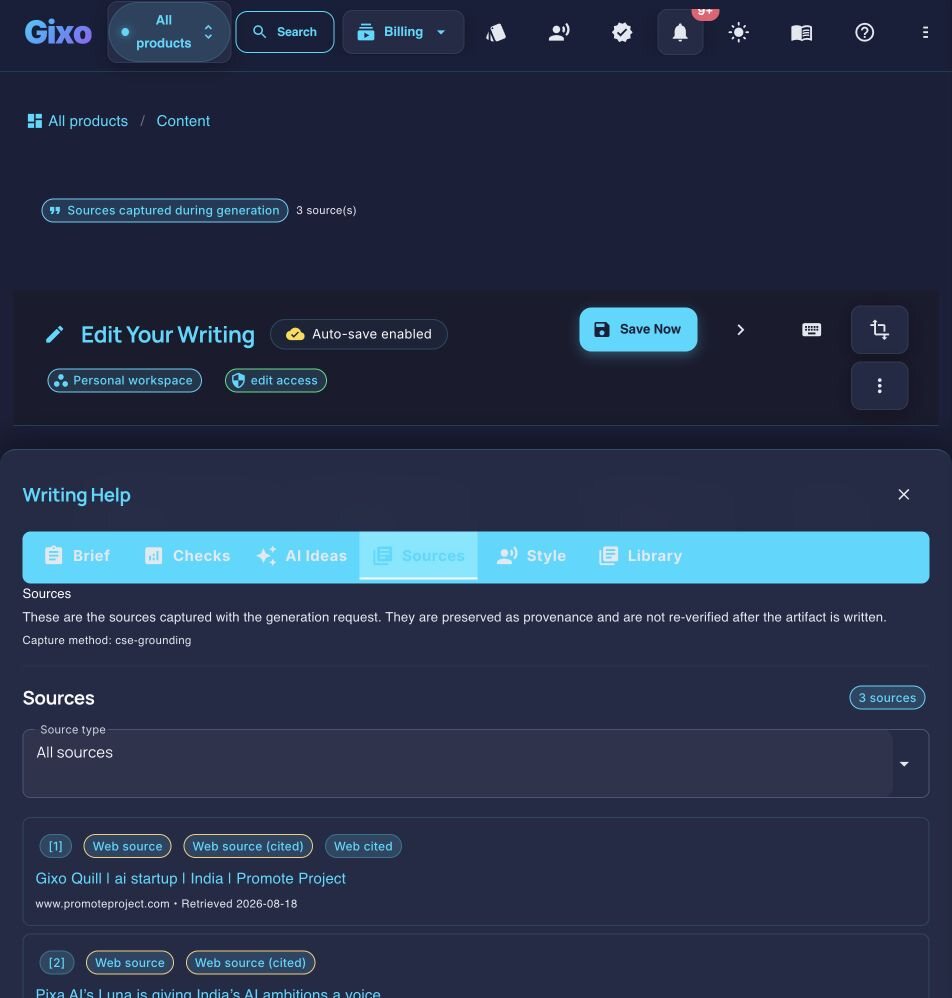
Inspect captured sources beside the working draft
Updated