
Gixo Prism · Visual guide
Mind Map
A mind map is a radial diagram with one topic at the centre and branches fanning outward into sub-topics. Its strength is speed: the structure imposes almost no constraints, so it is a fast way to get everything about a topic out of your head and grouped. Its weakness is the same thing — every idea gets exactly one parent, so genuine cross-connections between branches have nowhere to live.
Last reviewed: August 2026
A current Prism output
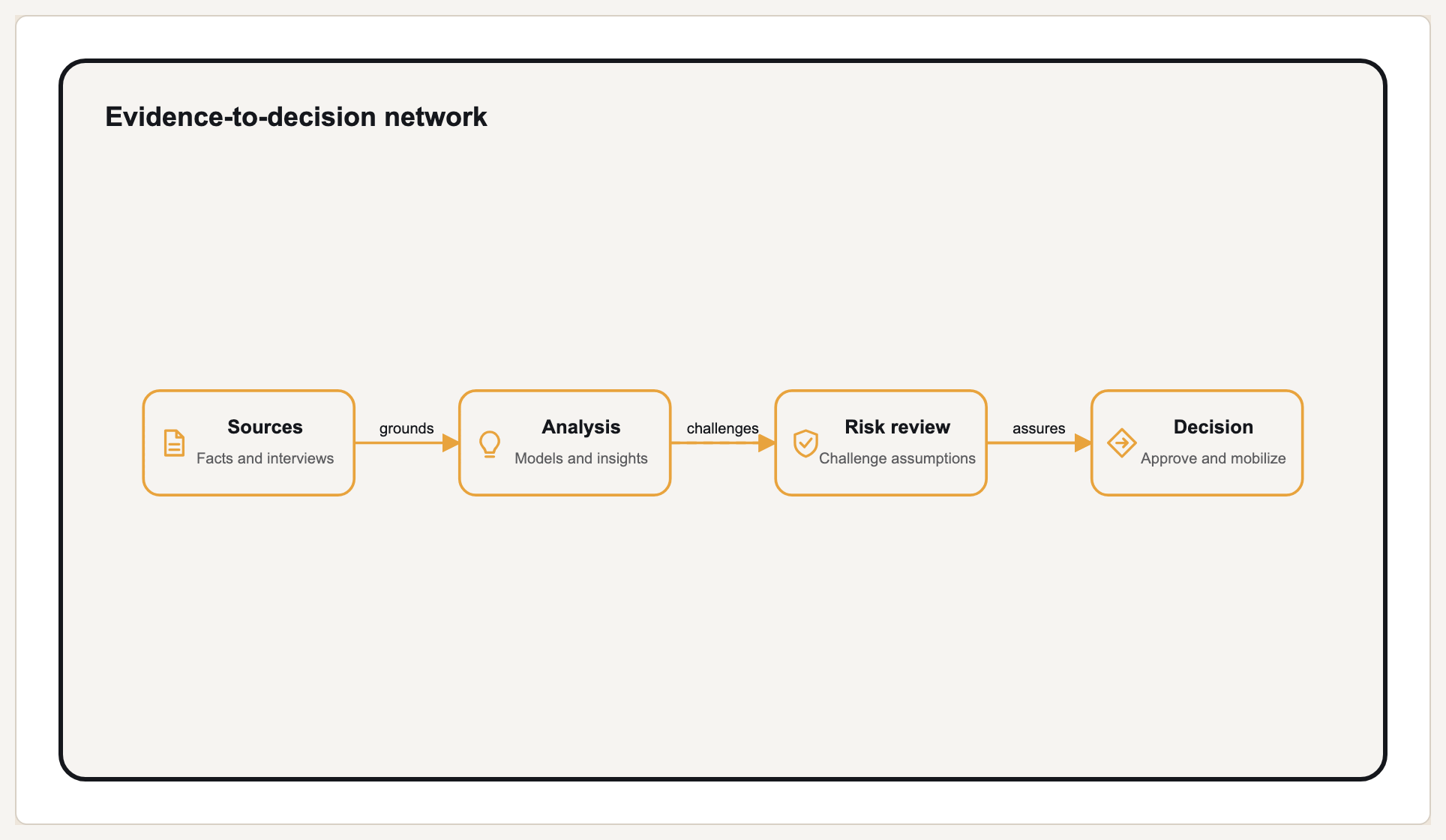
This current relationship diagram shows the kind of labelled structure Prism renders exactly from supplied nodes.
What the radial structure gives and costs
The value of a mind map is in the first ten minutes. Because branches require no justification, you can externalise a topic quickly and see grouping emerge. For planning a document, scoping a project or preparing a workshop, that speed is the point and the structure is good enough.
The cost appears when a mind map is used as a final artifact. A tree cannot express that a sub-topic on one branch drives a sub-topic on another, and in most real subjects those cross-links carry the insight. At that stage a concept map with labelled links, or a diagram chosen for the actual relationship, communicates more.
A second limit is comparison. Mind maps are poor at anything quantitative — branch length and position mean nothing, so a reader cannot infer importance from the shape. If relative size matters, the content wants a chart, not a map.
Mind map against the alternatives
| You want to | Use | Because |
|---|---|---|
| Get a topic out of your head fast | Mind map | No structural decisions to slow you down |
| Show how ideas relate | Concept map | Labelled links state the relationship |
| Show strict decomposition | Tree diagram | Parent-child with no implied brainstorming |
| Show sequence | Process or timeline | A radial layout has no natural order |
| Compare magnitudes | Chart | Mind map geometry encodes no quantity |
Building a useful mind map
One topic in the centre
Narrow enough to be answerable. 'Marketing' produces sprawl; 'Q4 launch messaging' produces a usable map.
Main branches before detail
Get five to seven first-level branches down before going deep on any one, or the map inherits the shape of whatever you thought of first.
Keep labels to a few words
Branch labels are handles, not sentences. If a branch needs a sentence it is probably a sub-topic.
Note cross-links in the margin
When two branches connect, write it down even though the format cannot draw it. Those notes are usually the argument of whatever you write next.
Convert when it stops helping
Once the structure is known, a tree, process or concept map communicates it to other people better than the mind map did.
What Gixo Prism does here
Prism renders tree and hierarchy geometries deterministically, which is the structure a mind map produces once it settles. Prism is not a brainstorming canvas — it is the step after, where a structure you have already arrived at becomes a clean, on-brand diagram for a document, deck or report.
Mind map: FAQ
What is a mind map?
A radial diagram with one topic at the centre and branches fanning out into sub-topics, used mainly to get ideas out quickly and group them.
What is the difference between a mind map and a concept map?
A mind map is a tree with one centre and unlabelled branches. A concept map is a network with labelled links naming each relationship.
When is a mind map the wrong tool?
When cross-connections between branches matter, when order matters, or when quantities matter. The radial structure encodes none of the three.
Does Gixo Prism make mind maps?
Prism renders tree and hierarchy geometries deterministically, which suits a settled structure. It is a rendering engine rather than a brainstorming canvas.
Turn a settled structure into a diagram
The free diagram maker renders tree, hierarchy and process geometries from structure you supply.