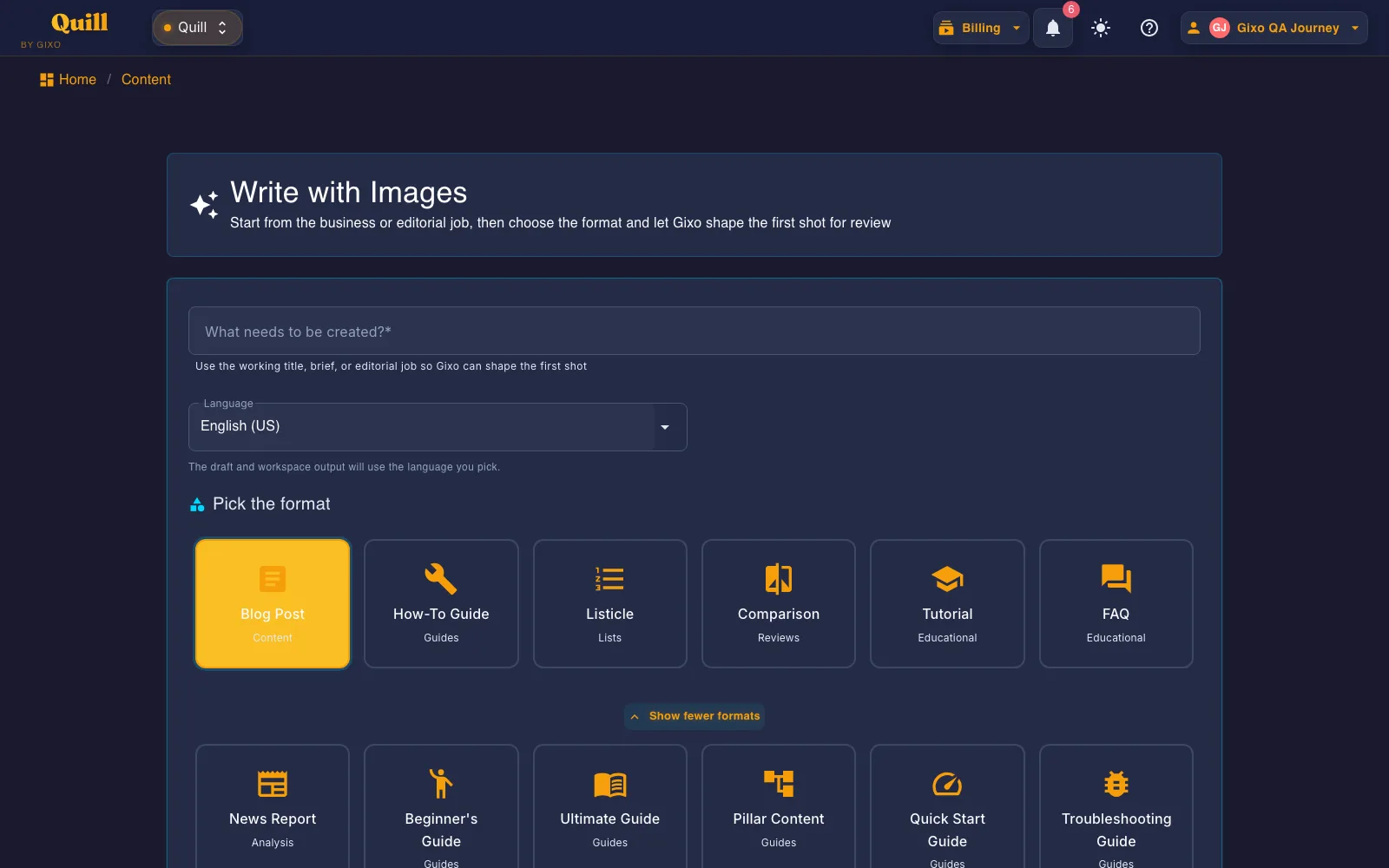
Create a useful listicle with explicit selection criteria, comparable entries, evidence, and a conclusion that helps readers act on the list. The active guide targets 2,500 words, asks the model for 17 structural elements and then checks the draft for them, keeps source review explicit, and keeps review before export.
~2500
Target word count
17
Required elements
4
Citation styles for source review
2
WordPress and Ghost sites
Details
Listicle format details
See the expected length, required sections, citation options, and publishing paths for this format.
Topic
Details
What to know
Target length
Approximately 2,500 words
Designed for the depth and reading experience expected from this format.
Required structure
17 required elements
Requested in the prompt, then reported as detected or missing on the workspace checklist.
Tone and voice
Engaging, scannable, and informative. Quality scales with list length.; Active voice
Keeps the writing style aligned with the selected format.
Shapes the draft for the people most likely to read and use it.
Source handling
Generation-time sources and citation review
Sources captured at generation are listed for review, with inline source links where the draft cites them.
Delivery
2 WordPress/Ghost site connections; PDF, DOCX, HTML, Markdown, TXT, and JSON
Export the finished content or publish it through a connected destination.
What should I provide to the AI Listicle Generator?
Provide the list topic, intended reader, inclusion and exclusion criteria, source material, ordering logic, and what readers should decide or do after reviewing the entries.
What structure does a Gixo Listicle follow?
The active guide targets approximately 2,500 words and injects 17 required structural elements using a engaging, scannable, and informative. quality scales with list length. tone for readers seeking curated information, scanners wanting quick insights, sharers looking for interesting content..
Can I review and publish the generated Listicle?
Yes. The Listicle opens in the Quill workspace for editing and team review. You can add sources for review, render APA, MLA, Chicago, or Harvard citations, export in PDF, DOCX, HTML, Markdown, TXT, and JSON, or publish to a supported CMS destination.
What is an AI Listicle Generator?
An AI listicle generator creates a list-based article whose entries follow a consistent selection and evaluation method. Each item should contribute evidence, context, or a distinct recommendation instead of padding an arbitrary number.
What to provide: Provide the list topic, intended reader, inclusion and exclusion criteria, source material, ordering logic, and what readers should decide or do after reviewing the entries.
Read a real Listicle from Quill
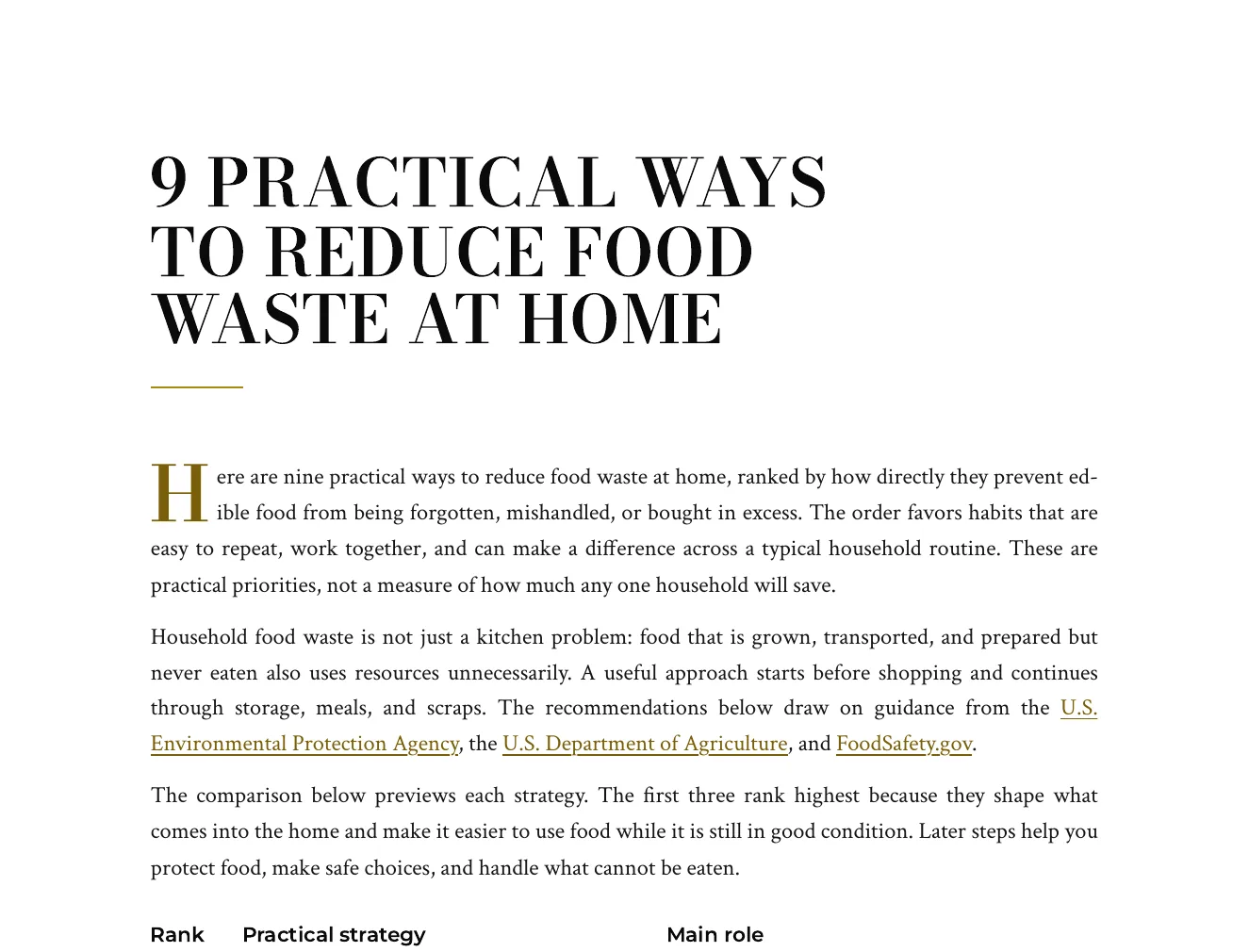
9 Practical Ways to Reduce Food Waste at Home. Nine numbered tips, each saying what to do, why it works and how to start, with a ranked summary table and EPA, USDA and FoodSafety.gov guidance linked in the text. Quill generated this on 3 October 2026. Compare its statements with the cited sources before reuse.
Open the PDFOpen the Word file
The brief it was written from: Write a numbered article of nine practical ways a household can reduce the food it throws away. Each item should say what to do, why it works and how to start. Include how to plan meals, store food, read date labels, use leftovers and handle scraps. Ground the advice in guidance published by the U.S. Environmental Protection Agency, the U.S. Department of Agriculture and FoodSafety.gov, and cite those agency pages. Cite no other organisation. Do not quote statistics, percentages or dollar amounts; give practical advice and attribute each piece of guidance to the agency page it comes from.
Listicle is one of the 49 direct-create formats generated from this same screen — a shared workspace, not a separate tool per format.
What is instructed, what is enforced, and what you check
The Listicle style guide below is read from the Gixo source at request time. Most of it is written
into the generation prompt to steer the draft. A smaller part is enforced by code after the model answers.
The editorial judgments stay with you — so they are listed separately rather than folded into one promise.
1 · Written into the prompt — steers the draft
These are instructions, not checks. They shape what the model is asked to produce; nothing afterwards
verifies that the tone landed or that the draft suits the audience. That is what step 3 is for.
Structure
Introduction & List Preview, Numbered Items (EXACT count from user request), Optional Honorable Mentions, Summary & Takeaways
Tone & voice
Engaging, scannable, and informative. Quality scales with list length. · Active voice
CRITICAL: Use exactly the item count the user requested. Put that number in the title and URL, optimize for featured snippets, use List schema.
Required structural elements
H1 title
CRITICAL: Generate EXACTLY the number of items requested by user
Numbered list items with word count scaled by list length:
• 1-5 items: 300 words each + 500 intro/outro = 1,000-2,000 words total
• 6-10 items: 250 words each + 500 intro/outro = 2,000-3,000 words total
• 11-20 items: 200 words each + 500 intro/outro = 2,700-4,500 words total
• 21-50 items: 150 words each + 500 intro/outro = 3,650-8,000 words total
• 50+ items: 100 words each + 500 intro/outro = varies
• Count left open by the user: 2,500 words (default ~10 items)
Why each made the list
Key highlights for each
Expert quotes (top items only)
Statistical backing (30%+ of items)
Mini case studies (top 3 items)
Surprise elements
Summary takeaway section
Call-to-action
Formatting preferences
Bold numbers
Subheadings for each item
Highlight boxes
Pull quotes
Progress indicators
2 · Enforced by code, after the draft comes back
Too short is regenerated. A draft under the floor for this format is sent back for another pass, not padded.
Too long is reported, not cut. For this format a structurally complete draft is allowed to ship above the target.
Brand compliance. The draft is passed through your brand rules and you get a report of what changed.
Structure sanitising. Malformed or unsafe markup is cleaned before the draft reaches the editor.
3 · Checked, then handed to you
The workspace runs a checklist over the finished draft and shows you the result. It reports; it does not
gate. Publishing remains your decision.
Required elements — each is marked detected or not detected in the headings and body text. This is a presence test on wording, not a judgment that the section is any good.
Word-count target — flagged for review outside roughly 1,625-4,375 words, rather than forced to a number.
Quality checklist — the items this format carries are always marked for manual review, because no machine check stands behind them.
How a Gixo Listicle is built
Every generation runs the first four stages automatically. Source review, citation rendering and publishing are steps you take in the Quill workspace.
The publishing pipeline
Plan — Token allocation, section count, structural completeness target. GenerationPlanner.cs
Review sources — Add your own sources and inspect the citations attached to the draft before export. EditableSourcesPanel.razor
Render — APA / MLA / Chicago / Harvard inline citations injected at export. CitationHtmlRenderer.cs
Publish — Send reviewed work to connected WordPress or Ghost sites, or to your own Webflow, Notion, HubSpot or Shopify connection. Destination actions differ: HubSpot receives a blog draft and Notion a page. Medium supports manual export or an available legacy-token draft handoff; inspect the receiving destination before publication. Export in PDF, DOCX, HTML, Markdown, TXT, and JSON.
Generate a Listicle now
Start in the real Quill writing workflow. No credit card required.
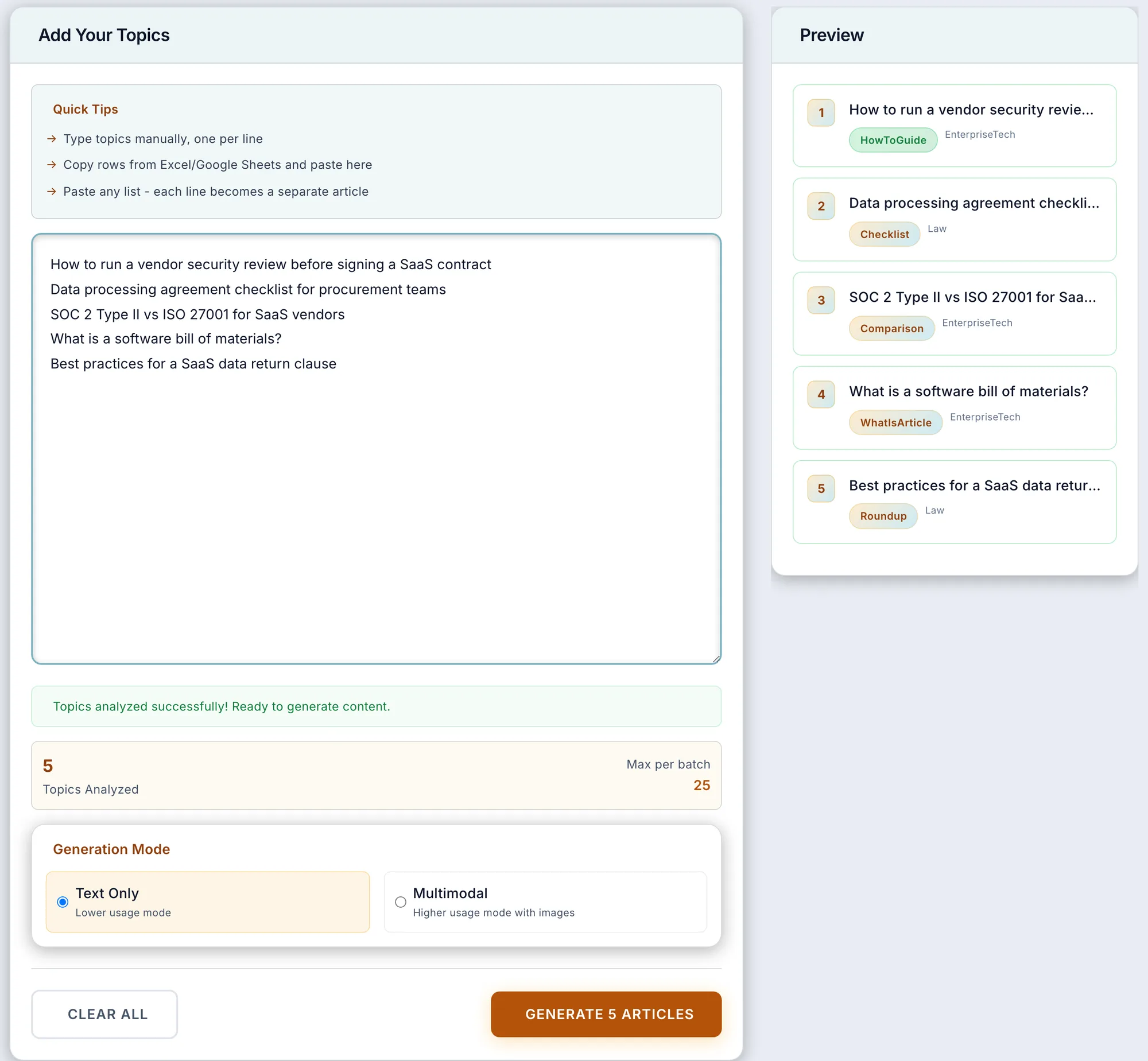
Current Quill bulk workflow at its preview step: five topics pasted in and analysed, each with the format and category Quill picked. Nothing has been generated yet; the next step generates these articles into the writing workflow.
Updated
Cookie
We value your privacy
We use cookies to improve the product, measure site usage, and keep settings in sync.
Choose which categories you want to allow.