
AI Executive Summary Generator: Format, Examples, and Template
Learn how to write an executive summary that leads with the decision, preserves material evidence and risk, and ends with a clear next step. Then use Gixo Business to turn your source material into a structured draft your team can review.
An AI executive summary generator turns a business topic and supporting material into a concise opening section that presents the purpose or decision, essential context, key evidence, recommendation, risks, and next action. Gixo Business creates that summary as part of a reviewable brief, runs it through a multi-stage pipeline that includes a word-count stage and, when the brief has sources, a number-check stage, adds [1], [2] citations when you upload files, and supports KPI and Checklist blocks. The AI prepares a structured draft; the accountable reviewer still decides what is material, validates the claims, and approves the recommendation.
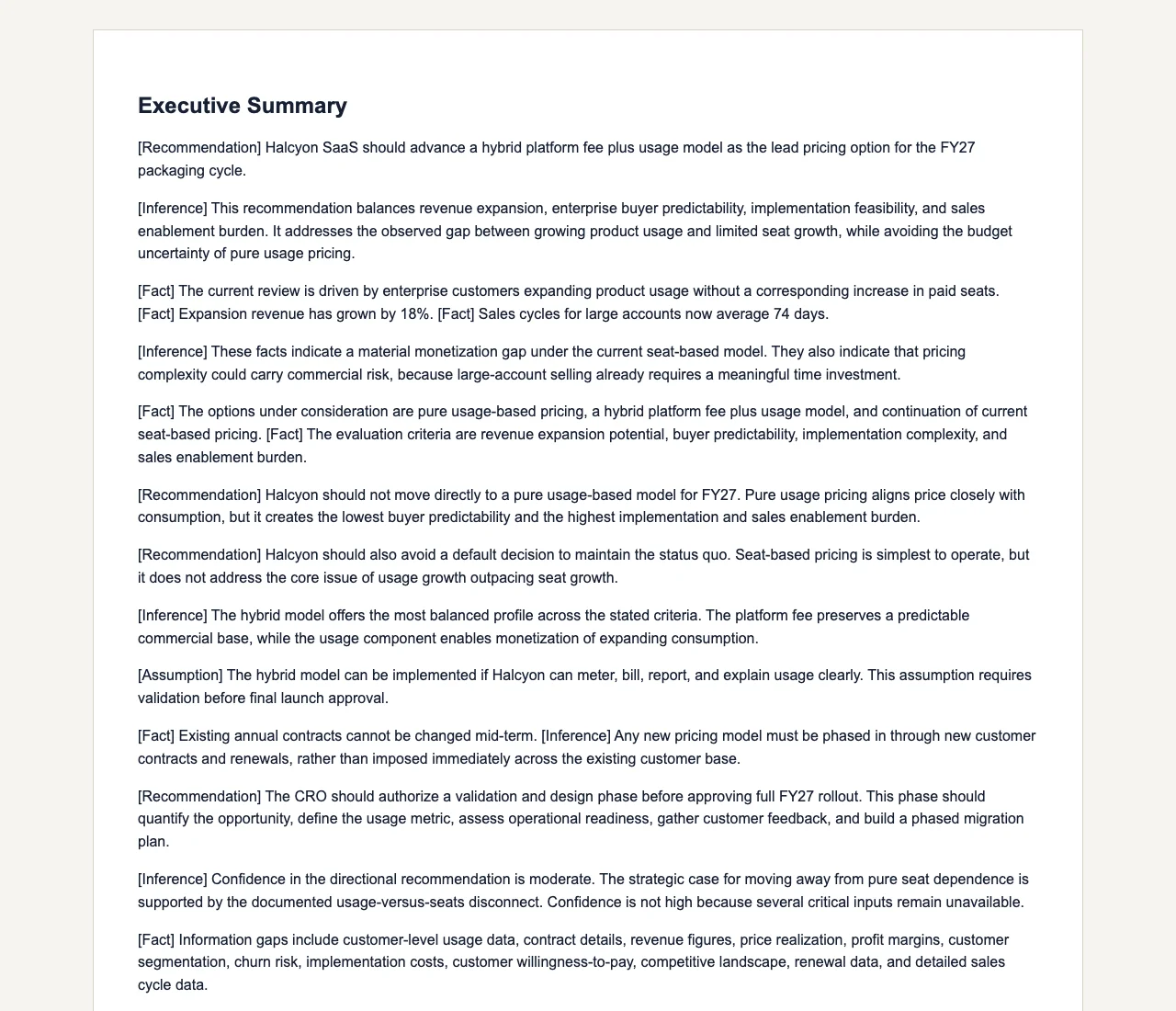
What Makes an Executive Summary Something Decision-Makers Actually Read?
The AI extracts what matters most and presents it in the format executives expect — concise, structured, and action-oriented.
The AI identifies and highlights the most critical findings from your business topic. Figures in paragraphs and lists are checked against the source documents you uploaded, so the metrics surfaced to leadership trace back to your sources; check any in tables yourself.
Every executive summary includes clear, prioritized action items using KPI and Checklist blocks. Decision-makers can immediately see what needs to happen and in what order, structured in the block-based editor with 20+ semantic block types.
The multi-stage pipeline includes a dedicated word count stage that calibrates each summary to the right length. Detailed enough to inform decisions, concise enough that busy executives will actually read them.
The AI writes in a professional, confident tone appropriate for C-suite and board-level audiences. Brand compliance applies your Brand Dictionary's preferred and banned terms to the output; it checks terminology, not your organization's voice or style guidelines, so review those yourself.
Executive summaries are built into the leadership recipes -- Executive Brief, Strategy Brief, Board Update, Business Case Summary, Proposal Summary and Market Deep Dive -- and the other recipes open with their own summary section. Choose from 59 curated recipes across strategy, market analysis, financial review, and more -- each with its own section structure and, when you upload sources, your figures checked against the source documents you uploaded.
Export as PDF or share through saved workspaces with real-time collaboration. Use Quick AI for last-minute rewrites or Power Edit for deeper AI-assisted revisions before distributing to your leadership team.
How to Generate an Executive Summary
Describe the project, initiative, market, or business question. The AI will analyze the topic and extract the most important points for leadership.
Select from market analysis, strategy, competitive intelligence, or any other domain. Choose a leadership recipe such as Executive Brief, Strategy Brief or Board Update and the executive summary is generated as the opening section.
Get a concise executive summary with figures checked against your sources, automatic [1], [2] citations, and KPI blocks for key metrics -- all produced by the multi-stage pipeline that includes number checks when you upload sources and Brand Dictionary term checks.
Refine with Quick AI for instant rewrites or Power Edit for full AI dialog. Use 20+ semantic blocks to restructure sections, then export to PDF for your next leadership meeting or board review.
What does Gixo's AI executive summary generator include?
Compare AI-generated executive summaries with traditional approaches.
| Feature | Gixo AI | Manual Writing | Generic AI Chat |
|---|---|---|---|
| Time to produce | Seconds | 1-2 hours | 5-10 min |
| Business structure | Built-in | Varies | No |
| Action items included | Always | Sometimes | No |
| Executive tone | Calibrated | Varies | Inconsistent |
| Part of full brief | Yes | Manual | No |
| PDF export | Yes | Manual | No |
| Auto [1],[2] citations | Multi-stage pipeline | Manual | No |
| Number checks | Yes | Manual | No |
| Brand compliance | Brand Dictionary terms | Varies | No |
| Quick AI + Power Edit | Built-in | N/A | N/A |
What is an executive summary, and what does one look like?
What is an executive summary? It is a short, self-contained decision document at the front of a longer business plan, proposal, report, or project update. It should let a busy reader understand the issue, the evidence, the recommendation, the material risk, and the action required before reading the supporting detail. A good executive summary is not a shortened table of contents or an introduction that merely previews what follows.
What should an executive summary include?
- The purpose or decision: what the reader must understand, approve, choose, or do.
- Essential context: the business problem, opportunity, scope, and why it matters now.
- The central finding or solution: the answer in plain language, stated before supporting detail.
- Decision-relevant evidence: the few facts, metrics, or observations that materially support the conclusion.
- Impact and requirements: expected value, cost, resources, timing, and important dependencies.
- Risks and uncertainty: material trade-offs, limitations, assumptions, and practical mitigation.
- The recommendation and next step: the requested action, accountable owner, and decision date where known.
Choose the executive summary format by document type
The core decision path stays consistent, but the emphasis changes with the source document. Use the format that answers the reader's actual question rather than forcing every summary into the same generic outline.
What is an executive summary in a business plan? It is the investment case in miniature: customer problem, solution, market, business model, traction, team, financial direction, funding need, and use of funds. A business plan executive summary example should connect those facts into one credible reason to keep reading.
Lead with the client's desired outcome, your understanding of the problem, the proposed approach, expected value, delivery confidence, and immediate next step. A proposal executive summary example should be client-centered rather than a company biography; for a software proposal, include implementation scope, adoption, security, and measurable success criteria when relevant.
A report executive summary usually covers purpose, scope or method, principal findings, implications, limitations, and recommendations. When learning how to write an executive summary for a report, preserve the confidence level behind the findings instead of presenting every observation as settled fact.
Show current status against the approved baseline, delivered milestones, budget or schedule variance, dependencies, material risks, recovery actions, and the next decision. The reader should see what changed and where intervention is required without reconstructing the project history.
State the resolution or decision requested first, followed by strategic and financial implications, alternatives considered, major risks, management's recommendation, and the precise approval needed. Separate facts from forecasts and assumptions so directors can challenge the right inputs.
Describe the question, method, most decision-relevant findings, strength of evidence, limitations, and implications. If the evidence supports several interpretations, say so and identify what additional information would materially change the recommendation.
How to write an executive summary step by step
Write the final summary after the underlying analysis is stable. That order makes it easier to compress the actual argument instead of predicting conclusions before the evidence has been reviewed.
Write down who will read the summary, what they already know, and the decision or action the document must support. A divided audience may need a shared recommendation with separate implications for finance, operations, and risk.
Read the full source and identify the problem, answer, strongest evidence, material caveat, recommendation, and next step. If the source does not support a clear recommendation, describe the unresolved choice and the evidence needed to resolve it.
Arrange the extracted points in the reader's decision order: answer, context, evidence, implications, risk, and action. Do not mirror the source document section by section unless that order also serves the decision.
How to start an executive summary: state the recommendation, central finding, or decision required in the first paragraph. Avoid openings such as “This report discusses,” which delay the information the reader needs most.
Include only evidence that changes the conclusion or the reader's confidence in it. Give numbers a baseline, direction, magnitude, and timeframe where available, and preserve source references for verification.
Distinguish fact, inference, assumption, forecast, and recommendation. Name material downside, implementation constraints, and mitigation; omitting credible risk makes a summary less useful, not more persuasive.
Specify what should happen, who owns it, what approval or resource is required, and when the decision is needed. A reader should not have to infer the ask from the final paragraph.
Executive summary outline
Fill in the free executive summary template, or use this outline to draft from your own evidence.
Copy this decision-first executive summary outline
- Decision or purpose: We recommend [action], or this document asks [reader] to decide [choice].
- Context: [Situation or opportunity] matters now because [business consequence or deadline].
- Finding or solution: The analysis indicates [central answer], subject to [important limitation].
- Evidence and value: The conclusion is supported by [two or three material facts], with an expected impact of [measured outcome and timeframe].
- Requirements: Delivery requires [budget, people, systems, dependencies, and schedule].
- Risks and mitigation: The main risk is [risk]; reduce or monitor it through [control, owner, or trigger].
- Recommendation and next action: Approve [specific action] by [date], owned by [role], with [review point or success measure].
A one page executive summary template is useful for routine or well-bounded decisions, but “one page” is a constraint, not the objective. Remove repetition before removing material risk, evidence, or the decision ask. Use short paragraphs, descriptive headings, and selective bullets or a small table when those devices make comparison faster.
Executive summary examples for common business documents
These short examples are illustrative structures, not claims or finished advice. Replace every bracketed detail and sample fact with validated information from your own source document.
“[Company] addresses [customer problem] for [target segment] through [solution]. Evidence from [validated source] shows [traction or demand signal]. We seek [funding or approval] to achieve [milestone] by [date]; the main assumption is [assumption], which we will test through [measure].”
“[Client] needs to improve [outcome] while protecting [constraint]. We propose [approach] delivered over [timeframe], with success measured by [metric]. The main delivery risk is [risk]; our mitigation is [control]. Approval of [scope or next step] allows work to begin by [date].”
“This review examined [scope] using [method]. It found [principal finding], supported by [key evidence], although [limitation] reduces confidence in [specific conclusion]. We recommend [action] and a follow-up review after [measure or timeframe].”
“[Project] is [status] against the approved [schedule or budget] baseline. [Milestone] is complete, while [variance] is driven by [cause]. Management recommends [recovery action]; the sponsor must decide [specific issue] by [date] to protect [outcome].”
“Decision: approve a limited [pilot]. Evidence: [validated finding] is strongest in [segment], while [constraint] remains material. Recommendation: run a time-boxed pilot owned by [role], monitor [success and stop measures], and review the result before broader rollout.”
“Current evidence does not distinguish reliably between [option A] and [option B]. The decision should be deferred until [missing evidence] is available, unless [time or risk constraint] requires an interim choice. In that case, use [reversible step] with [review trigger].”
How long should an executive summary be?
There is no universal page count. A routine, bounded decision may fit in less than a page or a one page executive summary. A complex, high-stakes proposal, board paper, or report may require two to four pages to explain the evidence, financial implications, alternatives, and material risk responsibly. The often-quoted five-to-ten-percent rule can be a useful warning sign, but audience and decision complexity matter more than a fixed ratio.
Use the decision test, not just the page count
A summary is long enough when the intended reader can identify the decision, understand why it matters, see the evidence and uncertainty behind the recommendation, and act without searching the full document for a missing caveat. It is too long when background, repeated findings, or methodological detail compete with those essentials.
Executive summary writing best practices
What makes a good executive summary is disciplined selection, not simply shorter prose. Apply these checks before the document reaches a decision-maker.
Draft after the body, analysis, and recommendation are stable. Revisit it whenever a late finding changes the decision, risk, cost, or expected outcome.
Use a decision-first structure: answer, necessary context, evidence, implications, risk, and action. Do not make the reader wait through a chronological narrative.
Ask whether each fact would change the decision, confidence, timing, resources, or risk response. Move useful but non-material detail to the supporting document.
Do not present forecasts as facts or assumptions as evidence. Qualify uncertainty and avoid unsupported terms such as “guaranteed,” “unprecedented,” or “risk-free.”
Name the material risk, likelihood or trigger where known, business consequence, mitigation, and owner. Negative findings should be clear rather than softened beyond recognition.
Check every number, quotation, source, and recommendation against the full document. AI can accelerate extraction and drafting; accountable humans still determine materiality and approve the final position.
What does the Evidence tab check after a brief is generated?
For a brief written from sources you upload, the Evidence tab under Checks in the brief editor lists up to five sentences whose wording or figures it could not match to those sources, for you to check. It matches wording and exact figures, not meaning: a faithful paraphrase, or $8.1M where the source says 8,100,000, can fail to match while being true, so an unmatched sentence is a place to look, not an error, and a matched one is not confirmed either, because this is a comparison with your own sources, not a fact-check. It reads only part of a long source (24 passages of up to 1,600 characters), cannot see web research, so for a brief with web research turned on the list is advisory, and it checks the draft as generated, not your later edits.
Executive summary format and AI generator FAQs
Updated